What Was Behind Marco Rubio’s Visit to Hungary’s Viktor Orbán?
European skepticism of the US as a “leader of the free world” continues to increase, especially as Trump ramps up his flirtations with autocrats in the background.
|
Listen To This Story
 |
It is not hard to see why many Europeans are still trying to decide what to make of US attitudes to the rest of the world. Secretary of State Marco Rubio’s presentation to the Munich Security Conference last week was considerably more sensitive than the speech JD Vance delivered a year ago, saying, “There is a new sheriff in town.”
But once European analysts had a chance to deconstruct what Rubio actually said, the message looked very much the same: The US is no longer interested in any commitment to being “Leader of the Free World.”
A number of non-MAGA Americans, including California Gov. Gavin Newsom (D), did their best to calm the nerves of America’s former European allies, but it was all too clear that the real power in Washington, at least for the moment, is still Donald Trump and his obedient allies in the administration.
In the background, Trump is ramping up his flirtations with Russia. While Putin may be friendly with Trump, Russia is no friend of the United States. As far as any nation not led by an autocrat counting on the US these days, that train has pretty much already left the station.
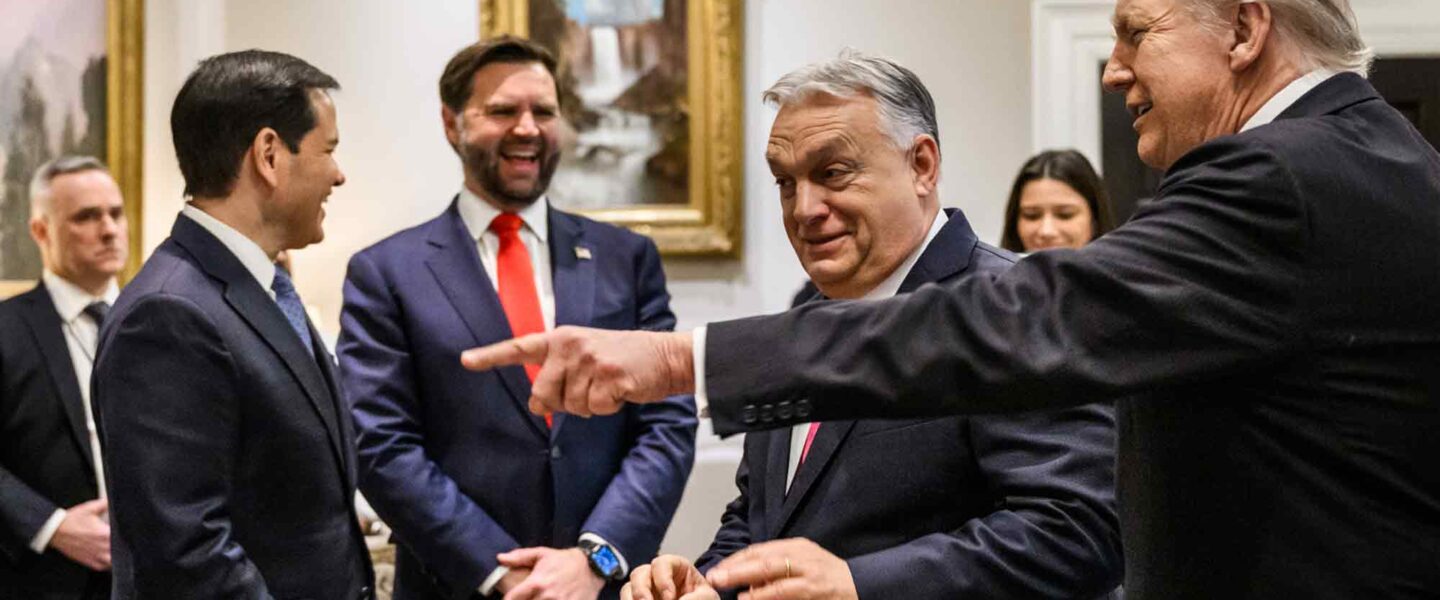
European skepticism was nevertheless further increased when Rubio made a special effort to reassure Hungary’s embattled prime minister, Viktor Orbán, that Trump is still behind him with the current White House’s full support.
Orbán’s openness to Russian President Vladimir Putin, despite Putin’s continued bombardment of Ukraine, has made him unpopular, both at home and with fellow Europeans.
In Hungary’s upcoming parliamentary elections, Orbán, who lags behind in pre-election polls, will almost certainly try to rig the outcome. He may also hope that Putin can save him from electoral defeat. Trump is not likely to make much difference unless it involves handing Orbán a bundle of cash similar to the $20 billion lifeline that he used to shore up Argentina’s embattled president, Javier Milei.
The real question is why Rubio and Trump are so anxious to save Orbán’s already tainted political future.
If most Americans aren’t asking themselves that question quite yet, Western Europeans certainly are. The answer may be that Trump himself is beginning to feel threatened. His poll numbers are, like Orbán’s, rather deeply underwater and, unless he can successfully sabotage the upcoming midterm elections, he looks very likely to spend the last two years of his administration as a lame duck.
In showing support for Orbán, a darling of today’s far-right MAGA Republicans, Trump may be making a final effort to rally conservative solidarity throughout the world, to shore up his own prospects at home.
If that makes Trump sound delusional, he’s in good company: The pattern is common to many of the narcissistic authoritarians that Ruth Ben-Ghiat describes in her book Strongmen: From Mussolini to the Present.
The narcissist, Ben-Ghiat maintains, begins life afraid of the world around him and consequently learns to act as a bully. When the bullying succeeds, the bully gains confidence and pushes the strategy further. The more he succeeds in intimidating those around him, the more isolated he becomes from reality. His decisions become increasingly erratic, and before long, he becomes dangerous to himself and to the people around him.
In functional democracies led by a parliament, the narcissistic bully can simply be voted out of office and ushered into early retirement. In more authoritarian countries, revolution or assassination may be the only alternatives. That was the case with Mussolini, Hitler, and more recently, the Congo’s Mobutu Sese Seko, Iraq’s Saddam Hussein, and Libya’s Moammar Gadhafi. The US, with its four-year appointments and complex impeachment procedures, falls somewhere between the two.
Unfortunately, violently deposing a narcissistic tyrant who has remained in power for an extended period of time may lead to considerable collateral damage.
The more troubling cases occur when a country finds itself halfway between democracy and authoritarianism. Orbán is not quite a full dictator yet, but he has taken steps to convert Hungary from a parliamentary democracy to a semi-totalitarian state. He has suppressed the press, tampered with elections, and done his best to suppress dissenting opinions.
Especially disheartening for a nation that fought a desperate, if losing, attempt to throw off the yoke of Russia in 1956.
After perestroika — the failed attempt to reform and modernize the Soviet communist state — Putin finally dropped the Communist label and focused instead on Russia’s expansionist ambitions. To just about everyone’s surprise, the Ukrainians have proven extraordinarily resilient in resisting Putin’s efforts to restore what he sees as the lost glory of the former Soviet empire.
Any pretense at Russian communism is long gone, but Putin is nevertheless doing his best to reconstruct the former Eastern Bloc that once existed behind the Iron Curtain. The new Russian empire that Putin is trying to put together is based on money and oligarchy. No longer paying even lip service to communist ideology, it tends to be right-wing and semi-fascist. That’s whom Orbán is flirting with. And Rubio and Trump are playing a similar game.
It’s clear that the Russians feel the US under Trump is more susceptible to joining forces with the Kremlin than it has been at any time since World War II.
The latest bait being dangled by the Russians is that if Trump can only swing Washington towards aligning itself with the Kremlin, and of course drop its economic sanctions against Russian trade, then as much as $14 trillion in business deals could be waiting. How could a band of former real-estate promoters like Trump and his side-kick, real-estate magnate Steve Witkoff, resist an offer like that?
Of course, none of it makes any sense. Russia’s whole GDP is only $2.5 trillion. What Putin is really talking about is getting America to invest in Russia. He’s offering US companies a chance to join his own oligarchs in pillaging what is left of Russia’s natural resources and its people.
Putin may not expect American companies to go for the proposal. But there’s always a chance that Trump will be attracted by yet another chance to make a financial killing.
Before the 2016 election, the Kremlin looked at Trump as just another useful idiot. As a former KGB officer, Putin is well aware that useful idiots often make the best assets. He may hope that Trump is just desperate enough to take the bait, and Marco Rubio’s Munich Security Conference speech did nothing to deflate such hopes.