Citizenship in the Dark Republic of Trump
Watch or do? The choice is ours.
|
Listen To This Story
 |
On a Saturday morning six weeks ago I awakened to the news that Donald Trump’s America had launched a war with Iran. In the 42 days that followed, I have arisen in darkness every morning at six and immersed myself in an effort to discern what changed over the previous 24 hours in Donald Trump’s “little excursion” into Iran.
Each day I produced a report that distilled what I learned and shared it. It has been a grind. But it has also been rewarding in its own severe way, because hard looking has a moral value. It strips away illusion. It forces clarity. It teaches the difference between spectacle and consequence, between noise and signal, between what merely startles and what actually matters.
Today I slept late, all the way to 7:45. I awakened to bright Southern California sunlight streaming into the bedroom, and it was one of those Saturdays when time itself seems to loosen its grip. I awoke without feeling the pressure to understand and define the moment in a pressure-packed 90 minutes of research and writing.
Instead there was a feeling that life is not yet defeated; that history, however ugly, has not quite closed its fist; that one may still pause and think before plunging back into the machinery of crisis.
So before returning to the daily work of scanning the battlefield, I have chosen to stop, reflect, and ask a larger question: Where are we, really, as a nation? What does this moment mean? And what is the right attitude to take toward it?
What Keeps a Republic?
Despair is tempting. Cynicism is fashionable. Gallows humor has its place; God knows it has its place. But none of those can sustain a republic. They may get you through an evening. They do not tell you how to live. They do not tell you what citizenship requires when the country begins to feel estranged from its own ideals.
Last night Bruce Springsteen — blue America’s actual if unofficial poet laureate — issued a call to action that, for me, landed with quiet force. He asked his audience to choose “hope over fear, democracy over authoritarianism, the rule of law over lawlessness, ethics over unrivaled corruption, resistance over complacency, truth over lies, unity over division, and peace over war.”
That is not merely a slogan. It is not therapeutic uplift. It is a civic challenge. It asks something of us. The question is: what?
I find myself turning to two old texts that have mattered to me across the long and varied decades of my adult life: William Faulkner’s Nobel acceptance speech and Theodore Roosevelt’s “Citizenship in a Republic.” Not because I want to wrap the present in borrowed grandeur, but because both men, in different ways, were grappling with the same essential problem: What remains of human dignity, and of civic duty, when the surrounding world is convulsed by fear, vanity, violence, and decay?
Faulkner began with what he called the “old verities of love and honor and pity and pride and compassion and sacrifice.” Those words matter because they sound almost unfashionable now. They sound antique, even embarrassing, in an age trained to reduce everything to appetite, branding, transaction, and pose.
But Faulkner understood that once a people loses contact with those verities, everything that follows becomes thin and false. Public life becomes a theater of “glands” rather than “heart.” We get lust instead of love, victory without hope, defeat in which nobody loses anything of value, grief that leaves no scars because it touches nothing universal.
And then comes the passage that has stayed with me for years. Faulkner warns that, until man relearns those things, he will write of what he sees “as though he stood among and watched the end of man.”
Then comes the refusal: “I decline to accept the end of man.”
He mocks the merely biological consolation that man will endure because there will always be “his puny inexhaustible voice, still talking.” No, he says — not that. Humanity will not merely endure. It will prevail, because humanity “has a soul, a spirit capable of compassion and sacrifice and endurance.”
That, to me, is not just literature. It is citizenship.
The Great Temptation to Watch
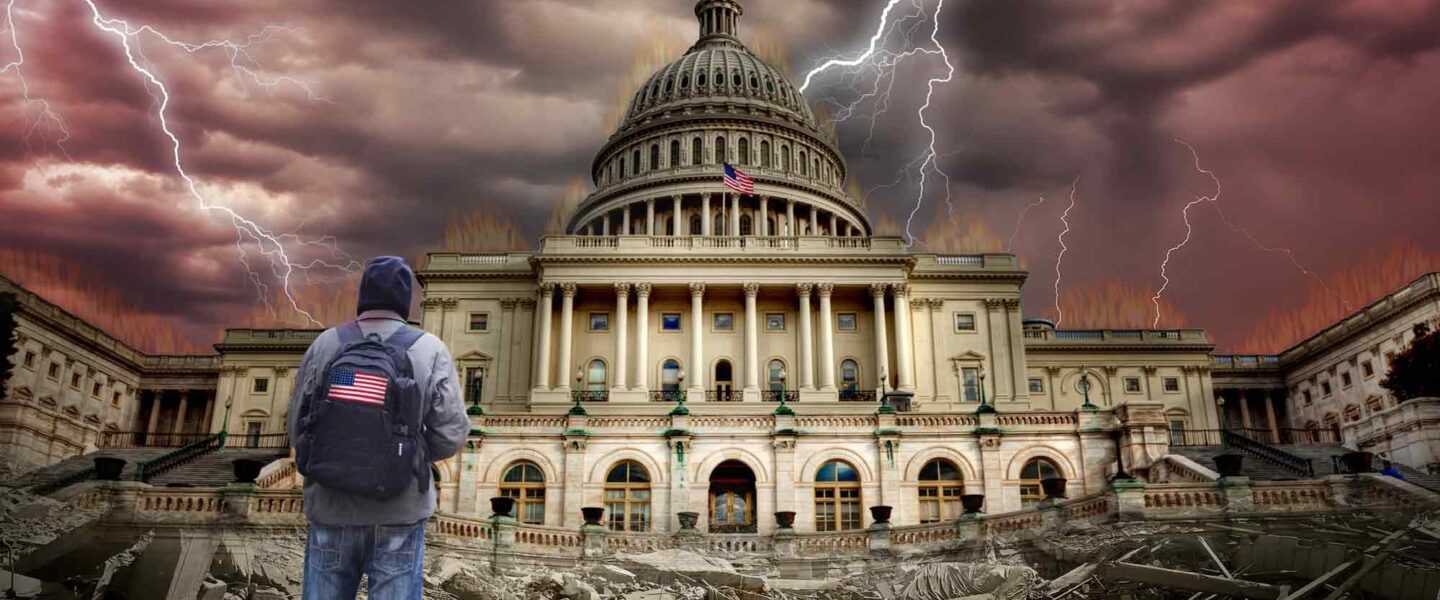
Because what is the great temptation of this moment if not precisely to stand among and watch the end of America? To narrate it cleverly. To become connoisseurs of decline. To perfect the tone of exhausted knowingness. To say, with a bitter little shrug, that the rot is too deep, the contagion too widespread, the metastasis too far advanced, and that all one can do now is watch, document, sneer, or withdraw.
The question is not whether the evidence is bleak. The evidence is bleak. The question is whether we will define ourselves by the bleakness.
I understand that temptation. I feel it myself. There are days when the country seems less like a republic in crisis than like a stage-four malignancy: a spreading sickness of cruelty, lawlessness, spectacle, corruption, and civic cowardice.
There are days when America looks less like a troubled democracy than like a bleeding carcass being fed on by grifters, zealots, cowards, and strongmen. No honest person should minimize the severity of the disease.
But even here, Faulkner offers something better than optimism. He offers defiance rooted in moral anthropology.
The question is not whether the evidence is bleak. The evidence is bleak. The question is whether we will define ourselves by the bleakness. Whether we will surrender the “love and honor and pity and pride and compassion and sacrifice” that alone make self-government worth preserving.
Whether we will give up on the soul of the country before the body is dead.
‘The Man Who Does Nothing’
That leads me to the other classic speech that has played in my head one way or another since I first discovered it at age eighteen. We remember Roosevelt’s “man in the arena” passage, and rightly so, but we often forget the larger title of the speech: “Citizenship in a Republic.” That matters, because Roosevelt was not giving us a poster for locker rooms. He was describing the obligations of democratic life.
Yes, the great line is there: “the man who is actually in the arena, whose face is marred by dust and sweat and blood; who strives valiantly; who errs, who comes short again and again.”
But what follows is just as important. “The man who does nothing,” Roosevelt says, “cuts the same sordid figure in the pages of history, whether he be a cynic, or fop, or voluptuary.” There is little use, he says, for the being whose “tepid soul” knows nothing of “great and generous emotion,” of “high pride, the stern belief, the lofty enthusiasm.”
That lands hard on me now, because it speaks directly to the role I have tried, however imperfectly, to play, and to the ask I want to make of this community.
A republic cannot be defended by tepid souls. It cannot be preserved by people who have refined themselves into fastidious uselessness. It requires people willing to get dusty. To get tired. To be wrong and try again. To bear the brunt of the day.
Citizenship is not spectatorship. It is not merely having opinions. It is not treating politics as a running commentary track over national collapse. It is not the sterile superiority of the critic who points out how the strong man stumbles, nor the chilly cleverness of the cynic who has made a little home inside contempt.
A republic cannot be defended by tepid souls. It cannot be preserved by people who have refined themselves into fastidious uselessness. It requires people willing to get dusty. To get tired. To be wrong and try again. To bear the brunt of the day.
In the Arena
In our time, an arena has been created where citizens can acquire a megaphone through hard work and passion. We are in that arena now — writers, readers, commenters, all of us.
Civic duty is not always glorious. Sometimes it is merely staying awake. Paying attention. Reading carefully. Refusing to normalize the grotesque. Writing when it would be easier not to write. Speaking when silence would be more comfortable. Organizing, voting, donating, marching, persuading, risking friendships, risking reputation, risking the embarrassment of caring too much. Keeping the puny inexhaustible voice going even when it seems absurdly unequal to the scale of the thing.
All of that is citizenship in a republic, and all of that matters.
So when Springsteen asks us to choose hope over fear and democracy over authoritarianism, I do not hear a request for uplift or mood management. I hear a demand that we decide what kind of citizens we are going to be.
Are we going to stand among and watch the end of man — the end of America, the end of civic seriousness, the end of moral proportion — and narrate it with superior detachment? Or are we going to insist that the country still possesses some immune system, some capacity for moral resistance, some soul “capable of compassion and sacrifice and endurance”?
Some will say it’s naive, but I choose the latter.
Not because I am blind. Not because I think this will be easy. Not because I believe history guarantees a happy ending. That ship may well have sailed.
I choose hope because the alternative is to choose surrender in advance and that is unworthy of us. Cynicism, however intelligent it may feel, is finally just another form of passivity, of abdication of responsibility.
I choose it because the “man who does nothing” does indeed cut a sordid figure, and I do not want that figure to be me, or this community, or the better part of America.
I want to believe this nightmare version of the country will not stand. That it is not a permanent mutation. That maturity and responsibility can make a comeback. That the fever can break, the cancer can be treated, the republic can recover some measure of its balance and honor. That is, in the end, a choice — not a naïve choice, but a disciplined one.
And if citizenship asks anything of us now, it is this: reject the tepid soul. Stay in the arena. Hold fast to the old verities. Refuse to stand among and watch the end of man. Keep faith with the possibility that this country can still prevail, not merely because it will continue to exist, but because enough of its people still have a spirit capable of compassion and sacrifice and endurance.
That is the choice I make this morning in the sunlight.
And I am asking you to make it with me.
As a service to our readers, we curate exceptional stories through partnerships with outside writers and thinkers. Michael D. Sellers is a former CIA officer currently working as a criminal defense and civil rights investigator. This column has been adapted with the author’s permission from his substack Deeper Look with Michael Sellers.