It Doesn’t Make Sense to Bomb Iran
If Trump can find an off-ramp to the tensions, it would sidestep another bloody disaster in a region that has known all too many of them.
|
Listen To This Story
 |
A number of Middle East experts have cautioned President Donald Trump that a new wave of bombing against Iran could trigger a conflagration that envelops the entire region.
Despite his TACO nickname (Trump Always Chickens Out), Trump’s dominant characteristic so far has been a readiness to trust his own instincts rather than rely on the experts whom he dismisses as the “Deep State” or, in simpler words, the Washington establishment. This time around, Trump might do well to listen to the experts.
Republican administrations in general have long felt impatience at what they saw as an overly cautious approach by the US State Department and America’s professional intelligence agencies. The GOP’s temptation is to shoot first and clean up the mess later. That might have worked in the “gunboat diplomacy” era of the late 1800s. In today’s world, considerably more is at stake.
A not too distant example is the case of President George W. Bush’s efforts to topple Iraq’s Saddam Hussein.
Using the US’s overwhelming military superiority to defeat a weakened Iraqi regime was not difficult. But the administration’s key strategists, Defense Secretary Donald Rumsfeld and Vice President Dick Cheney, chose to put a stop to State Department efforts to draft a plan for what was likely to happen once Saddam’s regime had disappeared.
Bush’s “Operation Iraqi Freedom” invasion triggered a war that lasted nearly eight years from 2003 to 2011, and cost the lives of more than 4,400 US servicemen and wounded another 32,000. The actual fighting cost somewhere between $700 billion and $800 billion. Helping American veterans recover from the war added another $2 trillion to the US budgetary costs.
A Full House, or a Bluff?
The justification for going to war was a series of highly suspect reports that Saddam might be developing a weapon of mass destruction. The reports turned out to be false. It also seemed likely that members of Bush’s administration had intentionally manufactured erroneous information in order to justify launching the war.
The situation in Iran appears more serious. There is no question that Iran has made progress towards producing a nuclear weapon. What is less clear is why, or what it would do with a bomb if it had one.
Both India and Pakistan developed functional nuclear weapons and then promptly forgot about them. For these long-time adversaries, simply possessing such a weapon seemed to be enough of a deterrent.
At a World Economic Forum meeting in Davos, Switzerland, a few years after the 9/11 attacks, former President Bill Clinton acknowledged that the roots of the problem with Iran could be traced back to the 1953 coup, which overthrew Mohammed Mossaddegh, the democratically elected prime minister, and restored the Shah, the most powerful figure in the country. The coup was instigated by British intelligence, but it was the CIA that actually carried it out. Mossaddegh’s crime had been to nationalize the Anglo-Persian oil fields, and the coup was ostensibly to keep the Soviet Union from gaining control.
What no one had counted on was that, over the years, the Shah would increasingly turn out to be a monarchical monster who imprisoned and tortured huge numbers of his own people. The victims included a large number of protesting students, who often turned out to be children of some of the country’s elite families. That was unfortunate in itself, Clinton suggested, but what, he asked, did anyone think that Iran was really going to do with a nuclear weapon? The Iranians had to know that as soon as they did anything, they would be obliterated in a retaliatory blazing inferno. The odds were that the Iranians were bluffing.
It is much more likely that the Iranians really want the bomb as a bargaining chip and a deterrent against future attack rather than as an offensive weapon. Then again, Iranians are risk takers.
Saddam had also engaged in a bluff when he tried to make the world think that he had a weapon of mass destruction. His real goal, in retrospect, was to intimidate his neighbors and to make himself appear too dangerous to attack. The strategy obviously backfired, and the miscalculation cost Saddam his life.
At the time, many Middle East experts advised the Bush administration that Saddam was already facing collapse, and that if left alone, he would soon be gone. Competing egos in the administration pushed those calculations aside and decided that the US thrashing a brutal Iraqi dictator was just what the American public — still recovering from the shock of 9/11 — needed. To buttress their case, they cherry-picked random pieces of intelligence to make what they thought was a convincing argument. Hubris can be costly, both in lives and in money.
Gathering Bargaining Chips
My introduction to Iran occurred casually while I was hitchhiking in Washington, DC, in the early 1970s. I caught a ride with a young US Marine lieutenant and asked what he was doing. “We are training Iranians,” he said. Then he added, “I don’t know why. One day, we will end up fighting them.”
By the late 1970s, I was freelancing for both ABC News and Time Magazine in Paris. While working on a story for Time about the supposed political effectiveness of torture, I met and became friends with the head of the Paris Iranian student union, Sadegh Ghotbzadeh. Ghotbzadeh would eventually become Ayatollah Khomeini’s first foreign minister.
In 1978, Khomeini, exiled from Shah-ruled Iran, moved to the Paris suburb of Neauphle-le-Château. Ghotbzadeh became one of his principal advisers in understanding European affairs. I mentioned to a political officer at the US Embassy in Paris that a lot seemed to be going on in Neauphle-le-Château and that someone in our embassy might want to talk with some of the key players. “We can’t,” he said. “If we were to do that, it would be seen as sending a signal that we approved.”
In January 1979, the Shah fled Iran and installed himself in Egypt. The ABC Paris bureau began sending camera crews to Iran regularly, and the news coming back was not encouraging. Towards the middle of January, I went to Tehran as part of an ABC News team to cover the demonstrations that would eventually result in Khomeini’s takeover.
The demonstrations became increasingly violent and dangerous. To disperse the protesters, the police would fire real bullets into the air, but the crowds were so large that there was a risk that when the bullets finally came down, they would take out stragglers in the back of the crowd.
I spoke with an American political officer, who showed me a video of one incident. “See,” he said, “those protesters in the crowd are hurling stones at the police.” The video showed an Iranian protester walking up to a police officer and ripping his own shirt open, daring the policeman to shoot him in the chest. The police complied, yet as soon as one protester had fallen, another would take his place, rip open his shirt, and ask to be shot also. After a while, the police couldn’t take it anymore. They simply gave up and disappeared. The US Embassy seemed unaware, at least publicly, of what was happening.
After the Iranian Revolution, I signed on as a staff correspondent covering the Middle East for Time. When Khomeini died in 1989, the magazine sent me to Iran to see how the Islamic government was evolving without Khomeini.
I interviewed Akbar Torkan, the Islamic government’s first defense minister. I asked what he thought about Iran obtaining a nuclear weapon. “They’re useless,” he said. “They cost a great deal of money, and no one is ever going to use them. You are simply wasting your resources. You are better off spending the money on training and equipping a functional army that can actually fight.”
I mentioned Torkan’s comments to a friend in Paris, a right-wing American who also knew a great deal about Iran. “They’re lying,” he said. “They are spending a lot on developing a weapon.”
The friend may have been right, but simply having a weapon is not enough to be a genuine threat these days. It’s necessary to have the means to deliver it, and also to consider the consequences if one gets it wrong. As Clinton pointed out at Davos, a nuclear attack that does not succeed in completely destroying each and every one of its opposing nuclear enemies with the first strike is likely to trigger a retaliation that results in total destruction.
Taking that fact into consideration, it is much more likely that the Iranians really want the bomb as a bargaining chip and a deterrent against future attack rather than as an offensive weapon. Then again, Iranians are risk takers.
‘What Took You So Long?’
When I was in the Middle East in the 1990s, Iraq seemed the US’s most immediate problem. Iran was always in the background, however, and everyone knew that even without a bomb, Iran was potentially a far more dangerous problem than Iraq.
Iran’s population of 92 million is double Iraq’s. Although Iraq had caused Britain problems during colonial days, it had never really engaged in a serious Middle East conflict until the Iran-Iraq war (1980-1988). That grinding conflict ended in a stalemate, largely because it proved too costly for both sides. Iraq’s army could intimidate smaller countries in the region, but it did not amount to that much as an organized force. Iran, on the other hand, eventually proved itself not only to have an impressive military capability but also an effective strategy in developing and funding non-state allies, such as Hezbollah in Lebanon, Hamas in Gaza, and the Houthis in Yemen.
During an Israeli incursion into Lebanon in 2006, Israeli troops found that the Hezbollah troops had become much more effective fighters than Israel had encountered in the past. That was attributed to the professional training they had received from Iran, which had clearly made substantial progress in improving its military tactics. Faced with unexpected losses, the Israelis pulled out of Lebanon.
As we learned in Iraq, bombing does not make dangerous troublemakers disappear; it simply moves them somewhere else.
Taking on Iran militarily promises to be an entirely different challenge from the neutralization of Saddam Hussein’s Iraq. And even defeating Iraq, it turned out, was not an easy task.
When Saddam mounted his invasion of Kuwait in August 1990, I was in Saudi Arabia. The concern was that Saddam’s military force would simply knife through Kuwait and grab the oil fields in northeast Saudi Arabia. There was literally nothing to stop him. The US flew the 82nd Airborne Division into Saudi Arabia to provide a blocking force.
What no one knew at the time was that the US paratroopers had only enough ammunition to hold out for 48 hours. The rest was a bluff. The US flew in fighter bombers and stationed them on the runway so that they would look impressive to arriving reporters.
I was invited along with a TV crew from Bahrain to visit a US Navy guided-missile cruiser. The TV crew and I were ushered into the ship’s command center, where the Persian Gulf was outlined on a giant wall-sized computer screen, and virtually the entire region’s defenses were displayed. I remember thinking that the Russians would give anything to be in that room. What was a Bahrain TV crew doing there? The Bahrain TV station almost immediately broadcast a three-hour special detailing the formidable defenses that the Navy had on call.
Saddam looked like toast, but it was all a bluff. It took six months, from August until January, before the US had enough forces in place to take out Saddam’s army. When it finally did, Iraqi prisoners of war, delighted to be removed from the action, asked their American captors, “What took you so long?”
It is obvious that Iran would be a far more redoubtable foe, and far more apt to call any such bluff.
Flying Blind
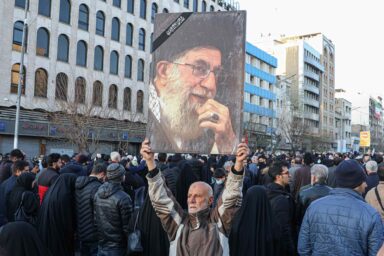
Trump, who believes in his own genius-level instincts, has suggested that the US might engage in “regime change” by knocking out Iran’s Supreme Leader Ali Khamenei, who is due to retire soon anyway. Eliminating Khamenei and the current government, however, would simply clear the way for Iran’s brutal Revolutionary Guard Corps (IRGC) to seize power. The result could be another version of Saddam Hussein, only this time the dictatorship would be equipped with a formidable military and the basic knowledge needed to acquire a workable nuclear bomb.
If the IRGC were not able to take power, the country would very likely disintegrate into outright civil war between competing tribes and clans. The result would be an exodus of refugees spreading throughout the Middle East. That would effectively destabilize the entire region, which still remains the source of a significant portion of the world’s energy supply. As we learned in Iraq, bombing does not make dangerous troublemakers disappear; it simply moves them somewhere else.
The big mistake the US made in the Iraq war — aside from invading in the first place — was to preemptively dismantle Saddam’s government and dismiss the Iraqi army’s officer corps without first considering what those defeated enemies would do next or where they would go. When some of those trained soldiers, who retained their weapons, joined insurgent forces, that mistake cost thousands of American lives, not to mention the destitution of what remained of Iraq.
But the Bush administration at least tried to hire people who seemed to know what they were doing. Trump is far from even that level of competence.
We now have a former US Army nurse with no intelligence experience as the overlord of America’s intelligence agencies. We have a secretary of defense whose only military experience was as a part-time member of the National Guard and who has no real management experience, but nevertheless gained a following in Trump’s MAGAworld as a weekend anchorman on Fox News. And we have a military personnel infrastructure that continues to be hollowed out and corroded by political and ideological purging.
Essentially, the Trump administration is flying blind. It’s a safe bet that anyone with experience in the Middle East will rejoice if Trump pulls yet another TACO and finds an off-ramp, sidestepping what could turn out to be another bloody disaster in a region that has known all too many of them.