Trump Versus the Catholic Church
Taking on the pope and posing as Jesus in a country with 60 million or so Catholics is a move even the madman theory might struggle to explain.
|
Listen To This Story
 |
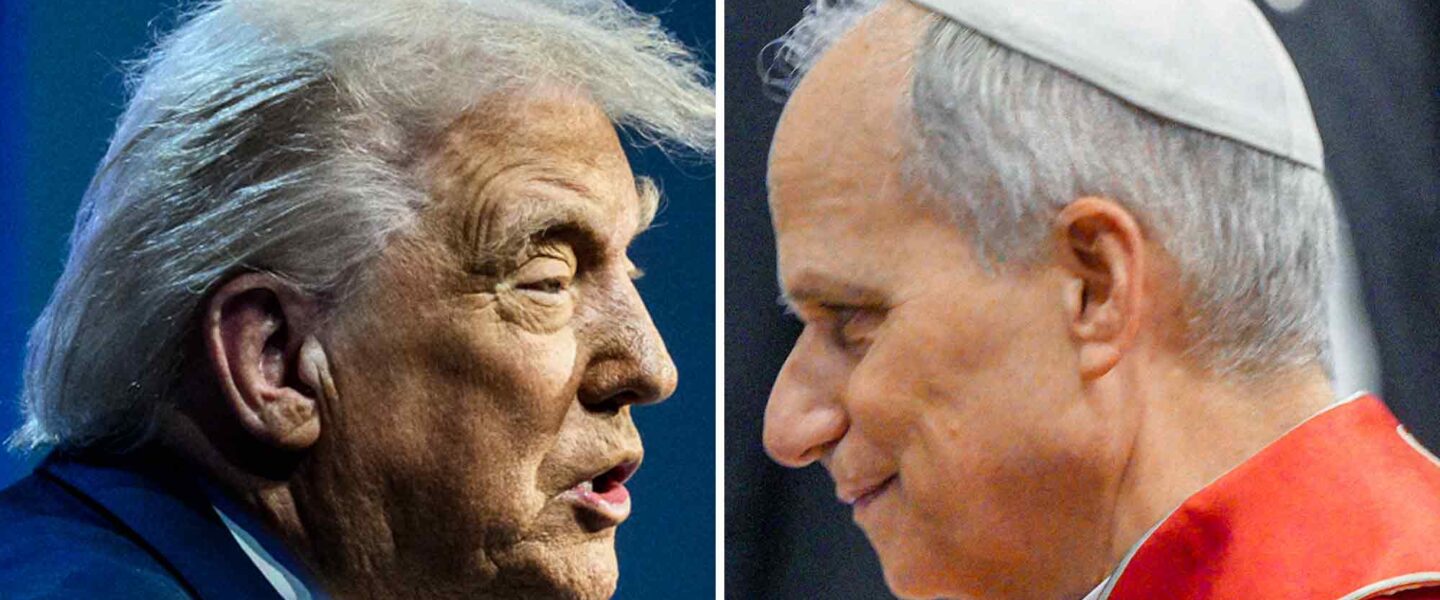
Despite the growing clamor for Donald Trump’s removal, when it comes to Iran, it is still hard to tell whether the president really has gone off the deep end or is simply a wily political fox. Trump’s current battle against the Catholic Church, and more specifically against Pope Leo XIV, is more difficult to explain away.
The tendency over the last few weeks has been to dismiss Donald Trump’s most unhinged comments regarding his war with Iran as nothing more than a shrewd negotiating tactic known as the Madman Theory. The concept, developed by Richard Nixon during the Vietnam War, says that in complex negotiations, logic can be a trap that lets your opponent predict your next move.
By behaving erratically, the situation becomes unpredictable, and the opponent has to worry that you just might do the unthinkable. In Iran’s case, that might be a decision by Trump to drop a nuclear weapon on Tehran.
In the United States, the public expects the president to be transparent about the decision-making process, or at least let the pubic know what is going on. After all, we are a democracy. Trump’s wild statements naturally caused almost as much alarm in Washington as they did in Tehran.
According to the Madman Theory, Trump’s talk about erasing Iran as a civilization amounted to simply sending a message that things were beginning to get out of hand. Trump himself later explained that the comment about bombing Iran back to “the Stone Ages, where it belongs,” was an attempt to let the Iranians know that he means business.
The strategy could be a rational explanation for Trump’s recent behavior, or it could be a rationalization intended to soothe die-hard Trump supporters who don’t want to believe that their leader might actually be going bonkers.
Plenty of people remain unconvinced that Trump is really OK, and not experiencing an increasingly alarming series of potentially lethal senior moments. Former CIA Director John Brennan, and more than 70 Democrats in Congress, called for Trump’s removal either by applying the 25th Amendment, which empowers a majority of the Cabinet to decide when the president is dangerously incompetent and to then transfer acting power to the vice president, or by impeachment, which requires a majority of the House of Representatives and a two-thirds majority in the Senate to remove the president for actions forbidden by the Constitution. There have been plenty of such actions recently.
Anyone building a case questioning Trump’s fitness would find it bolstered by the other war Trump has recently started — the one with Pope Leo and the Catholic Church.
At least on the surface, it looks as though Trump has nothing to gain by antagonizing the Catholic Church. At least eight members of his Cabinet are Catholic. Vice President JD Vance converted to Catholicism at age 35. Six of the nine justices on the Supreme Court are Catholic. So what was Trump thinking when he took on the church?
Trump’s primary complaint was against an address given in Italian, in which Pope Leo XIV warned against “the delusion of omnipotence,” and to “break the demonic cycle of evil,” an obvious reference to launching an unnecessary and unwanted war against Iran.
Leo, the first American pope, seemed to be stating the obvious when he suggested that hubris has led the US towards a dead end and that the way out is to return to Christian values, which consist mainly of rejecting hatred and inflammatory language and a return to basic decency and consideration of one’s fellow man.
“It is here that we find a bulwark against that delusion of omnipotence that surrounds us and is becoming increasingly unpredictable and aggressive,” he said. “Even the holy Name of God, the God of life, is being dragged into discourses of death.” It was eloquent but fairly traditional papal fare — most, if not all, of Leo’s predecessors have, at one time or another, made comparable pleas for peace and restraint.
Perhaps it was the reference to “delusion” that did it: Trump’s response to Leo’s gentle reprimand was a series of tirades in a tone similar to that of his unhinged comments about Iran.
“I don’t want a Pope who thinks it’s OK for Iran to have a Nuclear Weapon,” he posted on TruthSocial. “I don’t want a Pope who thinks it’s terrible that America attacked Venezuela, a country that was sending massive amounts of Drugs into the United States and, even worse, emptying their prisons, including murderers, drug dealers, and killers, into our country.”
Apparently, it did not matter to Trump that Leo never mentioned Iran, or Venezuela, much less nuclear weapons, or that Venezuela was sending drugs to Europe, not the US. It no doubt also failed to occur to Trump that his reaction was a brilliant illustration of the hubris that Leo had warned against.
Trump’s final denunciation of Leo was that he was a “liberal.” It’s not entirely clear what Trump means by “liberal.” The Oxford Dictionary describes a liberal as “a supporter of a political and social philosophy that promotes individual rights, civil liberties, democracy, and free enterprise.” While many would regard that as a description of what it means to be a US citizen, Trump obviously had something much darker and more nefarious in mind.
Trump accompanied his disparaging of the pope on his “Truth Social” platform with an AI-generated image of himself, rather unambiguously depicted as Jesus Christ administering to the sick and poor. Not too long ago, simply posting the image would have been considered blasphemy. Probably unnoticed by Trump, the AI image included a three-horned figure appearing above his head.
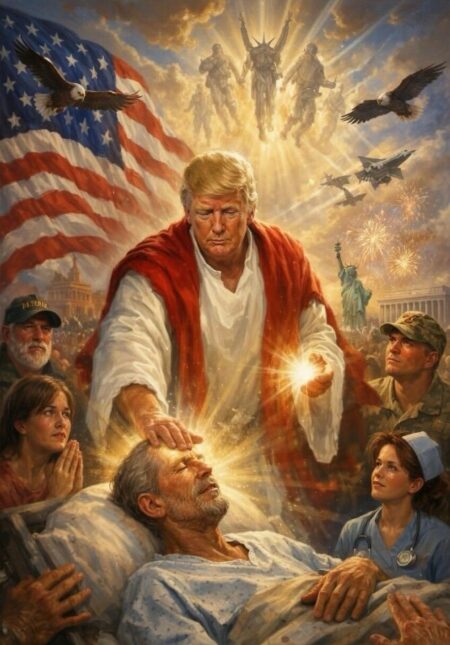
When I typed a query into Google’s Gemini AI inquiring about the figure, it answered: “In the Bible, specifically Daniel 7:8, the ‘three horns’ (or three uprooted horns) represent three kingdoms, nations, or kings that are conquered or displaced by the rise of the ‘little horn,’ which many scholars identify as an end-times ruler, the Antichrist, or a specific political power. They symbolize the overthrow of established powers.”
Trump, who rarely goes to church, was raised a Presbyterian or Calvinist, but now refers to himself as “nondenominational.” Is he the Antihrist, a figure in the Bible who pretends to be Christ, but, in fact, opposes everything that Christ stood for? Or is his bizarre and politically mystifying belligerence simply a theatrical attempt to intimidate the pope — an odd foray into Madman Theory?
In the Bible, the Antichrist, or false Christ, appears shortly before the End of Times — in other words, the end of the world. Some evangelicals, many of whom voted for Trump, encourage the approach of the Antichrist as hastening Armageddon — the destruction of the planet, which, according to certain texts, will initiate the “Second Coming,” in which Christ returns to deliver a final judgment. Trump, with his ability to launch a nuclear war, no doubt looks like an appealing candidate to usher in the End of Times.
Trump is hardly a religious scholar, and it is doubtful he was aware that he was entering dangerous territory here. Indeed, when his confounding post roused an overwhelming outcry, he deleted the image of himself as Christ, and then awkwardly tried to explain that he really thought the image of him emitting rays of light from his hands and standing underneath a heavenly figure representing the Antichrist was nothing more than a portrayal of himself as a simple medical doctor, healing the sick — in short, nothing more than a humble volunteer for Doctors Without Borders or some other do-gooding NGO. Many, including some among the MAGA base, thought Trump’s explanation went well beyond awkward and was, simply, absurd.
The incident and immediate backlash emphasized the dangers of mixing religion and politics, yet that is precisely what the Trump administration has increasingly been trying to do.
Joseph Campbell, who spent his life studying comparative mythology, pointed out that much of the early organization of human society was based on myths that attempted to explain creation and existence itself. The myths ultimately evolved into religions, which proved extremely powerful in structuring human society.
The problem, Campbell said, arose when obvious contradictions in a mythology cast doubt on its explanatory power. Once the contradictions were too obvious to be ignored — for example, the people worshipping a supreme god were defeated by people worshipping another god — the social structure that the mythology had held together as a kind of glue began to crumble away. The result inevitably looked like a slide into social anarchy.
In the US, freedom of religion provided a refuge early on for a multitude of Christian denominations. Each interpreted the Bible in its own way, and that often resulted in contradictory conclusions. Trump’s self-styled “secretary of war,” Pete Hegseth, for instance, cites Bible texts to support his efforts to increase lethality in the military. It’s doubtful that Jesus would have agreed, but Jesus is not here to contradict Hegseth.
The Catholic Church, which Pope Leo XIV now heads, fought long and hard against letting individuals interpret the Bible for themselves. William Tyndale was burned at the stake in 1536 for daring to translate the Bible into English and making it accessible to the common man.
Pope Leo attempted to do something much less controversial. He simply wanted to warn Americans that hubris and delusions of omnipotence often lead to lethal consequences, and that a return to basic decency and concern for one’s fellow man will inevitably lead one in a preferable direction.
Trump characteristically and predictably failed to get the message, even though the attitudes Leo warns against could chart a course toward Armageddon. Whether it is already too late for Trump or the rest of us to grasp that simple fact remains to be seen.
William Dowell is WhoWhatWhy’s editor for international coverage. He previously worked for NBC and ABC News in Paris before signing on as a staff correspondent for Time magazine based in Cairo. He has reported from five continents — most notably during the Vietnam War, the revolution in Iran, the civil war in Beirut, Operation Desert Storm, and in Afghanistan.