Trump Unleashes ‘Epic Fury’ on the Middle East
Trump bypasses Congress to start a war against Iran that risks destabilizing the entire Middle East.
|
Listen To This Story
 |
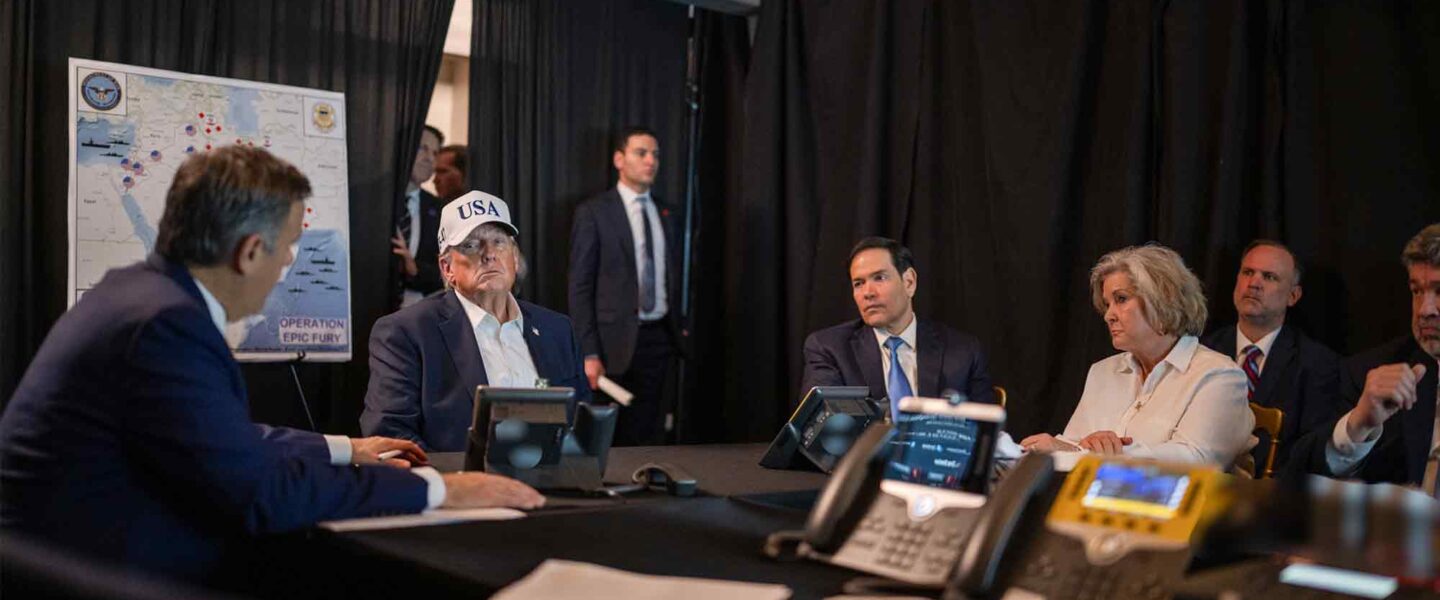
In case anyone had any doubt, Donald Trump’s speech on the launch of “Epic Fury,” a massive US and Israeli military assault against Iran, was clearly aimed at “regime change.” Calling on Iran’s protesters to rise up and overthrow the theocratic regime that has been in power since the Iranian revolution in 1979, Trump warned that if the Iranian public missed its chance to exercise power now, it might be a generation before there was another chance.
It’s safe to say that most Middle East experts think that’s not likely to happen. Despite widespread dissatisfaction with the mullahs and the enormous size of recent protests, the chances of any democratic government arising from the ashes of a collapsed regime in Tehran are virtually nonexistent.
What is a lot more likely to happen is that a government that at least makes a pretense of adhering to religious principles will be replaced by a violent faction of the Islamic Revolutionary Guard Corps, the Iranian group most responsible for Iran’s acts of terrorism.
At the very least, the massive bombardment — in which Iran’s Supreme Leader Ayatollah Ali Khamenei and several other top leaders have been reported killed, and in which another American missile hit a school and killed more than 100 innocent school girls — is likely to confirm Iran’s most vicious anti-American stereotypes. Instead of helping protesters, Trump’s action will make opposing excesses of the regime even more difficult.
Trump also claimed that he is determined to prevent Iran at all costs from developing its own nuclear weapon, but Trump is the one who definitively canceled the agreement, negotiated by Barack Obama, that put heavy restrictions on Iran’s nuclear development.
The key element in developing an atomic bomb is not the equipment used to make it; it is the knowledge and commitment of the scientists and engineers who know how to put it together. Trump’s air strikes may look impressive, but the knowledge necessary for a bomb remains, and if the Iranians weren’t serious about building a bomb before, they will be once Trump has finished.
Airstrikes and missiles alone will not succeed in changing Iran. To do that, it’s necessary to have troops on the ground and there needs to be an occupation. At the very least, enough troops need to be committed to support a new government until it finds its footing.
The US public is not ready for that kind of commitment. In fact, pre-attack public support for military action in Iran hovered around 21 percent.
Trump talks about American soldiers being heroes, ready to sacrifice their lives, but when Trump was confronted with the military draft, he was anything but a hero. He dodged induction into the US Army at least five times, claiming that his feet were crippled by “bone spurs.”
There is something unsettling about a man who refused military service himself now urging other Americans to sacrifice their lives. Nevertheless, this latest attack against Iran put an estimated 40,000 American servicemen now stationed in the Middle East at risk. That risk is exacerbated by the fact that the missiles and ammunition needed to protect them are in short supply.
Not only are US soldiers threatened by Trump’s action, but Iran’s counterattacks against American bases throughout the region immediately put the governments in the countries where the bases are located at risk. Even worse, if the violence escalates, it could shut down the Strait of Hormuz and cut off the transport of roughly 20 percent of the world’s energy supply.
Whence ‘Epic Fury’? Some Forces at Play
The real motivation behind Trump’s eagerness to go to war with Iran remains open to question. Even while negotiations were underway to replace the nuclear treaty that Trump had pulled out of, he had already begun the costly military buildup needed to attack Iran.
It’s hard to avoid the impression that the negotiations may have been simply stalling for time while Trump put in place the forces necessary to carry out the attack.
Israel’s reason for wanting to participate in what amounted to a joint offensive is not hard to understand. Israeli Prime Minister Benjamin Netanyahu clearly sees a war with Iran as a possible diversion that could contribute to his political survival. He has been pushing the US to destroy Iran for decades.
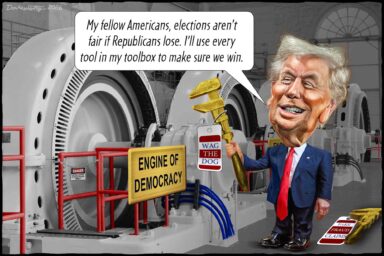
Trump may also be interested in using war for personal survival. War certainly distracts from the scandal over his previous contact with convicted pedophile Jeffrey Epstein — and especially over the pages from an FBI investigation that mysteriously disappeared from recently released documents.
With Trump’s poll numbers in the gutter, he may also have hoped that a sudden war would provide him with a boost as Americans harken to the call of patriotism.
Or, as a pronounced narcissist who is embarrassingly obsessed with winning the Nobel Peace Prize, Trump may have thought that the use of America’s military power to impose “peace” on the Middle East might just do the trick. The suggestion sounds absurd, but so do many of Trump’s other actions, and anything is possible with this administration.
The fact is that if we are lucky, all that will happen with Epic Fury is that prices will continue to rise, and one of the world’s most volatile regions will be momentarily destabilized.
If we are not lucky, the consequences could be considerably greater. World War I began with the shooting of an Austrian archduke by an assassin wielding a semi-automatic pistol. This time, Trump has fired a much bigger gun.