Religion in the Military: A Dangerous Motivation
Iran, Israel, and the United States have all embraced a crusader’s mentality.
|
Listen To This Story
 |
If the US, Israeli, and Iranian armed forces have anything in common, it may be militant interpretations of faith as a motivational driver that demonizes the enemy, projects war as inevitable, and obstructs long-term negotiated conflict resolution, if not outright precluding it.
The pathways of the three militaries towards positioning faith as an overarching ideological driver differ. They represent alternative models for the indoctrination of militaries with faith.
Iran’s Islamic Revolutionary Guard Corps (IRGC) is the easiest, most straightforward model. It also suggests that faith as a motivational driver has its limits.
Faith and ideology were baked into the IRGC from its inception. The Corps was founded as a force loyal to the Islamic Republic that, in the wake of the 1979 Islamic Revolution, distrusted the country’s conventional military inherited from the days of the shah.
When put to its most recent test in two existential wars in which the Islamic Republic’s survival was at stake, faith faded as the IRGC’s prime motivational driver.
If anything, the 2025 12-day Israel-Iran war and the current US-Israeli assault on Iran accelerated the IRGC’s evolution from a force inspired by religious zeal to a fighting unit focused on survival and security of the Islamic Republic and preservation of the IRGC’s sprawling economic interests.
The IRGC’s evolution suggests that US Defense Secretary Pete Hegseth’s top-down introduction of faith and the Israeli bottom-up approach — with pre-military academies that breed ultra-nationalists and ultra-conservatives and military units that cater exclusively to the ultra-orthodox — may have shelf lives of their own.
Faith as Motivation
At the very least, the contrasts among the Iranian, US, and Israeli militaries demonstrate that the sustainability of faith as a motivational driver depends heavily on politics and demography.
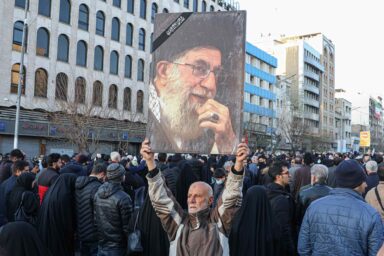
For starters, the infusion of faith as a motivational driver in the militaries occurred under the auspices of leaders — Ayatollah Ruhollah Khomeini, the Islamic Republic’s founder, and his assassinated successor, Ayatollah Ali Khamenei; US President Donald Trump; and Israeli Prime Minister Benjamin Netanyahu — who envision their countries as civilizational entities rather than as nation-states.
The pitfalls of faith as a motivational driver are evident in the IRGC’s involvement in political violence at home and abroad and the Israeli military’s conduct of the Gaza war, which raises the specter of war crimes and crimes against humanity justified by militant interpretations of faith.
Already, the International Criminal Court (ICC) has issued arrest warrants for Netanyahu and his former defense minister, Yoav Gallant, on charges of war crimes and crimes against humanity — including starvation as a weapon of war, murder, and persecution in Gaza.
The warrants and Israel’s war conduct call into question Israel’s assertion that its military is “the world’s most moral army.”
The IRGC was born in the wake of a popular revolution in which a majority of the population supported regime change, while religious forces fought for the Islamic Republic’s institutionalization against competing left-wing and liberal trends, and against Iraq in an eight-year war.
By contrast, the US and Israeli militaries were created as secular forces that politicians and ideologues more recently have sought to infuse with religion.
Hegseth’s effort to turn the US military into a religiously motivated fighting force is the most recent, commencing with Trump’s return to the Oval Office in 2025.
Like Israel, Hegseth seeks to create a religiously motivated officer corps that projects the military’s mission as underwritten by God.
In the case of the Iran war, the mission has Christian supremacist and anti-Muslim undertones that hark back to the medieval Crusades that sought to wrest control of the Holy Land from the Muslims.
‘Break the Teeth’
Hegseth, a member of a Christian nationalist church who sports tattoos with Christian messaging — including one associated with the Crusades that reads “Deus Vult,” God wills — asked God during a recent Pentagon prayer meeting to “break the teeth” of and kill America’s “wicked” enemies “who deserve no mercy,” and should be “delivered to the eternal damnation prepared for them.”
Hegseth has also inserted biblical verses about destroying the enemy into Pentagon videos featuring US weaponry, including fighter planes and missiles, and soldiers firing their guns.
Hegseth ended a recent Pentagon news briefing with a prayer asking God to endow US troops with “overwhelming violence of action against those who deserve no mercy.”
Members of all branches of the US military have complained that commanders have invoked Christian rhetoric about biblical “end times” and “God’s divine plan” to justify the Iran war.
In a statement announcing the appointment to the US Air Force Academy board of Erika Kirk, the widow of assassinated far-right activist Charlie Kirk, the White House said Kirk would continue the legacy of her husband’s “bold Christian faith.”
Fertile Soil for Fanaticism
The academy has a history, predating Hegseth’s tenure, of allegations that it favored Christian beliefs in its leadership and cadet culture, including pressure to attend chapel services and adopt evangelical Christian beliefs. In this regard, it resembles Israel’s bottom-up approach to infusing religion into its military.
The Israeli government has since 1988 subsidized up to 60 pre-military academies that prepare students for obligatory conscription, many of which are operated by supremacist rabbis, who advocate genocide, and, at least in one case, the killing of secular Jews.
Estimates of the number of officers who graduated from these academies range from 25 to 40 percent of the military’s officer corps.
The ultra-nationalist and ultra-religious academies strive to instill in their students principles grounded in the harsh codification of halakha, Jewish religious law, by Moses Maimonides, an acclaimed 12th-century medieval scholar.
The codification included notions of Jewish supremacy and the subjugation of a ger toshav, or resident alien, that needs to be “demeaning and humiliating.” Resident aliens, in Maimonides’s codification, were not allowed to lift their heads against Jews or enjoy preferential treatment.
The modern-day militant religious interpretation of these principles means that the Israeli government must demand that Palestinian ger toshav recognize Jewish sovereignty and Israel as a Jewish state. Refusal to do so deprives them of the right to reside on the land, a principle that has gained prominence in Israeli policies.
Echoing Maimonides’s precepts, Rabbi Eliezer Kashtiel advises his students at Bnei David, the first West Bank-based pre-military academy, that fighting a war is as much about conquering the land as saving lives.
Kahstiel proudly embraces racism in his classes. “Yes, we’re racists. We believe in racism… There are races in the world and peoples have genetic traits, and that requires us to try to help them,” Kashtiel tells his students.
Kashtiel asserted that “the gentiles [read Palestinians] will want to be our slaves. Being a slave to a Jew is the best… Instead of just walking the streets and being stupid and violent and harming each other, once they’re slaves, their lives can begin to take shape.”
Kashtiel’s colleague, Rabbi Giora Redler, uses his lectures to praise Adolf Hitler.
“Let’s just start with whether Hitler was right or not. He was the most correct person there ever was and was accurate in every word he said… he was just on the wrong side,” Redler said in a lecture.
Redler claimed that pluralism, humanism, and secular culture were the “real” genocide against the Jews, not the Nazis’ gas chambers.
“The real Holocaust was not when they murdered the Jews; that’s not it. All these excuses — that it was ideological or systematic — are nonsense. Humanism, and the secular culture of ‘We believe in man’: that’s the Holocaust,” Redler said.
At one point, the Bnei David academy featured a quote on its wall by another of its instructors, Rabbi Joseph Kalner, charging that “all secular Jews are traitors and the state can do anything to sanction them, including putting a bullet through their head.”
Some 4,000 Bnei David graduates have so far served in the Gaza war.
Rabbi Eliyahu Mali, head of the Shirat Moshe religious school in Jaffa, last year asserted that “the basic rule we have when fighting a holy war — in this case, Gaza — is the doctrine of ‘not sparing a soul.’ The logic of this is obvious. If you don’t kill them, they will try to kill you. Today’s saboteurs are the children of the previous war, whom we kept alive.”
Mali went on to say:
Today’s terrorists are the children of the prior operation that left them alive. The women are essentially the ones who are producing the terrorists. It’s not only the 14- or 16-year-old boy, the 20- or 30-year-old man who takes up a weapon against you, but also the future generation. There’s really no difference.
With Israel at one extreme in the comparison of the Jewish state’s military with Iran’s Revolutionary Guards and the US’s armed forces, it serves as a wake-up call to the pitfalls of employing religion to motivate the troops.
A US attack on a primary school in the southern Iranian town of Minab that killed 168 people, including more than 100 children, on the first day of the Iran war, sparked international condemnation.
The Pentagon has suggested that the military used outdated coordinates that mistook the school for an adjacent IRGC naval base to which the school was connected until it was partitioned off in 2016.
There is no indication that the attack was not a mistake.
Even so, the Israeli experience suggests that religious indoctrination of the US military could lead to a future incident that may not be an error.
Moreover, where such deep foundations are in place, coupled with the kind of religious fanaticism evident in leaders such as Hegseth, rolling back the impact on the military’s secular ethics, norms, and respect for laws governing warfare may be easier said than done.
James M. Dorsey is an adjunct senior fellow at Nanyang Technological University’s S. Rajaratnam School of International Studies, associate editor of WhoWhatWhy, and the author of the syndicated column and podcast, The Turbulent World with James M. Dorsey.