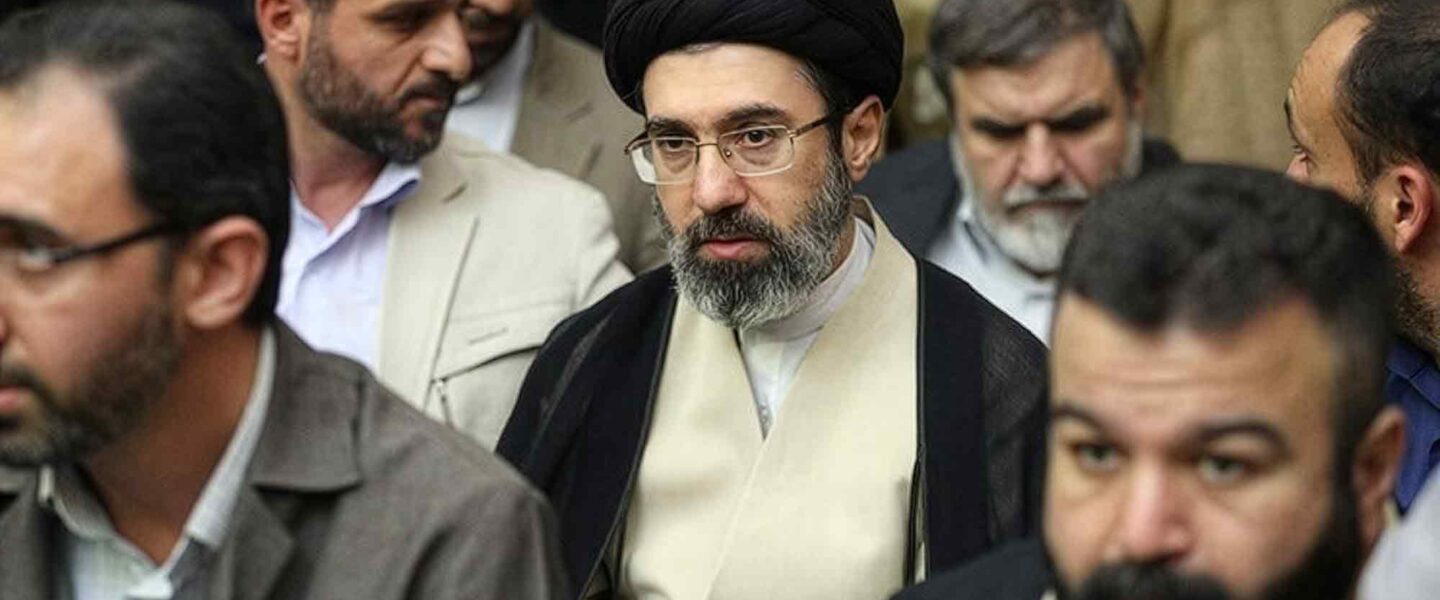
Iran’s New Leader Is a Dark Horse
Defiance, resilience, resistance, unity, and consistency will likely be the motto of the new Supreme Leader, Mojtaba Khamenei.
|
Listen To This Story
 |
The jury is out on Iran’s newly appointed supreme leader, Mojtaba Khamenei.
Judged by his track record, Khamenei’s appointment does not bode well for Iran or a quick end to the war. It is an act of defiance that signals resilience, regime cohesion, and consistency rather than Iran’s turn to a hereditary system.
His appointment also has religious significance.
Khamenei is the son of a leader viewed by many as a martyr killed by enemy forces, much like Husayn ibn Ali, the son of Ali and grandson of the Prophet Mohammed, who died in the Battle of Karbala in 680 CE. Shiites annually commemorate Hussein’s death as a prime example of resistance against injustice and tyranny.
The killing of Ayatollah Ali Khamenei and US President Donald Trump’s insistence that he would have a say in the appointment of Iran’s next supreme leader and warning that Mojtaba Khamenei would be “unacceptable,” reinforced Khamenei’s position as a frontrunner.
Long touted as a potential successor of his father, who was killed in the early hours of the February 28 US-Israeli assault on Iran, Khamenei has never held public office but served behind the scenes as Ali Khamenei’s powerful gatekeeper and political broker.
As such, he is likely to quickly consolidate power and assert control of the Islamic Republic’s system.
Many associate Ali Khamenei with the repeated crackdowns on antigovernment protests starting with demonstrations in 2009 against an allegedly fraudulent presidential election and, most recently, the brutal repression of protests in January.
Even so, 56-year-old Mojtaba Khamenei is, for all practical purposes, a dark horse who has rarely appeared in public.
While perceived as a hard-liner with close ties to Iran’s clerical class and security and military establishment, including the Islamic Revolutionary Guard Corps (IRGC), Khamenei’s appointment marks a generational change in Iran’s most senior leadership.
While loyal to the Islamic Republic, many among Iran’s next generation are perceived to be more pragmatic than Iran’s old guard, represented by Ali Khamenei.
With Iranians and the world waiting with bated breath for Khamenei’s first address to a nation that knows little about him, his initial statements are likely to suggest little, if any, change.
Defiance, resilience, resistance, unity, and consistency will be his motto.
But if the history of the Middle East has any lessons for Iran, it is that hard-liners rather than moderates often prove the most credible in embracing compromise.
It was Ayatollah Ruhollah Khomeini, the Islamic Republic’s founder, who in 1988 swallowed the “poison” of a ceasefire in the eight-year-long Iran-Iraq war.
Similarly, hard-liner Israeli Prime Minister Menachem Begin made peace with Egypt, while another Israeli prime minister, Yitzhak Rabin, and Palestine Liberation Organisation Chairman Yasser Arafat compromised with their acceptance of a two-state solution for the Israeli-Palestinian conflict.
“If there is anyone who could move toward some sort of de-escalation with the United States, it is him — any other person would face backlash from the ruling class and conservatives. He intends to bring structural change,” said Abdolreza Davari, a politician close to Khamenei.
That is, if Khamenei survives long enough. He is a man with a target on his back — Israel has vowed to kill whoever succeeds Ali Khamenei.
As a result, Khamenei’s longevity will be one more litmus test of US and Israeli intelligence penetration of Iran.
James M. Dorsey, an Associate Editor of WhoWhatWhy, is an Adjunct Senior Fellow at Nanyang Technological University’s S. Rajaratnam School of International Studies and the author of the syndicated column and podcast, The Turbulent World with James M. Dorsey.
.jpg target=)