In Iran, Assassination Has Consequences
Hard to negotiate when you’ve killed the enemy’s negotiators.
|
Listen To This Story
 |
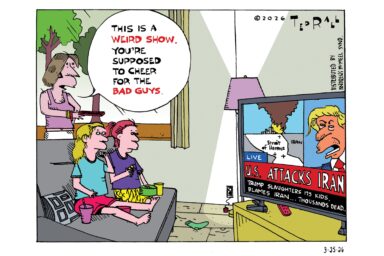
Both President Donald Trump and Israeli Prime Minister Benjamin Netanyahu have taken special pride in their ability to target and kill key figures in Iran’s leadership.
The use of airstrikes and missile attacks to kill Ali Larijani, the head of Iran’s security network, and Esmaeil Khatib, Iran’s chief of intelligence, may look like the road to victory, but the strategy can also backfire.
Iran’s Supreme Leader Ali Khamenei, Larijani, and Khatib were known quantities, and their approach to warfare was understood by Western intelligence agencies. The actions of their replacements will be harder to predict.
In short, the Trump-Netanyahu strategy has had the effect of substituting a future opponent we don’t know for one that we did know fairly well. Not only that, but the replacements are likely to have less experience and consequently less secure judgment than their predecessors. It can easily turn into a downward spiral for increased violence.
Not a Brain He Can Trust
Trump’s confusion over Iran is not hard to understand. Both he and his “Secretary of War” Pete Hegseth have a fundamental distrust and disdain for what they consider to be the “deep state,” and which everyone else considers to be the Washington establishment. That includes the US State Department, the CIA, the National Security Agency, and, in Hegseth’s case, the Pentagon.
Trump fired a wide range of career diplomats who together represented decades of painfully acquired expertise. Hegeth dressed down America’s military command, sneering that they were not lethal enough and too afraid of taking risks.
The result in both Trump’s and Hegseth’s cases has been a venture into dangerous new territory that neither is equipped to handle. Instead of turning to American diplomats with a proven track record in the Middle East, Trump appointed his real estate buddy, Steve Witkoff, and his own son-in-law, Jared Kushner, to try their hand at navigating a diplomatic minefield that had previously baffled America’s best and the brightest.
Witkoff, who had no previous diplomatic experience, lacked the technical expertise to understand what the Iranians were saying. He may have thought that enriched uranium intended for use in a reactor was actually going to be used for a bomb. He was unaware that the reactor had been modified to operate on less-highly enriched uranium and that the uranium in question posed no threat.
Other diplomats felt that Witkoff should have taken the Iranian offer to Washington, where it could be examined by people who had a better understanding of technical issues.
Conflicting Agendas
A more serious problem was that Trump, having rejected the State Department’s expertise, found himself increasingly influenced by Netanyahu. It’s doubtful that Trump ever fully realized that Netanyahu and the US have very different agendas in the Middle East.
Trump’s vision is to hurt Iran enough so that it will agree to his terms. Netanyahu’s goal is to kill everyone in Iran’s leadership so that there is nothing left except disorganized factions squabbling with each other and too weak to pose a threat.
The US is primarily interested in regional stability, which is a requisite for business, which is what America is really about. The ultimate American goal has to be a peaceful solution.
By contrast, Netanyahu represents a country with a population of only 10 million people, only 7.7 million of whom are Jewish. He is trying to survive in a hostile environment in which Israel appears hopelessly outnumbered. His strategy for the last several decades has been to divide and conquer. He may not be able to definitively defeat the overwhelming numbers that want to do Israel in, but he can at least weaken them by setting one faction against another, and creating a semipermanent state of chaos.
Netanyahu’s strategy, in effect, calls for a perpetual state of war in which no one has enough power to challenge Israel. The strategy worked to a degree in Lebanon, which was already defined by the artificial divisions imposed by colonial powers after the collapse of the Ottoman Empire following World War I. But Iran is much larger and strategically far more important.
The conflicting American and Israeli goals leave Trump in a bind. His vision is to hurt Iran enough so that it will agree to his terms. Netanyahu’s goal is to kill everyone in Iran’s leadership so that there is nothing left except disorganized factions squabbling with each other and too weak to pose a threat.
Lights Out, Nobody Home
Trump would like to get out of Iran, but there is no one left right now to negotiate with and, after the mayhem that the American-Israeli campaign has wreaked on Iran, it’s unlikely that anyone would negotiate with Trump in any case.
For Trump, there is no ready exit. The Strait of Hormuz is likely to remain closed and the US will have to deal with the financial consequences.
Netanyahu also faces a difficult situation. Having decapitated Iran’s leadership, he now has to deal with a dispersed command that the Iranians call their “mosaic defense” strategy. The Islamic Revolutionary Guard Corps has established at least 31 relatively autonomous command centers, each capable of making decisions and acting independently. Ali Khamenei’s son, Mojtaba Khamenei, was supposed to be the unifying element, but if he goes, the different commands can operate without him.
That’s already started to happen with independent rocket attacks against countries in the Persian Gulf. The dispersal of command has made it hard to predict what Iran will do next, or how anyone will get all of the centers to agree to a ceasefire.
The only solution is to send in troops on the ground. Israel doesn’t have sufficient manpower to do that, and the US doesn’t have the will. Iran is much bigger and more complicated than Iraq or Vietnam.
As far as the dispersal of command goes, Italy faced a similar situation when it isolated the heads of the Italian Mafia by imprisoning them on a remote island in the late 1990s. The tactic eliminated the Mafia as a coherent organization, but the central leadership was replaced by dozens of independent groups, each of which had to be dealt with separately. The autonomous groups proved even harder to deal with than the old hierarchy.
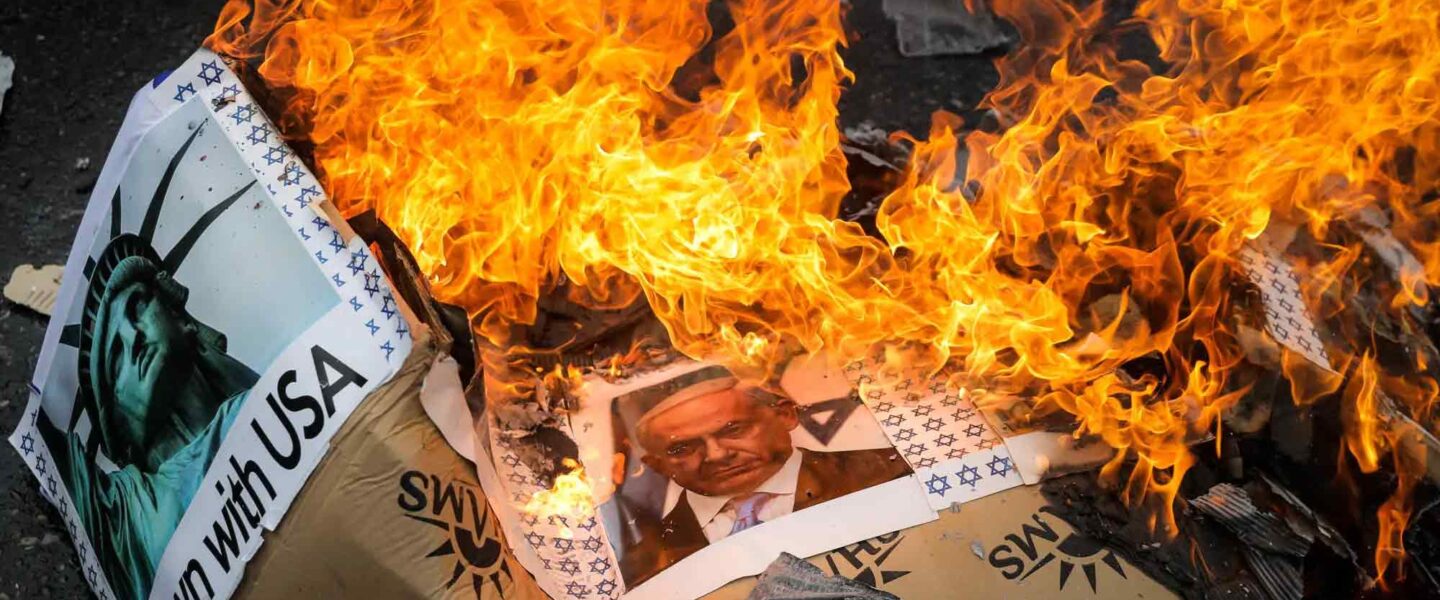
An irony in Iran is that despite the regime’s anti-American rhetoric, many Iranians remained surprisingly pro-American. After the Trump-Netanyahu shock-and-awe bombing campaign, it’s doubtful that any pro-American sentiment will remain. Hegseth has made it abundantly clear that he wants nothing to do with “nation building.” Nation destroying is a different matter.
William Dowell is WhoWhatWhy’s editor for international coverage. He previously worked for NBC and ABC News in Paris before signing on as a staff correspondent for Time magazine based in Cairo. He has reported from five continents — most notably during the Vietnam War, the revolution in Iran, the civil war in Beirut, Operation Desert Storm, and in Afghanistan.