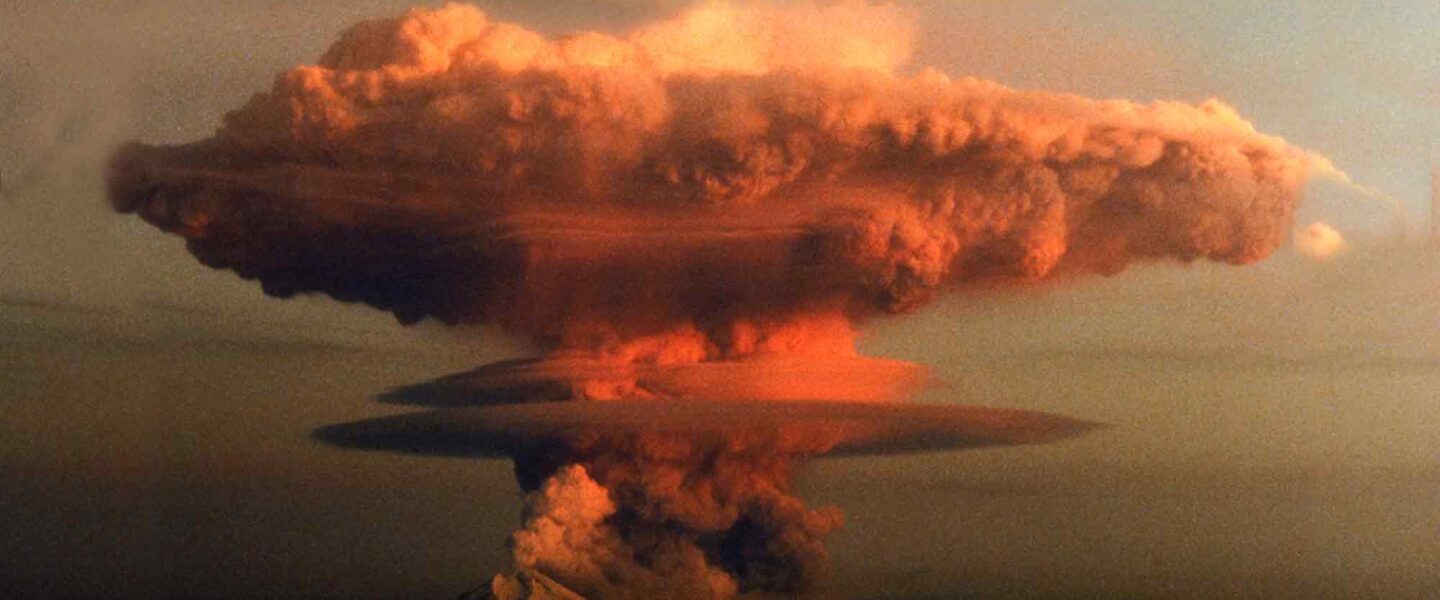
The Unexplained War: Stumbling Toward World War III
War without strategy. Drones without limits. Data without wisdom. How the Iran conflict is stumbling toward World War III — and no one can explain why.
My guest on this week’s WhoWhatWhy podcast, RAND senior defense analyst David Shlapak, has for decades made a living by imagining how wars spiral out of control — war-gaming the scenarios where miscalculation becomes catastrophe, where deterrence fails, where World War III stops being theoretical.
Today, those scenarios are no longer simulations. They’re unfolding in real time over Iranian airspace, and the people running them may not have thought through what happens next.
Shlapak explains how the current conflict in Iran has become something without precedent: a great power pouring resources into a fight whose strategic objective shifts like sand, exhausting precisely those capabilities and resources needed if China does the math on Taiwan or Russia tests NATO’s resolve.
Fifty-thousand-dollar drones are rewriting the economic calculus of warfare. Artificial intelligence is mining oceans of data while human judgment drowns in the noise. The offense-defense balance that kept American forces operating with near-impunity for three decades has collapsed. Shlapak has imagined every possibility: how wars get out of control, how they can be kept under control, and what happens when no one articulates why they started in the first place.
He discusses what Ukraine has taught every side, why nuclear proliferation may be the real lesson other nations are learning, the Iran-Israel tripwires no one’s naming, and why this conflict has no historical analogy — and so no easy answers.
 Apple Podcasts
 Google Podcasts
 RSS
RSS
Full Text Transcript:
(As a service to our readers, we provide transcripts with our podcasts. We try to ensure that these transcripts do not include errors. However, due to a constraint of resources, we are not always able to proofread them as closely as we would like and hope that you will excuse any errors that slipped through.)
[00:00:09] Jeff Schechtman: Welcome to the WhoWhatWhy podcast. I’m your host, Jeff Schechtman. War has always been a calculus of miscalculation, an equation where hubris meets fog, where signals cross in darkness, where the unthinkable becomes inevitable, not through grand design, but through a cascade of small errors, each one defensible in isolation, catastrophic in sequence. Today as Israeli jets strike deep into Iranian territory and Tehran’s proxies probe across a dozen frontiers, we are watching that equation being solved in real time. The question isn’t whether the pieces are moving towards confrontation. They already are. The question is whether anyone still controls the board. $50,000 commercial drones against billion-dollar defense architecture, signal intelligence drowning in noise while human judgment atrophies, autonomous weapon systems where the man in the loop becomes a formality, a legal fiction, a box checked on the way to decisions measured in microseconds. Ukraine gave us the laboratory. Iran is giving us the exam. And the grade, should we fail it, will be written in a script we spent 80 years trying to forget. David Shlapak saw this coming, not the specific players perhaps, but the shape of the threat, how speed collapses decision space, how asymmetry inverts power, how the battlefield of tomorrow punishes the doctrines of yesterday. At Rand as a senior defense analyst, he has spent decades modeling the scenarios that we pray remain theoretical. Escalation spirals, compounding errors, the moment when deterrence stops deterring and becomes the match that lights the fuse. His work on air-based vulnerability, on drone swarms, on the brittleness of our assumptions about military dominance reads differently now. Less like warning, more like prophecy. Because what’s unfolding in the Middle East isn’t just another regional flare-up. It’s a test case for every assumption underpinning global security architecture. How fast can wars escalate when the tools of war move at the speed of code? What happens when adversaries can absorb 1,000 drones for every jet we shoot down? And in an environment where AI is beginning to make targeting decisions, where the gap between provocation and response shrinks to nothing, where human judgment is the bottleneck we’re engineering out of the system, What are the odds that we stumble into World War III? Not because anyone wanted it, but because no one could stop it. It is my pleasure to welcome David Shlapak back to the WhoWhatWhy podcast. David, thanks so much for joining us.
[00:03:01] David Shlapak: Thank you for having me again.
[00:03:02] Jeff Schechtman: It is a delight to have you. Thank you so much. One of the things that certainly seems to be true about this conflict that is going on in Iran is there seems to be more technology at play than we have ever seen in a conflict before. Some of it’s AI, some of it’s drones that we’ve talked about in the past, but there seems to be a higher level of technology which by its very nature makes the decision-making process need to be faster and cuts humans more and more out of the process, it seems. Talk about that first.
[00:03:37] David Shlapak: Well, first, warfare has always tended to bring to bear the contemporary leading technologies of that era, whether it was the longbow at Agincourt, whether it was the machine gun in World War I, the airplane, right, the atom bomb, warfare has always tended to exist at the leading edge of technological change. So what we’re seeing here is just, it’s a different mix of technologies. And every mix of technologies brings its own peculiar dynamic. One of them is the asymmetry between attack and defense that can switch very rapidly from one conflict to the next. And secondly, as you’re suggesting, as particularly information technology has become more powerful when we’re deeply integrated into our command and control systems, our targeting systems, we’re having to understand the implications of a new set of relationships between people and technology.
[00:04:53] Jeff Schechtman: And does all that result in a situation now where there’s just so much speed built into the system, and that while certainly there have always been the state-of-the-art technology in wars and conflicts in the past, that one of the things about today’s technology is it just speeds everything up, and that has consequences that are somewhat sui generis to this particular battle.
[00:05:18] David Shlapak: Yeah, I think that there are certain kinds of decisions, certain kinds of actions that you want to automate, because you said earlier about the humans being the bottleneck in the system. I’m thinking about like intercepting ballistic missiles, for example, where the engagement has to happen very quickly. There’s time invested in detection, discrimination, tracking, what the Israelis are doing with deciding whether it’s worth intercepting the missile, because it’s headed for the desert, persons headed for something important, all that stuff takes time, even if it’s just measured in seconds. And at some point, you’ve almost want that system to be automated. The Aegis combat system on US destroyers has always had an automated mode because in the heat of defending against a large-scale raid, there wouldn’t be time for the person to punch the button to launch every missile. I think where you want to draw the distinction, and maybe where you’re drawing the distinction, is between deciding what to fire at and when to fire at it, having decided to shoot.
[00:06:36] Jeff Schechtman: Do we lose, I was going to say, do we lose something in human judgment, given the state of the art today?
[00:06:44] David Shlapak: I think there’s a risk of that. I don’t know necessarily that we have. But certainly when you look at some of the more bold predictions about how AI will become embedded in military systems, you know, communications, command and control, even in individual weapons, You can begin to foresee a world where humans are very much at the margins of the decision-making process, or maybe different way of putting it is they’re at the very apex of the decision-making process. But a lot of just a lot of choices that we are accustomed to and comfortable with having people make at the lower levels will be taken over. I don’t think we’re there yet. I don’t even think we’re committed to that world. But it is something to, my point of view, be concerned about, something to be thoughtful about and something to do in a very intentional way, as opposed to a technology-driven way.
[00:07:53] Jeff Schechtman: Is it fair to think that the situation as it is today leads to potential mistakes that could have dire consequences, or is that kind of an artificial concern, given the reality of the technology today?
[00:08:08] David Shlapak: I think there has always been the potential for mistakes. You look at the conversation around the tragic destruction of the Iranian’s schoolhouse by a cruise missile that didn’t miss its target. It hit its target. It just wasn’t the target it thought it was hitting. And the idea of the reports that I’ve seen that there was some degree of automation involved and the target selection, and sort of that was where the slip happened. But then you go back and look at the attack on the Chinese embassy in Belgrade in 1998, when there was a human targeteer who put the X on the building, or the destruction of the former command and control bunker in Baghdad that was being used as a civilian bomb shelter in 1991, when again, it was a human being who made the decision. Mistakes happen in war. One hopes, I think that by automating, you perhaps eliminate some of the more predictable mistakes while not taking agency away from the humans for the more weighty decisions.
[00:09:38] Jeff Schechtman: Do drones play a part in that because they’re so relatively inexpensive, and they can swarm, and they can cluster, and you can have so many of them? That seems fundamentally different. And certainly, we saw some of this. I mean, you and I talked about it when it was first happening in the Ukraine. Now it seems to have gone to another level.
[00:10:01] David Shlapak: I think that drones affect what I mentioned earlier about the offense-defense balance within a conflict. The United States has, really, since the end of the Cold War, lived in what you can think of as an offense-dominant world, where we chose the terms of the fight within reasonable margins. We were able to render our adversaries incapable of mounting sustained resistance, and certainly incapable of mounting sustained counterattacks against us. Because in that era, you know, it was the billion dollar bomber against a hundred million dollar fighter. And our adversaries couldn’t afford enough of the hundred million dollar fighters to stop our hundred million dollar fighters and our billion dollar bombers. What drones have done is brought that offensive capability into the reach of adversaries who have fewer resources, less mature systems for targeting, less sophisticated ways of doing command and control. They become more of a point-and-click kind of weapon. Like you say, you can fire a bunch of them. Any one of them, unless you get lucky, I mean, looking at like a Shahed class drone, probably isn’t gonna do much damage, but you put enough 50-pound warheads into apartment buildings, people start getting agitated. That’s what happened in Kiev. That’s what I think we’re seeing happening in some of the Gulf countries, where it’s less the extent of the damage and more what the damage represents, which is the risk that these systems bring to an expanded battle space, a battle space whose dimensions the United States no longer gets to independently define, but that the adversary, as the saying goes, has a vote in.
[00:12:11] Jeff Schechtman: It changes the whole idea of something like air superiority, for example, when the sky can fill with clusters of these inexpensive drones.
[00:12:21] David Shlapak: Sure. I mean, air superiority for the US and Israel in this conflict really is about the ability to conduct offensive operations with relative impunity in Iranian airspace. And that’s what you might call high altitude air superiority. At lower altitudes, it’s very much contested because of the drones. You know, the ballistic missiles, I think we’ve developed a pretty decent handle on between me and the Israelis, at least the kinds of ballistic missiles the Iranians have. The drones, we’ve known since we first began looking at drones, and when I say we, I don’t just mean like, you know, wise-ass think tank people like me, but folks within the department have been thinking about this as well. And they’ve recognized that the defensive challenge against, you know, uncrewed air systems is enormous and very, very challenging to solve. And there’s been a lot of work done on that. I mean, a lot of the debates you’re seeing or discussion you’re seeing in the media about this, you know, shooting $4 million interceptors at $10,000 drones is kind of misguided. We’re shooting $4 million interceptors at, you know, $500,000 Iranian missiles. That kind of cost exchange, we can probably live with because we’re so much better resourced than they are ultimately. Or we’re shooting at, you know, $10,000 drones. I mean, I’ve seen prices for Shaheds from $4,000 to $40,000. And nobody in Iran will answer my questions when I ask them how much they’re really paying. But we’re shooting them down with things like $35,000 advanced precision kill weapon systems, which are basically old-fashioned, unguided hydro rockets with sensors that we’ve glued onto them. and that an F-15 can carry 18 of these instead of, you know, four AMRAAMs. And so you’re shooting, you know, an entire plane load of 18 of these costs less than one AMRAAM, let alone the cost of a, you know, a Patriot or whatever, which frankly wouldn’t probably be that effective against the Shahad, thinking about it. But absolutely, it means you have to worry about it. It means you have to dedicate F-15s or F-16s or combat aircraft to fly around with these rockets in order to intercept, or at least, you know, thin down these waves of Shaheds that are coming at you. It means you have to have ground-based counter UAF systems nearing your critical targets, which in this war aren’t just, you know, air bases and command posts. There are oil refineries and economic targets, which Iran is making a concerted effort to threaten, which expands the attack surface greatly. When all you have to worry about is defending military targets, you can sort of define pretty narrowly what it is that you need to defend. When you start talking about economic, political, civilian targets with large, that attack surface gets huge. And, you know, one thing we’re seeing here is that we’re shooting down a lot of Shaheds. We’re shooting down a lot of ballistic missiles, but it seems that everyone that lands has some sort of, if you will, impact, strategic impact. It affects the internal dynamics within the targeted countries. They don’t have to inflict a lot of casualties. They just have to create a perception of danger, a perception of risk, that these populaces haven’t had to live with. Unlike the Israelis, who’ve been subjected to these sorts of attacks for years and years and years, the Gulf States really haven’t had to live with that. And now suddenly things are blowing up around them and they’re saying, what the heck is going on here? So this is a case where the defender almost has to succeed damn near every time, because it doesn’t take that many leakers, not necessarily a physical effect, not necessarily to close the oil refinery or collapse the apartment building, but to do enough damage that people are now worried about protecting them.
[00:17:08] Jeff Schechtman: It does change the equation with respect to economics on so many levels. I mean, it makes the whole issue of trying to figure out who will win a different equation. Because you’re talking about the economic conversion with the drones and the missiles and the economic targets that you were just talking about. Suddenly, the economics of this is a whole different part of warfare that, arguably, we haven’t experienced before.
[00:17:36] David Shlapak: Well, I think that, again, wars always have some sort of economic repercussions. What we’re seeing here is because of the criticality still of oil to the – to the global economy and the sensitivity of markets, but also just, you know, political response to things like, you know, radically increased gas prices here in the United States, this conflict’s economic repercussions are more immediate, more visible, and I think are maybe biting harder than they might have if this was, you know, than when we did a very brief invasion of Venezuela, for example, or the midnight hammer strikes on Iran. This has gone on longer, and the Iranians have presented enough threat to shipping through the Strait of Hormuz that I think I read today that about 5% of the world’s global tanker capacity is basically anchored in the in the Persian Gulf because it- nobody wants sure it to leave. I mean definitely we’re seeing and again it’s not because any tankers have been sunk right it’s just because there is a at this point what appears to be an irreducible risk to any given tanker, that no tanker is going to sort of be willing to run the gamut just in case they’re the one that gets the sort of golden baby shot.
[00:19:28] Jeff Schechtman: With all this technology, with all of this speed that we’ve been talking about, is there also an increase in the amount of data that has to be mined, the data that has to be analyzed in order to make strategic decisions? And do we get to a point where there’s simply too much data? And then what becomes the role of AI in that?
[00:19:50] David Shlapak: That’s been a concern for the US military for a long time, that the issue is not a lack of data, it’s a lack of information, let alone a lack of wisdom for the commander. There’s an enormous amount of data out there. The question is, how do you turn the important data into actionable information? And I think that’s a place where AI clearly has a potential role. It’s a place where AI, I think, is already being used to some extent in trying to sort of separate the signal from the noise somewhat and tee up the important information for the the decision-maker, for the planner, for the commander, because we have so much data between the government-owned systems, commercial systems that are owned not just by us, but by our partners everywhere in the world. You know, every selfie being taken anywhere in the UAE is a potential source of data, right? You want to mine months back of, you know, images coming out of Iran to see what you can glean from that. There’s a lot of data. It’s the gleaning that’s always been hard. It’s just getting harder. And frankly, if we can’t figure out a way to make AI help us with that, then we’re going to be in an increasingly tough situation where human decision making is just going to be not so much pushed out of the picture but overwhelmed by the inability to understand the picture.
[00:21:43] Jeff Schechtman: How valuable was Ukraine as a lesson to all sides in this? What did we learn? What did war planners learn? What did strategic military officers learn from seeing how Ukraine has played out?
[00:21:59] David Shlapak: I mean, Ukraine very much increased the sensitization of folks, I think, around the world. I can speak for the department. To the new calculus that was presented by large-scale use of drones, what’s interesting to me is that the biggest takeaway to me from the Ukraine experience has been the speed at which drone technology advances. The fact that, you know, we think of a generation of fighter aircraft in terms of, you know, 30 years, or a generation of bomber aircraft is 50 years. It seemed that we looked at Ukraine and Russia, a generation of drones was about 15 minutes, right? The people were just, they were just hacking these things together. And whenever a countermeasure appeared, you know, days later, a counter countermeasure was out there. Or if it seems to be happening in the Gulf, at least in what I’ve seen, is a lot of stuff that was sort of on the shelf when Ukraine war started is being used, at least by the Iranians. Some of the lessons we’ve learned from Ukraine, like using APKSW as an anti-cover drone weapon, I think are paying off. But I think that the two-sided sophistication of the drone war in Ukraine is still bigger or greater than what we’re seeing in the Gulf. What’s happening in the Gulf is a lot more visible and a lot more impactful in terms of, as you were talking about, the economic aspects and the fact that the United States is actively involved obviously puts it above the fold on the front page. Whereas the fact that yesterday another 50 Russian tanks were taken out by Ukrainian drones is like, oh, we’ll cover that somewhere somehow, maybe opposite the comics page. Do newspapers still have comics pages? I don’t know, but I think, I hope my point is clear.
[00:24:16] Jeff Schechtman: I don’t know. It’s a good question. Indeed. Given the speed at which all this moves, does fatigue happen faster, does exhaustion happen faster in terms of commanders, in terms of the people responsible for all of this technology?
[00:24:34] David Shlapak: I read a quote today from a Marine officer who was involved in the battle to retake Mosul from Daesh back in, I guess it was, was that 2008? And that was the first time that the adversary used these quadcopter drones, basically to just drop grenades on the heads of people. And he said, you know, I’ve done a lot of tours, and I’m used to having to look ahead of me, look behind me, look to my left, look to my right, but damn it, I’ve never had to look up before. And I think that adds a kind of fatigue when suddenly, you know, the U.S. Air Force and, you know, the Naval Air Forces have been able to throw pretty much an impenetrable bubble over U.S. ground forces operating in the field since at least 1990. Um, you know, now, yeah, they can keep, you know, the enemy from probably flying airplanes through it. But keeping those UAVs from dropping a hand grenade on your head, that’s kind of up to you. Um, so that definitely increases the challenge to your sort of mental bandwidth as a commander and as an individual soldier, I think the fact that the battle space is so much bigger, and that it’s a 24-7 battle space. I mean, these UAVs can fly at night. Increases the fatigue at the planning level. And by fatigue, what I really mean is beginning to overstress the bandwidth, not just of people, but of the technologies that are available. You need to maintain radars. You write the step you need to do in order to maintain combat effectiveness. And the more area you’re fighting over, the more things you’re fighting against, and the more hours a day you have to fight, the harder that becomes. And then when the adversary is able to do things like, as the Iranians have to their credit done, take out some critical pieces of the Allied air and missile defense network, degrade those networks, makes it harder, gives you fewer pieces to shuffle on the board as you’re trying to make sure everything’s working right. So absolutely, it creates a much different problem. It’s a bigger problem, and it’s one that probably most folks in our military haven’t necessarily trained extensively against, which is not to blame them. This is a new problem. And it’s one that we’re going to, I think, be even more interested in after this board than we were before it. But you don’t sort of completely reset the problems that you’re planning against in six months or a year. That’s a longer cycle unfortunately than the technological cycles we’ve been seeing in the world lately.
[00:28:11] Jeff Schechtman: Given all of that, I assume it increases the chances for mistakes, and if so, what do you see, hypothetically, just in the context of the nature of this war so far, that are potential tripwires for big mistakes?
[00:28:29] David Shlapak: I think that there’s an interesting aspect to this, which is North Korea is probably an even worse regime than Iran, in terms of sponsoring terrorism within the region, in terms of how badly it’s treated its people, for how long, in terms of the direct military threat it presents to a key US ally. But we’re not making aggressive noises against them. We’re attacking Iran, now we’re threatening Cuba. What’s the difference? Well, I would argue there’s one big difference, which is North Korea has nuclear weapons and the other people we’re talking about don’t. I think there’s still an appreciation within the U.S. decision-making apparatus, both at the political, strategic, and military levels, that nuclear risks are different than other kinds of risks. President Trump has said that high gas prices for a few weeks are a small price to pay per whatever it is we imagine we’re accomplishing in Iran. And I think whether you agree or not, you can at least make the case that the risks in Iran are contained. And that even if one side or the other makes a serious mistake, it doesn’t have or doesn’t risk cataclysmic consequences. When you get into the world of nuclear risk with North Korea or China or Russia, I think there’s still a sensitivity that the risks here are just, they’re categorically different. They’re not just quantitatively different. They’re categorically different. And they demand an entirely different method of calculating them and an entirely different set of, sort of, sensitivities. Now, we’re still working through those. There’s still a lot of thinking that needs to go on about how to deal with those problems in the contemporary age, where we can take a lot of the lessons from the Cold War and a lot of things that people like Tom Schilling sort of codified in the, who I met once, by the way, kind of codified as strategic precepts of managing a nuclear armed world, and then changing those and editing those to suit current circumstances in these scenarios where the risks are more unbounded. I think to the extent that these sorts of technologies begin to become more prevalent in the conflicts we imagine against these sorts of adversaries, and particularly when you think about them being, you know, one level more sophisticated, both in terms of the capability of the weapon and the capabilities of the planning targeting execution system that is operating them. So that instead of getting, you know, lucky hits on a command and control node, they’re getting very precisely targeted and effective hits on command and control nodes. The more that begins to percolate down into those other spaces of conflict, the more I think you’re going to have to think about how you fold those risks into this larger calculus of managing the dangers of escalation in a nuclear-armed contingency.
[00:32:21] Jeff Schechtman: What it does, it seems that it’s an argument for greater nuclear proliferation on the part of other nations when they see what the consequences are and what the pluses are from having nuclear weapons.
[00:32:34] David Shlapak: I mean, we’ve been teaching other nations that since 1990. I mean, the Chinese went to school on Desert Storm, and when you look at what they’ve said in retrospect about what they learned from it was, of course, they needed to up their game conventionally, but also they needed to up their game as a nuclear power because they needed to be able to present a much more powerful deterrent to the United States in the event of a conflict. The North Koreans greatly accelerated their nuclear program in the wake of Desert Storm. The Indians and Pakistanis did the same thing. You know, the Iraqis had admittedly a half-assed nuclear program after 1990. The Iranians clearly have had a very serious effort to develop nuclear weapons, one that we at first tried to negotiate away and are now apparently trying to just blow up. But I mean, I think particularly to the extent that the US starts being seen as a less reliable ally, you’re going to see both sort of hardware proliferation in terms of actually building weapons and what I’ll call virtual proliferation of the kind that we’ve seen President Macron of France discussing in terms of maybe we’ll consider having some sort of dual key system with some of our closest allies in order to increase the extended deterrent umbrella over Europe given that we’re not sure the Americans are going to be here any longer. I mean, that’s another kind of proliferation that has its own sorts of danger.
[00:34:26] Jeff Schechtman: What is the worst-case situation in this current conflict as you see it theoretically? Everybody wants to write about World War III, and we’ve seen all these headlines over the past few weeks. Is that hyperbole? Do you see a scenario, an imaginary scenario even, where the current conflict does get out of hand?
[00:34:52] David Shlapak: I mean, I can concoct one, but I write those kinds of scenarios for a living, as you alluded to earlier. And there are many times I pick up my morning paper, virtually these days, and see a headline and go, oh, damn, I’ve seen this before, and I know where it ended, and luckily, it’s never ended there. So yeah, I could concoct one. But I think on a practical level, the real bad outcome, at least from the US perspective, is that we don’t come up with an exit strategy along the lines of declaring victory and having a parade soon enough that we haven’t begun to exhaust not just our missions inventories, which we’re already digging into some things that we didn’t have enough of to begin with, but also begin to exhaust the readiness of our forces to the point where our ability to respond to what are just empirically and factually much greater threats in the Asia Pacific and in Europe, where our ability to respond to them are brought into question, and where it perhaps tempts Xi Jinping to say, well, you know what, the Americans aren’t ready to come to the Taiwanese, to the defense of the Taiwanese now, because they shot their wad on this, you know, war in Iran. So, we’re going to go ahead and, you know, do this thing we’ve been waiting to do since 1949. I mean, that I think is the danger that we reduce our own capabilities and exhaust our own capabilities to the point where we risk one of the other adversaries we should be worrying more about doing something that touches our core national security interests, but where we’re not in a position to respond as effectively as we might have before this conflict in the Middle East.
[00:37:18] Jeff Schechtman: Of course, the other side of that is that as the United States becomes a more unreliable partner, both for political reasons and for the military reasons that you were just outlining, the Chinese seem to be more interested in taking the high road and ingratiating themselves with Europeans and other nations as well, which has a positive as well as a negative effect.
[00:37:42] David Shlapak: Well, for the last, I don’t know, 35 years, you’d have to talk to some of my colleagues who are more deeply versed in the minutia of China’s foreign policy. But for the past 30 years or so, China’s gone through these, sort of cycles of, we’re going to threaten everyone, we’re going to make nice with everyone, we’re going to threaten everyone, we’re going to make nice with everyone. Oftentimes they seem to be aligned with how the US is doing in terms of our soft power, or application of soft power. When we’re not doing it very well, the Chinese see opportunities. I think that the challenge with China is just not to take our eye off the ball there, which is that a Chinese, a successful Chinese attack and occupation of Taiwan would just call into question the entire security architecture of East Asia. They fight back some opinion. And that’s not about Taiwan. I mean, it’s bad enough. The consequences of the loss of Taiwan in terms of the global economy would be bad enough, but it would really fragment the security architecture of the region because of the reverberations from that. Same thing from any kind of conflict directly involving NATO in Europe. So, you know, we definitely have to be aware that our adversaries are more or less adept and perhaps episodically adept at managing carrots and sticks, just like we can be. I think right now we can be leaning really hard into the stick, which does create opportunities for folks to look at the other side’s carrots and go, those look tasty. We might wanna take a bite of those. Um, but I mean, boy, it’s a complicated world out there, Jeff, and please, that you use the word prophecy in your introduction. I do not ever want to be mistaken for a prophet. I’m the stopped clock that’s right twice a day. And sometimes I happen to be right in public, um, you know, but you know, it’s…
[00:40:25] Jeff Schechtman: And finally, David, is there, as you look around at other conflicts in the past, is there anything that you see, any historical conflict that’s kind of analogous to the complexity and the reality of what we are dealing with today? Anything that we can specifically learn from in a broader sense?
[00:40:47] David Shlapak: That’s a really good question. There haven’t been that many wars involving great powers in history that I can think of that didn’t have a clearly articulated strategic objective. I mean, you can talk about Vietnam, but Vietnam actually had clearly articulated objectives, but they changed over periods of years, not over periods of days. So I think it’s hard to find an analogy because the utility of the analogy is often less than thinking about, how is the war being fought? And more in terms of how are the means with which the war was being fought and how the war was being fought aligned with the ends over which it was being fought. And right now, it’s very unclear to me at least, what we’re continuing to fight over. So it’s hard for me to come up with an analogy because I don’t know that there are a lot of examples in history of a great power really exerting this much of its strength in pursuit of such a, I’ll be kind and call it, ambiguous strategic objective.
[00:42:24] Jeff Schechtman: David Shlapak, I thank you so very much for spending time with us today.
[00:42:29] David Shlapak: It’s my pleasure. It’s always fun talking to you, and again, I apologize for my voice, just the way it is right now. But I hope your listeners will have borne with it, with a grin or a grimace.
[00:42:45] Jeff Schechtman: Well indeed, I think it’s just fine. Thank you very much for doing this, given that, and appreciate it very much.
[00:42:51] David Shlapak: You take care. Be well. You as well, Jeff. Thank you.
[00:42:54] Jeff Schechtman: And thank you for listening and joining us here on the WhoWhatWhy podcast. I hope you join us next week for another WhoWhatWhy podcast. I’m Jeff Schechtman. If you liked this podcast, please feel free to share and help others find it by rating and reviewing it on iTunes. You can also support this podcast and all the work we do by going to whowhatwhy.org/donate.