Israel’s Explanation for Killing Three Journalists in Lebanon Doesn’t Add Up
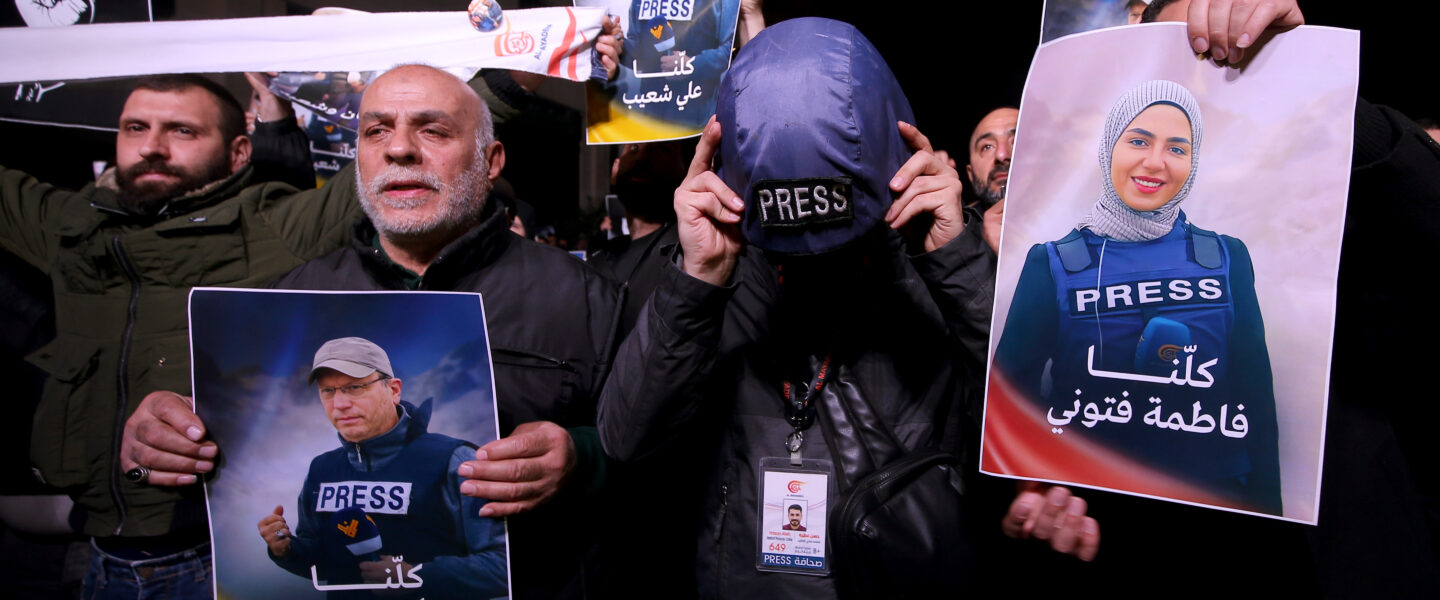
Israel claims that one of the three journalists it killed on Saturday was working for Hezbollah. Even if that turns out to be true, why did the other two riding in the same car have to die?
|
Listen To This Story
 |
Faced with criticism from Lebanon’s leaders and advocacy groups following its targeted killing of three journalists this weekend, Israel’s military on Sunday offered a few more details about the alleged association of reporter Ali Shoeib with the terrorist organization Hezbollah.
“[Shoeib] was officially recruited as a member of Hezbollah’s military wing in 2020, but in practice had been cooperating with the terrorist organization since 2013,” stated Lieutenant Colonel Nadav Shoshani, the international spokesperson of the Israel Defense Forces (IDF). “His role in the intelligence unit was to film intelligence information and transfer it to the Radwan Force, all under the guise of a journalist.”
Shoshani added that, by exposing the locations of IDF troops to Hezbollah, Shoeib “posed a tangible threat” to the Israeli forces occupying southern Lebanon.
However, even if the allegations are true — and the IDF has not offered evidence so far to back up its claims — that doesn’t explain why Israel chose to take out Shoeib, who worked for the Hezbollah-affiliated news outlet Al Manar TV, when he was traveling with two other journalists.
Reporter Fatima Ftouni and her brother, cameraman Mohammed Ftouni, who covered the war for the news channel Al Mayadeen and have not been accused of wrongdoing, also died in the strike.
In other words, the IDF wants people to believe that the only way it could take out Shoeib, who it claims was a known member of Hezbollah for six years (and affiliated with the terrorist organization for more than a decade), in a town bordering a warzone that Israel controls, was to kill two journalists in the process.
That doesn’t seem credible, which is why it is hardly surprising that the condemnation of the attack was swift.
Lebanese President Joseph Aoun called the strike “a blatant crime that violates all the norms and treaties under which journalists enjoy international protection in wars,” and the country’s Information Minister Paul Morcos said it amounted to a “war crime.”
In addition, what the IDF accuses Shoeib of doing, i.e., “exposing the locations of troops” and “filming intelligence information” is also often known as “reporting.”
Pointing out that Lebanon has been an “increasingly deadly zone for journalists,” the Committee to Protect Journalists (CPJ) said it is investigating the attack, which follows a familiar scheme.
“We have seen a disturbing pattern in this war and in the decades prior of Israel accusing journalists of being active combatants and terrorists without providing credible evidence,” said CPJ Regional Director Sara Qudah. “Journalists are not legitimate targets, regardless of the outlet they work for.”
Unfortunately, that has not been true in many warzones, especially those involving Israel.
RELATED: Committee to Protect Journalists Blasts Israel Over Killing of Reporter
More than 200 journalists and media workers, most of them Palestinians, have been killed in Israel and in the territories it has occupied since it invaded Gaza following the October 7, 2023 Hamas terrorist attack. This means that more journalists have died there than in the rest of the world combined, and that covering Israel’s military campaigns is currently the most dangerous assignment for any reporter.