Control of the Strait of Hormuz Puts Iran in the Driver’s Seat
Iran’s ability to control the strait shows the Islamic Republic’s skill in waging asymmetric warfare and exploiting Trump’s political and economic vulnerabilities, despite US and Israeli military superiority.
|
Listen To This Story
 |
President Donald Trump would be well advised to learn the lessons of the last time the United States sought to protect Gulf shipping by escorting oil tankers in the region’s waters.
In 1987, the United States escorted Kuwaiti vessels that the Gulf state had reflagged with the US Stars and Stripes to allow the US Navy to legally protect them during the Tanker War, a facet of the Iran-Iraq war in which both sides attacked shipping.
I stood on the bridge of the USS Fox, a destroyer, accompanying the first reflagged vessel, the MV Bridgeton, one of the world’s largest tankers, which hit an underwater Iranian sea mine some 135 nautical miles north of the Strait of Hormuz.
The explosion breached the outer hull of the Bridgeton and forward cargo tanks, spilling oily residue into the water. No one aboard the Bridgeton was hurt.
The incident handed Iran a significant public relations victory on a silver platter.
More importantly, it demonstrated that naval escorts provide at best limited protection unless the protecting power controls the waterway.
It also showed that warships are potentially more vulnerable than the vessels they are protecting.
The 413,000-deadweight-ton Bridgeton steamed under its own power to Dubai for repairs.
Had the 8,000-ton Fox, rather than the Bridgeton, hit the mine, it would have likely suffered severe damage and potentially seen members of its crew killed or injured.
The incident and the course of the current Iran war illustrate the pitfalls of any US attempt to wrest control of the strategic Strait of Hormuz from Iran.
Moreover, Iran’s ability to control the strait shows the Islamic Republic’s skill in waging asymmetric warfare and exploiting Trump’s political and economic vulnerabilities, despite US and Israeli military superiority.
For all practical purposes, Iran’s assertion of control has put the Islamic Republic in the war’s driver’s seat.
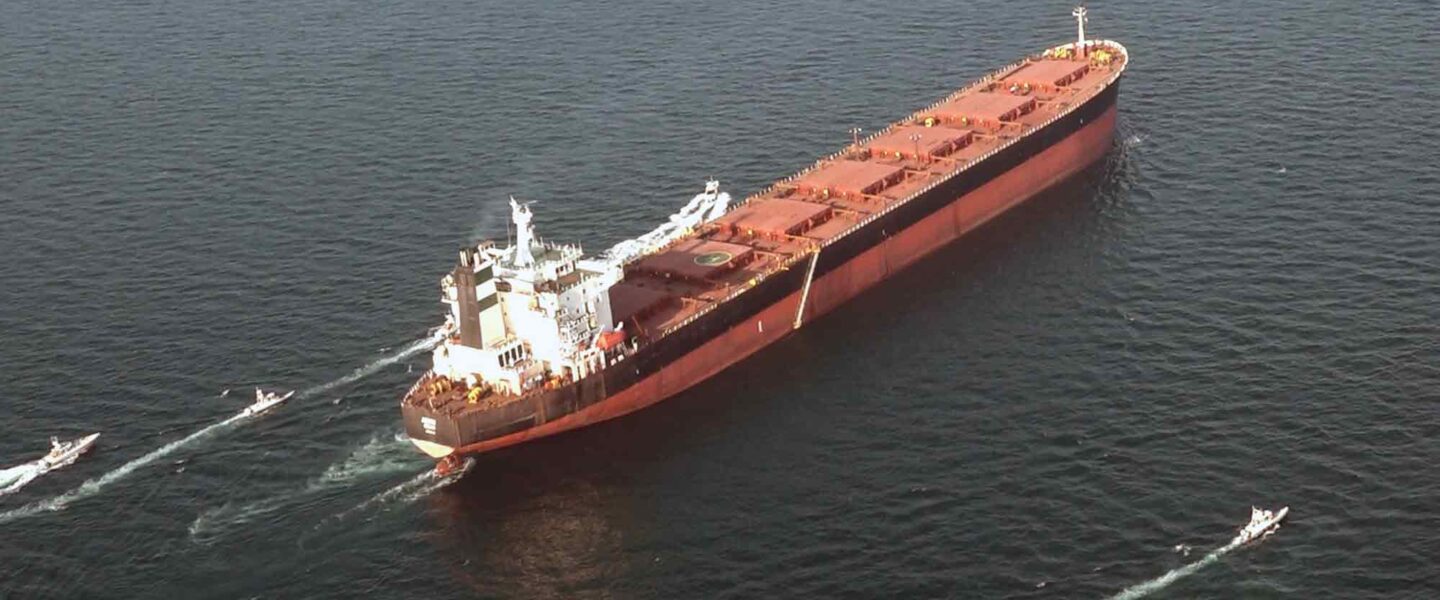
Iranian threats are enough to send insurance premiums skyrocketing and persuade shippers to avoid the Strait of Hormuz.
In addition, all Iran needs to reinforce its threats is one small speedboat to lay mines in the waterway or to fire a low-cost missile or drone at a ship transiting the strait.
Moreover, protecting hundreds of tankers would involve a significant diversion of military resources with no guarantee that it would secure shipping.
In other words, even if Trump unilaterally declared an end to the war, Iran could maintain control of the Strait of Hormuz.
A letter sent by Saudi Arabia’s oil giant, Saudi Aramco, advising oil buyers that it had yet to decide whether it would export oil in April from its Red Sea or Gulf ports said as much.
“I might as well call Iran to find out when this war ends so I can get my oil,” one regular Saudi oil buyer told Reuters national security reporter Phil Stewart in response to the letter.
Iran sees a Bloomberg analysis of the economic fallout of the war on global markets and the Gulf States as validation of its strategy, which aims not only to ensure regime survival but also to entrench Iran’s ability to shape the Gulf’s security arrangements, particularly in the Strait of Hormuz.
Iran believes that the economic fallout demonstrates that no postwar regional security framework will work without the Islamic Republic’s acquiescence, if not participation.
Iran is also convinced that the war will force Gulf States to reassess their relationship with the United States, the US military presence in the region, and potentially their overt and covert relations with Israel.
For Gulf States, “the biggest question is not merely who will win, or even what victory will look like, it’s what kind of regional order will emerge when the fighting stops,” said journalist Faisal Al Yafai.
“Every plausible outcome to the conflict — whether Iran emerges weakened but intact or faces internal disorder for a long time to come or undergoes a more dramatic metamorphosis — will leave the (Gulf) monarchies confronting a new set of strategic dilemmas,” Al Yafai added.
Bloomberg estimated that continued Iranian control over which ships can transit the Strait of Hormuz could see Qatar and Kuwait’s GDP contract by up to 14 percent, while Saudi Arabia and the United Arab Emirates could face declines of up to 5 percent.
By exerting control over the Strait of Hormuz, Iran has made a credible unilateral Trump declaration of victory impossible.
In fact, it may have trapped the US into the kind of protracted war with boots on the ground that Trump has long disavowed.
A US military effort to wrest control of the strait from Iran would likely suck the United States deeper into the war and narrow Trump’s ability to declare victory and withdraw US forces unilaterally.
To retain control of the strait without a change of regime in Tehran would have to entail US occupation of Iran’s coastline along the Strait of Hormuz and/or strategic islands at its mouth, such as Abu Musa and the Tunbs.
Alternatively, Trump could opt for occupying Kharg Island, Iran’s foremost oil export terminal, in a bid to further strangle Iran’s economy.
The US Navy has ordered the USS Tripoli, an amphibious assault ship, and some 2,500 Marines from the 31st Marine Expeditionary Unit, to sail from the Indo-Pacific to the Gulf for possible deployment aimed at regaining control of the Strait of Hormuz.
Iran’s toppled shah occupied Abu Musa, the Greater Tunb, and the Lesser Tunb, claimed by the United Arab Emirates in 1971.
Trump’s problem is that if he is contemplating seizing Iranian-held islands or territory, the expeditionary force needs two weeks to reach Gulf waters.
Trump highlighted his dilemma by calling on China, France, Japan, South Korea, and Britain to help enforce free passage through the Strait of Hormuz. The president has, so far, found no takers.
White House spokeswoman Karoline Leavitt sought to put a positive spin on Trump’s contradictory statements about when and how the war would end, insisting that “the president is dug in to ensure the objectives of Operation Epic Fury are fully achieved.”
Leavitt’s remark suggests Trump may have boxed himself into a corner with no obvious escape route.
James M. Dorsey, an associate editor of WhoWhatWhy, is an adjunct senior fellow at Nanyang Technological University’s S. Rajaratnam School of International Studies and the author of the syndicated column and podcast, The Turbulent World with James M. Dorsey.