Poem: ‘An Old Man Alone Among the Crags at Night’
Quester, cad, or both? Reimagining an epic hero who could not rest from travel.
|
Listen To This Story
 |
It little profits that an idle king,
By this still hearth, among these barren crags,
Match’d with an aged wife, I mete and dole
Unequal laws unto a savage race,
That hoard, and sleep, and feed, and know not me.
Alfred, Lord Tennyson — “Ulysses”
Tennyson’s “Ulysses” — the full text of which is linked here — was, in its time, read as a celebration of indomitable will and the eternal quest. This reading was reinforced by the poet’s own assertion that the poem expressed his need for “going forward” again after the tragic and untimely death of his closest of friends, and fellow young poet, Arthur Henry Hallam.
The year of composition was 1833 and Tennyson, born in 1809, was a young man imagining an old one. But there is no law that young poets cannot grapple with the challenges of aging and mortality, and certainly Tennyson’s illustrious predecessors — from Wordsworth and Coleridge through Keats and Shelley — had done so.
Four years before the queen’s coronation, the poem seems to exalt certain values of the coming Victorian Age — manly courage, for example — while more or less mocking others, such as the marriage vows.
Readers and critics gradually began to pick up on the tensions that made “Ulysses” something far greater, and more interesting, than a mere paean to indomitability.
In Tennyson’s poem, Ulysses — the name in Latin of Odysseus, Greek hero of the great Homeric epic The Odyssey — looks back on his life in the three years since he had returned home after fighting in the Trojan War and then pinballing his way back across the Mediterranean to his island kingdom of Ithaca. There, his devoted spouse, Penelope, had fought a war of her own — staying true to him by weaving and unweaving her father-in-law’s burial shroud, among other stratagems, to keep a flock of eager suitors at bay.
And how does Ulysses honor Penelope’s 20 years of epic sacrifice? By writing her off in half a disdainful line: “Match’d with an aged wife” — which can’t but suggest a certain stock hankering after a younger one. And then he all but spits on his dutiful son. Not for him these domestic balls and chains, impediments to all that striving and seeking and finding!
Modern critics see Tennyson’s hero as both a quester and something of a cad — a rationalizer who betrays little self-awareness in making his “heroic” case. Some come down harder than others, but few follow the Victorian majority in unqualified celebration of Ulysses’s new life plan.
In today’s categorical psychobabble, Ulysses would no doubt be extolled as a prototype of the “high agency” individual, boldly writing his own ticket. But isn’t a man who tells us he “cannot rest from travel” in fact rather low agency, having no choice but to be on the move?
I’ve always — from first exposure in my early teen years — read the poem in the modern, call it skeptical, way. I could hear Paul Simon cynically advising Ulysses to just “Slip out the back, Jack.” And I could imagine Tennyson’s contemporaries — the political philosopher John Stuart Mill, and the president Abraham Lincoln — suggesting to the bored king that he might want to try meting and doling some less unequal laws as his “work of noble note.” A good therapist would no doubt second that suggestion.
But, having done my own share of “roaming with a hungry heart,” neither do I render pat judgment on Ulysses’s moment of truth. I am haunted by these lyrics from the Leonard Cohen song “Bird on the Wire”:
I saw a beggar leaning on his wooden crutch
He said to me, “You must not ask for so much”
And a pretty woman leaning in her darkened door
She cried to me, “Hey, why not ask for more?”
Talk about putting your finger on the beating heart of perhaps the deepest source of human disquiet!
Homer’s main epithet for Odysseus was “wily.” He was, after all, the one who came up with the idea for the Trojan Horse. In Tennyson’s poem, the only one the wily Ulysses needs to fool is himself.
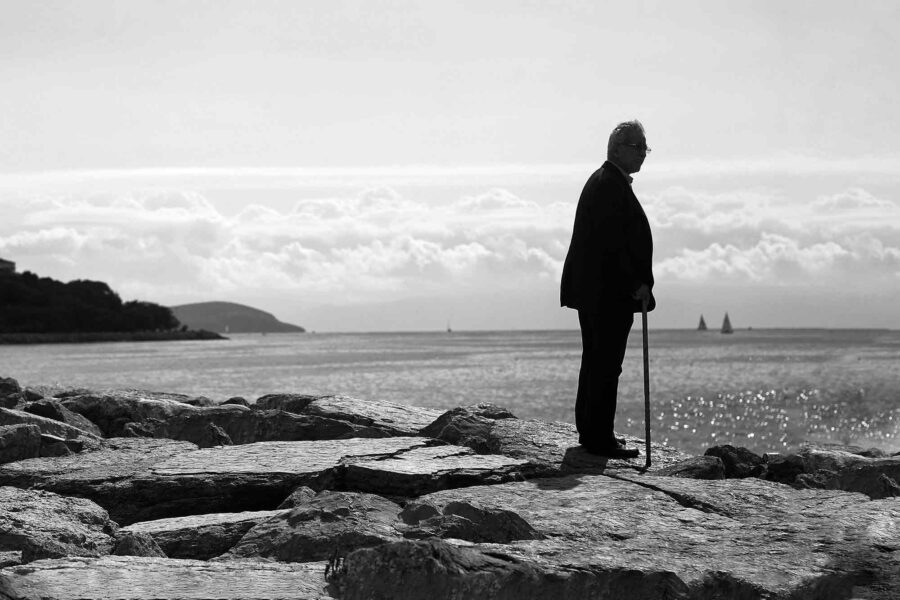
Fifty-odd years after first reading the poem, and now finally finding myself in Ulysses’s stage of life, I began wondering: What might a Ulysses who stayed — to live out his days with his “aged wife” and “savage race” — have to say to us? This poem sprang from that question.
An Old Man Alone Among the Crags at Night
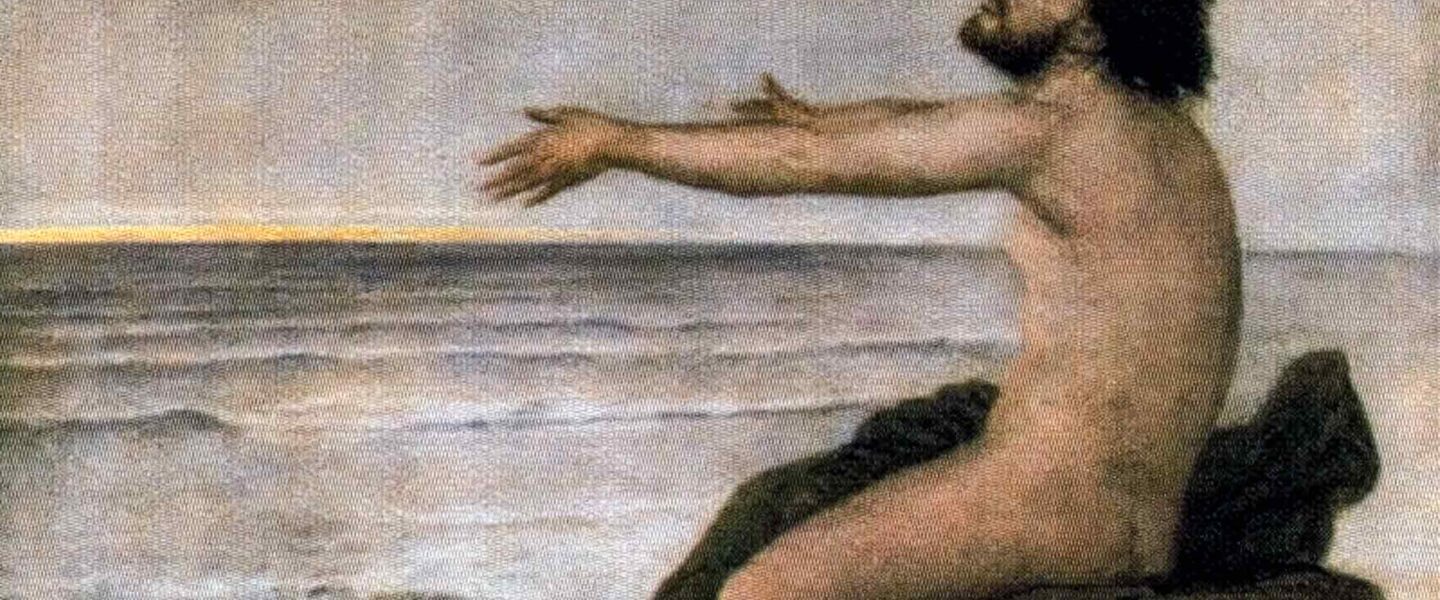
By night betimes I slip down to the shore,
And kneeling there alone gaze out to sea,
No bars define this cell, no lock, no door —
The only king who holds me here is me.
I stood here once among these crags, and thought
My aged wife and ordinary son
Were scant reward for all my battles fought,
The schemes, scrapes, loves, the honors won.
There gleamed the arch, I spied it through the gloom,
Where sea and sky were joined in coming night,
As one who wakes at sunrise in his tomb
And through a crack beholds the golden light.
I had but call my men and set a course,
Beyond the sunset and the stars — to move,
To strive, to seek, to find, to touch the source,
An old man oaring rimless seas for love.
I mused upon the profit and the loss —
Calypso’s scent, the Sirens and the mast,
Penelope, whose lips had lost their gloss —
And something in that musing held me fast.
Call it duty, then, devotion, call it home,
But must I live a slave to this desire —
Centrifugal, and fated thus to roam,
As though to breathe were only to aspire?
To seek a newer world merely to find
I’d brought the old one with me in my ship,
Always, always thus to be entwined,
And never, never give myself the slip?
I stayed. My mariners went back to bed.
Let the poet leave my wife, pursue the gleam,
While I attend to matters here instead —
And lend my name to his undying dream.
Yet still I slip down to this starlit shore
Betwixt the land and ocean. Here I stand —
The voices of the deep moan “more” and “more” —
I hear and grip on tighter to the sand.
(2026)