All That Matters
My exclusive focus until the dust settles on the midterm elections.
|
Listen To This Story
 |
As we have become immersed deeper and deeper in the vat of Trump 2.0 — his mighty second swing at national, if not global, ruination — I have struggled more and more with the task of writing about it.
If a writer’s brain can be imagined to pump out words and thoughts and observations the way the heart pumps blood, you might say I’ve been experiencing the journalistic equivalent of cardiac tamponade.
In this affliction, often caused by such traumas as getting stabbed or shot in the chest, the pericardial sac in which the heart resides fills up with blood such that the heart itself can no longer beat.
In my journalistic case, the “blood” that’s filled the sac is everything that others have written about Donald Trump and the state we’re in — a flood whose inky waters keep on rising.
Just as Trump is not normal, neither is what is being written about him, whether in scale or tone.
If you’re reading this, chances are you’ve read a good deal of that — the fury, the venom, the undisguised, vituperative assignment of this pestilential president to the eighth circle of hell.
From the near-trivial to the momentous. From the symbolic to the catastrophic. From tearing down a sculpture to tearing down a 250-year-old democracy. Every day, by the hour, by the minute, my inbox overflows with fresh hells: warnings, lamentations, castigations, forehead-slapping amazement, exhortations.
Triage in the Before Times
One of my favorite activities — perhaps for the modest sense it gave me of control, of at least negative agency — used to be going through my inbox with my cursor on the “trash can,” deleting without opening not only all the products being shoved at me, but also all the appeals for money from candidates and PACs and do-good (or -bad) organizations, and also all the “crises” that didn’t strike me as rising to the level of making a big enough difference.
Or things I couldn’t do anything about: Somalia, Sudan, Gaza, the manatees. Local stuff somewhere else, or even right here in my backyard.
With this “algorithm,” I could, in a matter of a minute — morning, noon, and night — trim my box by 90 percent (at least), tell all those voices clamoring for my attention to STFU and go away (very empowering in a grim, pathetic, Information Age kind of way).
My ruthless culling left me with just the really important stuff: the events and developments that, taken together, might tell me whether my country and the things I believed in were going to survive.
Then, this year, something new.
Even the most salient and justifiably urgent appeals for my attention began overflowing.
Analysis of serious things — an idiotic war; the purging and politicizing of the military; the crusade against renewable energy; the despoiling of our national parks; the militarization of our nation’s capital; coddling of and corrupt alignment with dictators; trade wars with most of our allies, including Canada(!); ICE thugs, having found their quieter groove after several ill-advised murders, ramping up detainments and deportations to ethnic cleansing–adjacent levels; DOJ vengeance against political enemies; threats against the press; and of course the never-ending lies…
Not to mention two full weeks of Natalie Harp.
Every single hour of every single day — in my newsfeed; in my print editions of The Week, the Sunday New York Times, The New Yorker; and by the hundreds in my inbox. Reporting, analysis, opinion — much of it first-rate and illuminating.
But how much illumination does this sordid picture really need?
And when does the light become blinding, such that one reflexively shuts one’s eyes?
Journalism has belatedly responded to the pathogen that is Trump and Trumpism with a vigor that, in a body, would pose the danger of anaphylactic shock.
And figuratively, but almost literally, I’m choking on it.
I doubt that I’m alone in my Renée Zellweger “you had me at Fuck Trump” response. Or, to quote a famous line of Hemingway’s, “Would you please please please please please please please stop talking?”
How About You?
But I’m curious about how you see it. Let’s try a show of hands.
Please raise your hand:
- If you entertain even the slightest doubt about the character of Donald Trump or the nature of his regime.
- If you dispute that the president is, to borrow a typically demure phrase from the Times, “prioritizing his own interests over the national interest.”
- If you believe that, given any decision or set of options, any victory or defeat, anything anyone else says or does, Trump will respond in a way remotely compatible with your own values system.
- If you entertain even the slightest possibility that, between today and Election Day on November 3, he will act or speak in such a way as to engender any inclination whatsoever in your mind to support and vote for any Republican candidate.
With apologies to anyone whose hand I may have missed (please feel free, if I missed you, to let me know at jonathan.simon@whowhatwhy.org), I’ll take it to be unanimous. We’ve all taken his savage, bloated measure in full.
What I Won’t Be Writing About
My point is that Donald Trump is a lock to say and do a shitload of awful, evil, lying, self-serving, corrupt, deranged, and dangerous things over the next two months. Every last befouling action or statement will generate volleys of commentary, criticism, analysis, and outrage. What you don’t come across in the legacy media, you can encounter over on Substack, or by taking a dip in the social media swamp.
But how much will any of it matter?
How much will it move your needle — or the needles of anyone you are likely to converse with or influence, out to several degrees of separation?
There’s been a good deal of internal debate in the journalistic community — including here at WhoWhatWhy — over our obligations in this regard. Our duty to inform, to shine light into these dark places, so that he doesn’t get away with anything.
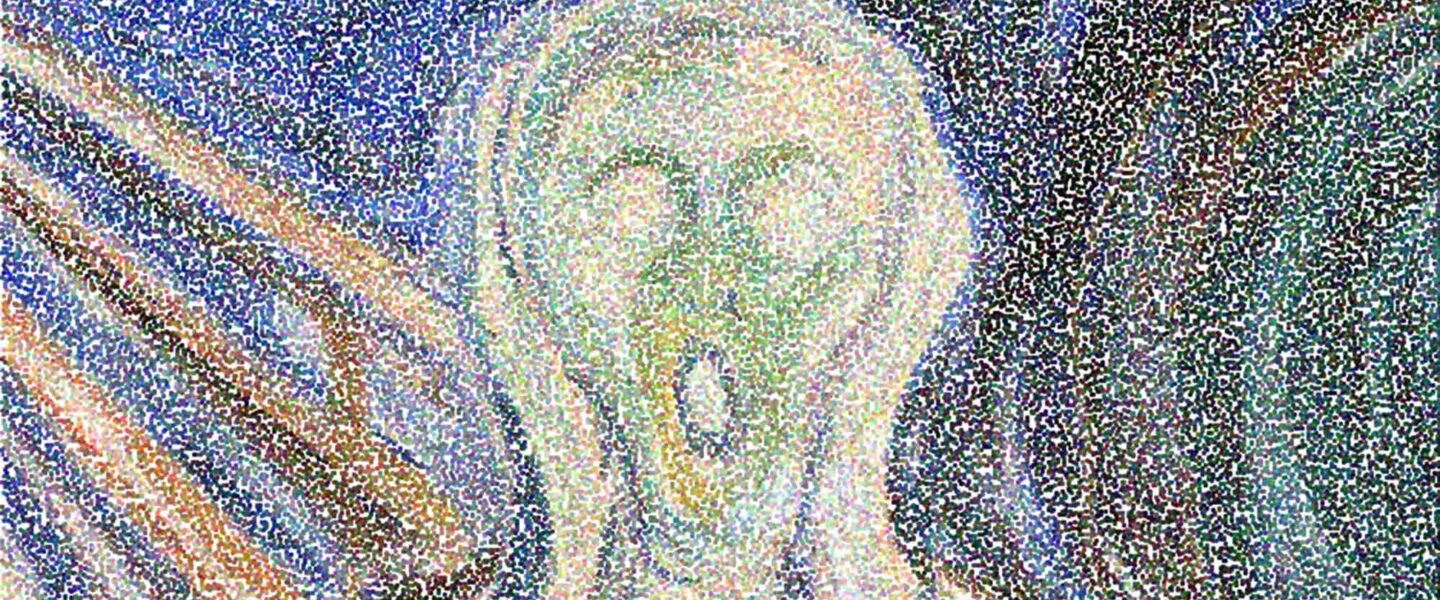
I understand. But what comes of adding yet another dot to our pointillist version of The Scream? Or dissecting the latest turd we sniff out in this sprawling sewage treatment plant?
It’s not like anything will be missed! Leaving aside the long, hard, hazardous work of a select band of intrepid investigative reporters, there is hardly a dark place not instantly illumined in a blaze of coverage and commentary — ranging from straight news to vituperous polemic to rollicking satire — the very torrent that every single day inundates my inbox and saturates my journalistic pericardium.
You know where to find it. It’s often enraging, sometimes comforting, reminding us that we’re not crazy and not alone. I’m glad it’s there and will be part of the historical record.
But, for the foreseeable future — up to the election and during its very likely fraught aftermath — that won’t be my beat.
And What I Will Be Writing About
The midterm election and the schemes to rig and steal it will be my beat.
One more show of hands. Please raise your hand:
- If you are confident that the upcoming election will be free and fair, unaffected by one or more tactics engaged in or promoted by Trump to selectively suppress opposing voters, rig the counting process itself, and/or nullify adverse results.
I hope your fists stayed clenched in your pockets on this one, as mine did. Because we are in the midst of an all-out assault upon voting and the electoral process, the principal theater of Donald Trump’s war on democracy — and on us.
It’s increasingly out in the open. Trump doesn’t care, because the die has been cast, the Rubicon crossed.
It’s been almost exactly a year since I penned a column here under the headline “As His Popularity Tanks, Donald Trump Turns to Power.” We are now watching the endgame of that terrible shift play out.
As Trump’s approval plumbs ever more dismal lows, his reliance on power plays is coming into ever-sharper focus: his court-defying USPS-fangled attack on mail-in ballots, federalized voter lists that can disenfranchise millions of citizens, armed ICE agents at the polls, ballot and equipment seizures, election administrators intimidated and strong-armed, a purged military amenable to following unconstitutional orders to snuff out our protests if push comes to shove.
Related: Voters Should Prepare for These Midterms Like No Other Election
These weapons, as history will attest, are how authoritarians survive once their cover is blown, once their support craters beyond recovery.
Of all Trump’s many options for keeping Congress under his control, I am most wary of the most covert one: vote-count manipulation, which, uncomfortable as it is, will be the subject of my next column.
As for all the overt schemes, some will come to full or partial fruition, some will be partially or fully blocked by the courts or states or public defiance, and some may function as misdirection, drawing media and public attention away from where the real action is.
My guidance for the next two months comes down to four recommendations:
- Save your attention and your energies for what really matters: the shooting war over how this election is conducted, both nationally and where you vote; and how to cast a vote with the best chance of being counted honestly and accurately.
- That doesn’t mean ignoring the rest of the news, but it does mean not letting the B-roll of Trump’s daily outrages exhaust or distract you, such that you lose focus and do less than you otherwise could to protect not just your vote but the rights of all voters.
- Direct and apportion your financial support for candidates, parties, or organizations with great care, based on an informed understanding of where it will be most efficacious (I will be providing and updating information on competitiveness and significance of individual contests, as well as overviews of the evolving national map, to help inform such decisions).
- Be prepared for a rough ride, very different from prior elections, with the partial exception of 2020. Trump’s back is to the wall, and there is no indication that he can accept defeat, even at a remove.
As one of the Apollo 13 astronauts put it, it will be “like trying to drive a toaster through a car wash.” So buckle up! We’ll be taking this ride together.