New Jersey Consortium Seen as Model for Reviving Local Journalism
A consolidated and corporatized media ecosystem has given rise to a growing number of “news deserts.” One state has taken the lead in funding oases.
|
Listen To This Story
 |
More than half the homes in east Omaha, Nebraska have unsafe lead levels.
Police use violent dogs to target people of color.
A Memphis nonprofit hospital, millions of dollars in the black, relentlessly hounding poor patients over unpaid bills.
What do all three of these stories have in common?
They were all broken not by networks or national chains, but by local news outlets — the Flatwater Free Press, the Indianapolis Star (in partnership with other media outlets), and MLK50: Justice Through Journalism, respectively.
As more local newspapers fold and communities designated as “news deserts” increase, depriving residents of access to local news coverage, the costs extend beyond the number of journalists laid off. Those costs include:
- A recent study found that lenders to local governments in news deserts generally ask for higher interest rates because those entities are not being monitored by a watchdog press. The study estimated that those local governments get charged an extra $1.1 billion in borrowing costs. In turn, those costs are passed on to the taxpayers in the form of higher taxes or service cuts.
- Another recent study found a direct connection between lack of access to local news and corruption by public officials. The disappearance of a newspaper led to a 6.9 percent increase in corruption (bribery, embezzlement, fraud) charges in federal court against public officials. It also led to a significant increase in the number of indicted defendants and overall number of corruption cases filed in federal courts.
- Still another study linked the closure of local newspapers directly to an increase in white-collar crime.
A 2019 WhoWhatWhy feature — “Can Local Newspapers Make a Comeback?” — having examined the problem of news deserts, reported on a new law passed in New Jersey establishing the Civic Information Consortium. Revisiting this story almost six years later, WhoWhatWhy finds not only that this program is living up to its potential, but that its success is encouraging other states to introduce similar legislation in efforts to increase access to local news coverage.
The New Jersey Civic Information Consortium (NJCIC) is a state-funded nonprofit that partners with several state universities to address the local news crisis. It is, through the award of project grants, dedicated to supporting quality local journalism, media startups, and other efforts dedicated to informing people.
“One statistic is that there’s 5.1 journalists for every 100,000 residents in New Jersey. That’s like the lowest number in the United States,” Lisa Sahulka, NJCIC’s executive director, told WhoWhatWhy. She added that the consortium specifically funds areas that are not only underserved by local news outlets, but are also low income or BIPOC (Black, Indigenous, and people of color).
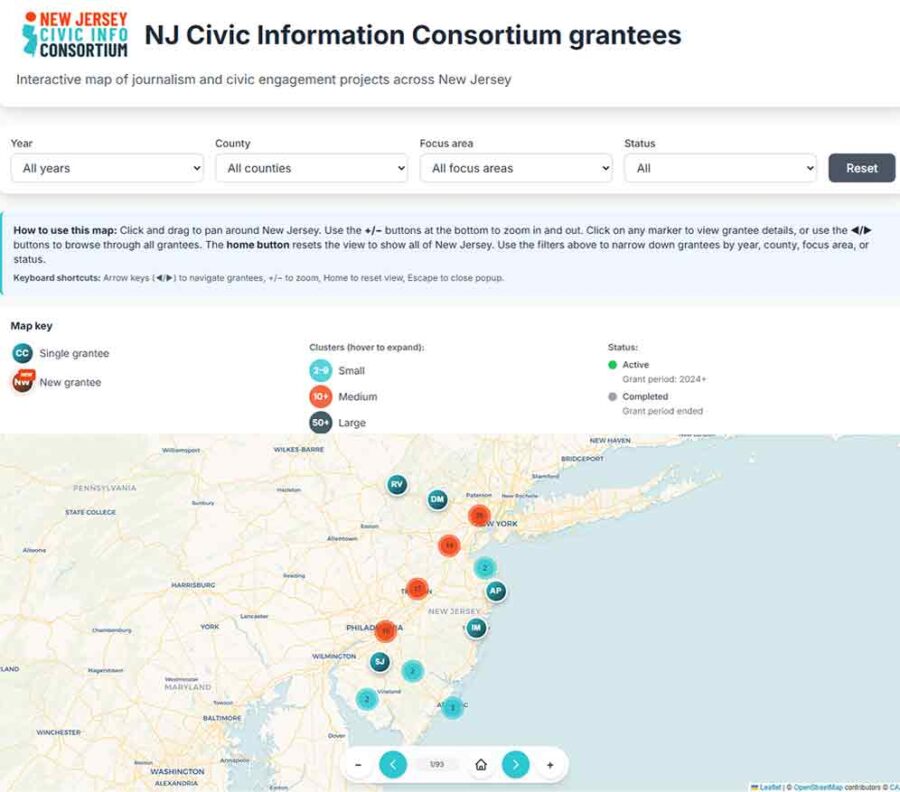
NJCIC’s Record to Date
NJCIC’s website lists their accomplishments via statistics over the years since the organization started awarding grants in 2021: $13.5 million invested in civic information across the state; 17,775 stories published; 5,900 BIPOC-focused news stories published; 1,601 community storytellers trained; 371 news-related jobs created; and 960 translated stories.
Supporters tout outstanding stories broken by local media outlets that were funded by NJCIC.
Janine Jackson — a program director at Fairness & Accuracy in Reporting (FAIR), a progressive media watchdog — highlighted one particular case study. She noted that NJCIC gave a grant to the media outlet Chalkbeat Newark. The funding enabled the nonprofit to break a story about the racial harassment of Newark high school students. The teachers union subsequently filed a lawsuit requesting the release of an internal report on the matter done by the school district.
While the issue has not yet been resolved, Jackson felt the impact of Chalkbeat’s reporting was unmistakable.
“This is what the students were saying they were concerned about and the support from the consortium buoyed them up to do more of this, and that ended up getting them more visibility from the public school system and eventually the teachers union,” Jackson told WhoWhatWhy. “It supported them to push forward the idea of racial harassment in Newark’s high schools to a level that it might not have been without the support of the consortium.”
Sahulka outlined how an NJCIC grant also allowed local news media to shine a spotlight on problems in the Montclair School District. She details how this district was unable to locate $19 million. A local media outlet, which the consortium funded, heavily covered the story. “The level of attention that the issue has gotten has led the school system to finally hire a forensic auditor to look at the records,” she said.
Nor were these isolated examples.
“The NJCIC grant allows us to show up — often as the only news outlet covering Black and Latino communities in South Jersey,” said Clyde Hughes, founder of Front Runner New Jersey, a media organization dedicated to elevating the voices, stories, and achievements of South Jersey people of color.
Bottom-Up vs. Top-Down
One of the key factors that explains the NJCIC’s success so far, according to advocates, is its “bottom-up” approach. They note that listening to the needs of community groups is a major factor in how it conducts business. Jackson explained:
[NJCIC] didn’t start by saying, “Hey, we have an idea, what do you think of it?” They started it with years of listening … to different communities in New Jersey, and asking them, “What do you think you need? What sorts of information do you need to engage people civically, to get people encouraged about participating politically and civically in your community?”
Others concurred with her viewpoint. “It’s very important that we reflect the needs of the community,” said Sahulka.
One measure of how successful this bottom-up approach has been, and how strongly grassroots groups were invested in NJCIC, came this year. When Gov. Mikie Sherrill (D) initially zeroed out the funding for the consortium, a wide range of labor, citizen, and community groups successfully lobbied to have the funding partially restored.
Does State Funding Equal State Control?
Many critics of the program believe the potential strings that come with state funding could compromise the independence of media organizations that receive its grants. “Government shouldn’t fund any media. It’s not a proper use of tax dollars. Taxpayers shouldn’t be forced to fund viewpoints they abhor. Any media’s funding source obviously distorts its coverage,” argues one columnist for Reason magazine.
Supporters, however, point to explicit language in the original legislation prohibiting editorial interference, as well as language in the individual grant contracts that does the same. “If [NJCIC] is a handmaiden of the state, how come every New Jersey governor comes forward and tries to zero out the funding for this consortium?” asked Jackson.
Will Other States Follow New Jersey’s Lead?
Still another measure of the program’s success is the number of other states that are considering legislation similar to the NJCIC law.
In February of this year, a Pennsylvania House committee passed a bill setting up the Pennsylvania Civic Information Consortium, modeled directly after New Jersey’s. Legislation has been introduced in Wisconsin setting up a grant program to support local journalism, also modeled directly after New Jersey’s. State lawmakers in Oregon, California, and Massachusetts are pushing similar bills.
Advocates see this legislation’s impact in much broader terms than just filling the local news vacuum. Sahulka asserted:
It’s important for people to understand the lack of local news impacts BIPOC and low-income communities at a far higher rate than it does other communities. It impacts everything from things like civic engagement and voting to understanding your community, being connected to your community, feelings of loneliness, all these things.
It’s a much broader issue than just a one-dimensional issue of reading the local news per se.
I definitely see this as an issue of protecting democracy. That is why I am so committed to what I am doing.