Teacher(s) of the Year: During Metro Surge, Educators Became Crisis Managers
Middle schoolers in Minneapolis during Operation Metro Surge were old enough to realize what was happening around them but too young to do anything about it. Many of their teachers stepped up to support them.
|
Listen To This Story
 |
This is the third article in a four-part series investigating the impact of Operation Metro Surge on Minnesota schools and students. You can find Part 1 here, Part 2 here, and the final installment here tomorrow.
At the height of Operation Metro Surge, the photo of a scared little boy with a bunny beanie and a Spider-Man backpack raced around the world and became a symbol for the inhumanity of the Trump administration’s anti-immigrant policies. The child’s name was Liam Conejo Ramos, and according to witnesses, agents tried to use him as bait to lure his mother from their home.
The five-year-old had been detained on his way home from Valley View Elementary School in Columbia Heights, MN, where he attended preschool. Together with his father, he was then flown to a detention center in Texas, where they were held for 10 days before a judge ordered them to be released.
While the case of little Liam might have been the one that attracted the most global attention, he wasn’t the only child in the Minneapolis area who was seized.
In fact, his case wasn’t even all that unusual for the small Columbia Heights school district, in which at least six other kids were detained. And in nearby Columbia Academy, the school that Liam’s brother attended, ICE agents seized at least one parent of 16 students.
These detainments not only had a profound effect on the students of the school but also spurred their teachers into action — even before Liam was snatched off the street.
The Columbia Academy faculty sensed that something was off at the beginning of 2026 when a lot of their Latino students — who were known for their high attendance rates — did not return to school after winter break.
“For Latinos, we don’t miss school,” Cara Hunn, a middle-grade Spanish teacher at Columbia Academy, said. “You have to be dead and dying to miss school because it is like, ‘You’re at school, this is important.’ This is just a cultural norm.”
Charlotte, a teacher at Columbia Academy who spoke to WhoWhatWhy under the condition that her identity would be protected, explained that when the school and its students became an ICE target, she and her colleagues began taking on new roles.
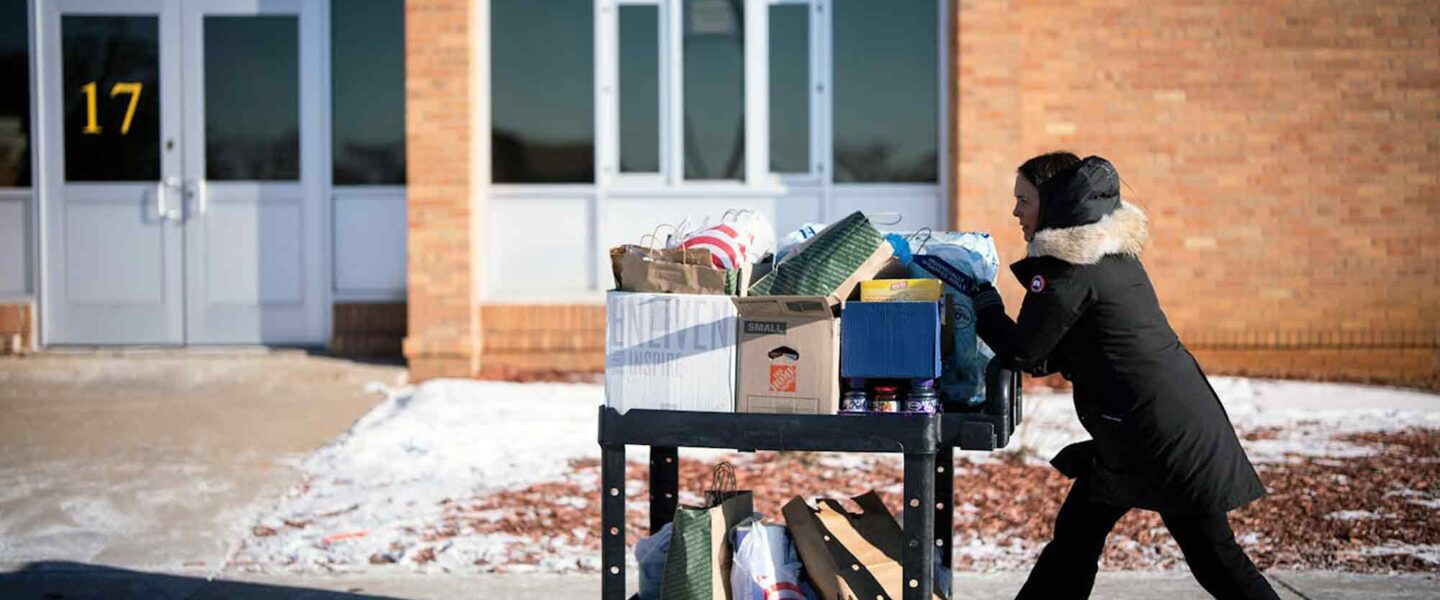
“Not only are we now their mentors, their teachers,” she said. “We’re also doing food delivery every Tuesday and Thursday after school. We are walking kids to and from home. We are riding along [with] people who are driving kids. To be an extra [set] of eyes.”
Hunn and Charlotte described their busy days during Operation Metro Surge as “GoPro days” — days so full, the teachers wished their loved ones could watch every moment as though through their eyes.
Hunn recalls a nonteaching workday in February when she found herself simultaneously emailing the local food service Land O’Lakes and talking on the phone with a nearby halal food cart in order to meet the requests of families in hiding. In the afternoon, the superintendent messaged her about someone at risk of deportation to Guatemala. Hunn, who used to live there, worked urgently to get in touch with contacts in Guatemala who could provide a safe ride, in case the person was deported.
Then, at the end of the day, Hunn still had to prepare for her classes the next morning.
According to Katie Lingras, a psychologist and associate professor at the University of Minnesota, it is extremely important for children in crisis to see people like Hunn, Charlotte, and other adult community members working hard to keep them safe. When students don’t know how to process traumatic events, Lingras said, echoing Fred Rogers, it is comforting to look for the “adult helpers” in their lives who are making a positive difference.
Supporting their students in this way became one more crucial role that many teachers described taking on as they helped children learn about and process Operation Metro Surge in real time.
Students Make Sense of ICE in the Classroom
On February 12, the Trump administration announced the end of Operation Metro Surge. In Charlotte’s media literacy class a few days later, the teacher recalled, a 12-year-old was making a silly joke, but suddenly became serious and said, “Huh, so, like, is there a reason why no one’s talking about ICE anymore even though [so many kids] haven’t come back to school?”
That’s when she realized that, even if it was not always apparent, her students were learning important lessons from watching history unfold around them.
According to Hunn, many of her in-person students were just as affected as those children who chose to stay home. She described an instance in early March when one of her in-person students lamented that she hadn’t heard a lot of people speaking Spanish recently. Hunn interpreted this as her student’s way of bringing up her missing classmates and expressing her desire to talk about what had happened to them. She clearly missed a former sense of community.
Middle Schoolers Learning Fear — and Resistance — in Real Time
Teachers and school administrators interviewed for this series explained that current middle schoolers already faced some challenges with learning because they missed critical, in-person learning in early elementary school due to the pandemic.
Furthermore, children at this age vary widely in their maturity and understanding.
“You have kids [so young they] literally pee their pants and kids who understand historical issues in passing,” Hunn said.
Now, these children in Minneapolis were again living through unprecedented times.
At Columbia Academy, there were instances where ICE agents interfered with students both directly and indirectly. In one case, the Taco Bell across the street from the school was being raided by ICE agents, and teachers got an email to close their blinds so the kids wouldn’t see. But when all the teachers decided to go out and help Columbia Heights locals defend themselves during the raid, the eighth graders crowded around the windows and peeked through the blinds to find out what was going on.
“It was all hands on deck outside, and that was when students started to notice,” Hunn said. “They were, like, ‘Why are all the teachers out here?’ And these are eighth graders, so then a girl would be like, ‘Duh. Like, use your head!’ So they knew. But I think even for our students, they didn’t wanna name it. Because it’s a real tangible fear, so they would like to talk around it.”
One day during dismissal, ICE agents were waiting for the kids who lived in the trailer park adjacent to Columbia Academy. At that moment, teachers had to decide whether students should stay or go. Some middle schoolers stood frozen in fear; others didn’t care what was happening and kept on playing in the snow. The staff ended up having the kids come back inside the school, where teachers called their families. Parents were crying over the phone because they were worried about their kids but also about coming to pick them up.
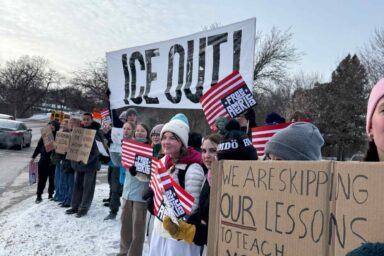
Despite their relatively young age, Hunn is certain that her students wished they could do something about what they were witnessing: When her class did their community action projects, every single student wanted to do a project involving ICE.
She also noted that one of her former middle schoolers, who is now a freshman, helped organize an ICE sit-in at her new high school.
The fact that she knows what a former student is up to highlights the continued importance trusted educators play in a crisis.
Having teachers such as Charlotte and Hunn available to discuss such things was crucial, according to Lingras. She explained that it’s important to let kids lead the conversation about their experiences during Operation Metro Surge and to be there when they are ready to talk.
“If we don’t open up that space, they’re gonna make their own stories about what’s going on and why,” she said.
In the final part of this series, we explore how Operation Metro Surge served as a teachable moment for students who learned about a government using force to get its way and the power of civic engagement.
This story was written by a member of our Mentor Apprentice Program (MAP). It gives aspiring journalists an opportunity to hone their craft while covering national and international news under the tutelage of seasoned reporters and editors. You can learn more about the MAP and how you can support our efforts to safeguard the future of journalism here.