Will Your State Bird Disappear?
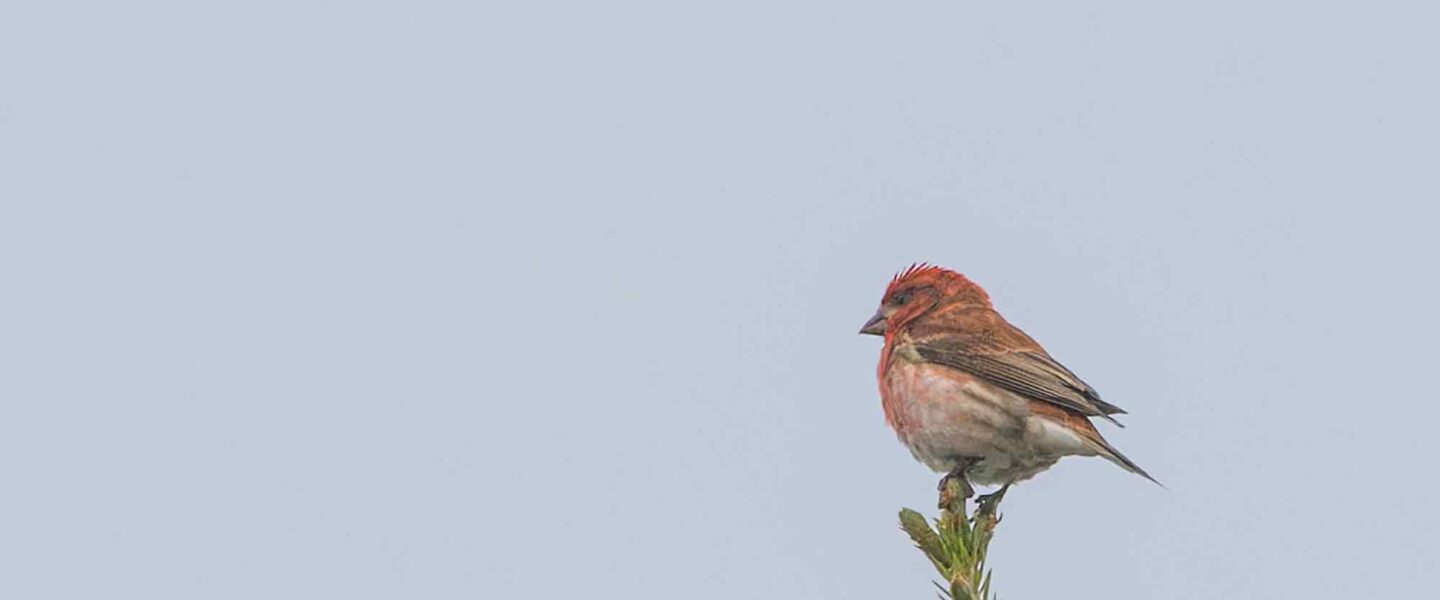
A new study shows that tens of millions of Americans could lose the chance to see their state bird due to climate change.
|
Listen To This Story
 |
If you’re a US resident, do you know the official “state bird” of where you grew up or currently live? If so, is it a bird you can easily see in your neighborhood? And if that changed, how would it affect your relationship with the place where you live?
Conservationists and wildlife biologists have been raising concerns for years about how wildlife species’ ranges will shift and contract due to climate change, but less consideration has been given to how that could damage humans’ relationships with the ecosystems we call home. A new study published in December examines this question through the lens of state birds and finds that tens of millions of Americans could lose the chance to experience their state birds in the decades to come.
The project got its start as lead author Abby Luna’s undergraduate honors thesis at Oregon State University. While searching for a topic, she connected with OSU faculty member Tyler McFadden, her mentor and coauthor, who was looking for students interested in bird research. “I was like, OK, birds sound cool,” says Luna.
McFadden’s original suggestion was to pick a single bird species and look at whether changes to its distribution driven by climate change would alter how many people in the United States were able to see it easily and whether that differed by race and ethnicity. However, the concept for the project expanded when Luna read a New York Times article describing eight official state birds who could vanish from their states entirely in the future.
Luna and McFadden decided to take that further and look at the entire country — well, most of it.
The resulting study examines how Americans’ likelihood of encountering their state birds in their neighborhoods is likely to change in 47 states. They didn’t include Delaware and Rhode Island because their state birds are domestic chicken breeds, and Hawaii didn’t make the cut because projections for bird range shifts in that state were not available.
Luna and McFadden drew from previous work projecting bird range changes under three climate change models: 1.5, 2, and 3 degrees Celsius (2.7, 3.6, and 5.4 degrees Fahrenheit) of warming. They overlaid this with census data to calculate the human population within each bird’s range now and how that’s likely to change in the future.
Some state birds — such as the cardinal and mockingbird, who together represent no fewer than 12 states — are easy-to-spot backyard birds across large swaths of the country. A few, such as Colorado’s lark bunting, require specific habitats that are often far from population centers.
Most states saw only minimal changes in access along race and ethnicity lines. But the total numbers tell a grimmer story.
Currently around 86 percent of the portion of the US population included in the study has access to their state bird. That drops to 79 percent with 1 degree of warming, 75 percent with 2 degrees of warming, and 71 percent with 3 degrees of warming.
Around 43 million people would lose the chance to easily see their state bird under the most extreme scenario.
If we hit 3 degrees of warming, of course, we’ll have much bigger problems to worry about. But lost access to state birds is one easy-to-grasp example of how climate change could eat away at people’s everyday opportunities to interact with nature, something that could have far-reaching implications for how we think about and care for the nonhuman world.
This is an example of what’s been called the “extinction of experience,” a term coined by naturalist Robert Michael Pyle in the 1970s. Luna and McFadden raise the possibility of a potential feedback cycle where people have fewer opportunities to engage with and appreciate nature in their immediate surroundings, leading them to care less about taking actions to preserve and protect nature, ultimately reducing their access to nature even further.
State birds are “a really good starting point” for thinking about this issue, according to the National Audubon Society’s Brooke Bateman, lead author of the study from which Luna and McFadden drew their data on projected bird range changes.
Some serious birdwatchers scoff at the concept of state birds, Bateman acknowledges, since so many of them are common backyard birds that might be considered “boring.” But “most people know what their state bird is, [and] that’s a great way to get people’s attention and have them thinking about the impact of climate change.”
Luna, who graduated from Oregon State University in 2024, is currently working seasonal wildlife-related jobs in preparation for pursuing a master’s degree. She hopes to continue studying birds and says that moving around the country for work and education has given her an even greater appreciation of how birds and nature can connect us to the places we call home.
“Sometimes I think you don’t notice it until you leave,” she says. But “if the whole species assemblage [where you live] is going to change under climate change, what does that mean for your sense of place, your identity in where you live and the nature that surrounds you?”
This story by Rebecca Heisman was originally published by The Revelator and is part of Covering Climate Now, a global journalism collaboration strengthening coverage of the climate story. WhoWhatWhy has been a partner in Covering Climate Now since its inception in 2019.