Alaska’s Wildfires Heat the Planet, but Canada’s Cool It
Using two decades of satellite data, researchers learned that wildfires in North America don’t follow the same script: In western Canada, snow reflectivity drives a cooling effect, whereas in Alaska, permafrost burning leads to net warming.
|
Listen To This Story
 |
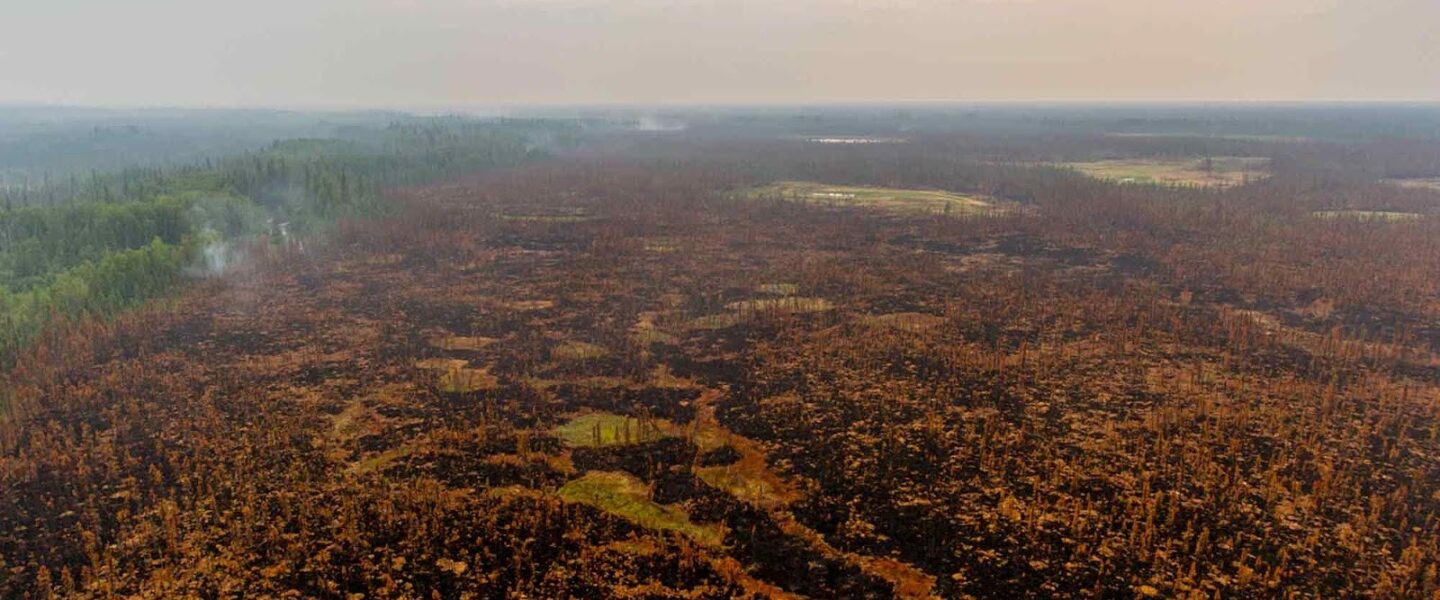
When it comes to wildfires, the story may seem straightforward: As forests burn, they release greenhouse gases like carbon dioxide, carbon monoxide, and methane that warm the planet. But in the far northern parts of North America, wildfires don’t always follow the same script.
In a new study published in Nature Geoscience, researchers found that forest fires in Alaska tend to have a warming effect on Earth’s atmosphere, but those in western Canada can contribute to net cooling.
“The most surprising aspect is that if you take away this permafrost component, fires in general in Alaska would switch” from a net warming to cooling effect.
Geography and permafrost help explain the discrepancy. When forest fires burn in Alaska, they not only burn the forest but also thaw permafrost. Both of these phenomena release carbon into the atmosphere. Northern Canada also has permafrost, and blazes there also burn trees and the soil layer that anchors them. However, as reported in an influential 2006 study, these fires are more likely to leave behind open spaces that can be blanketed by bright snow in winter. This brighter surface reflects more sunlight, triggering a net cooling effect.
“The most surprising aspect is that if you take away this permafrost component, fires in general in Alaska would switch” from a net warming to cooling effect, said Max J. van Gerrevink, a climate scientist at Vrije Universiteit Amsterdam in the Netherlands and lead author of the study.
Missing Permafrost
Van Gerrevink’s research builds on the landmark 2006 study, which provided an innovative approach to assessing the climate-warming potential of boreal wildfires but didn’t address a key contributing factor: carbon emissions from permafrost. This exclusion meant that while the 2006 finding held true for some boreal regions, it couldn’t be generalized across the board.
“We know that there’s more carbon released than was actually implemented in that study,” van Gerrevink said.
Van Gerrevink and his team tracked the satellite data of all wildfires in Alaska and western Canada from 2001 to 2019. They accounted for possible warming processes such as greenhouse gases released during a fire and permafrost thawing after a fire. They also considered possible cooling processes, including snow-covered landscapes or atmospheric aerosols reflecting sunlight and forest regrowth absorbing carbon dioxide.
“We also trained models, first on historical climate data making the models quite robust and then substituting climate data with future projections,” van Gerrevink added.
They found that even a small number of fires that burn intensely and thaw the carbon-rich permafrost can have a large warming effect. Importantly, as climate warms and snow cover declines, even fires that have a cooling effect may increasingly shift toward a warming in the future.
A 360-Degree View of Wildfires
“Every fire is really ecosystem dependent. When a fire burns, it’s going to burn differently depending on what the surrounding ecosystem structure is,” said Kimberley Miner, an Earth scientist at the NASA Jet Propulsion Laboratory who was not involved in the study. “What this study is pointing out is that’s true in the Arctic too.”
In the new paper, van Gerrevink and his coauthors found that “climate-warming fires occur preferentially in dry, high-elevation, steep permafrost landscapes,” while “climate-cooling fires are driven by longer spring snow exposure and occur more frequently in continental regions near the tree line.”
“I think the study motivates us to think of fires as being more complex than [just] good or bad.”
Dense permafrost layers in some areas of the Northern Hemisphere, Miner explained, mean “we have to think about fires in a really different way, in a much more complete, almost 360-degree way — not just what’s happening aboveground,” but below the surface too.
Christopher Williams, an Earth system scientist at Clark University in Worcester, MA, who also was not involved with the study, said its consideration of the relationship between permafrost and wildfire-related emissions could reshape the way scientists think about the ecological effects of fires.
“I think the study motivates us to think of fires as being more complex than [just] good or bad,” he said.
This story by Saugat Bolakhe was originally published by Eos Magazine and is part of Covering Climate Now, a global journalism collaboration strengthening coverage of the climate story. WhoWhatWhy has been a partner in Covering Climate Now since its inception in 2019.