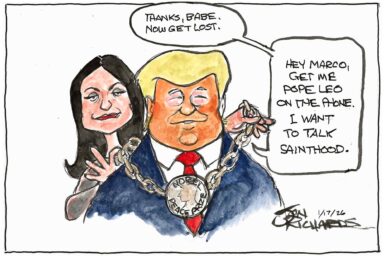
Donald Trump, Meet Marie Kondo
Our garage was piled high with the chronicles of the Trumpocene.
|
Listen To This Story
 |
“To truly cherish the things that are important to you, you must first discard those that have outlived their purpose.” — Marie Kondo
After many years of faithful service, our heat pump gave up the ghost in October and, though the Santa Cruz mountains of California are hardly the frozen tundra of Thule Ultima, we began waking up to indoor temps in the 40s. So we piled on some extra blankets and purchased a new unit — heat pumps are energy-efficient appliances that provide both heating and cooling — which was on back order and didn’t arrive for installation for several months.
That’s the backstory, or part of it. The other part is the clogged artery that is our garage, through which the new unit would have to pass to reach its final resting place in our very unfinished storeroom of a basement, itself reminiscent of an appendix on the verge of bursting.
We needed to carve a serpentine (straight, was out of the question) corridor through something approaching a landfill of stuff — a path wide enough for the massive appliance (if it had wheels you could drive it) to be moved.
If you know how a septic system works — a good idea for anyone living in the boonies — think of our garage as the tank and our basement as the leach field, and you’ll have the right idea about the flow of our effluence — itself the product of consumer culture and our own frequent lapses of judgment and discipline.
Unfortunately, you can’t just pump a garage like a septic tank. You kind of have to attack it — ruthlessly, but also thoughtfully, à la Marie Kondo, item by useless (or might it be useful?) item, box by box, relic by relic.
Which brings me to the subject of this obituary: our private hard-copy archive of the Trumpocene, documented in 1,000 pounds of print coverage dating from March 2016, when we moved in, through, well, last week.
I had read obsessively — even though most of what I read sickened me. News stories, opinion, dialogues, roundtables, focus groups, stats and charts. I had read less as a rubbernecker passing by a gruesome trainwreck than as a passenger on one of the trains — believing that the key to survival was to maintain consciousness by uninterrupted attention to the descriptions and accounts of the catastrophe.
Several hundred thousand pages detailing every aspect of the dark — and darkening — age through which we have lived and are still living.
I am no hoarder, but I began finding shelf space, and then floor space, for this collection from pretty much our first days of occupancy. I was moved by a premonition that it would somehow matter, that history was about to take one of those turns, sweeping us all before it.
Donald Trump was not yet elected when I arrived here from the East in 2016, but my background in election forensics had bestowed upon me an enduringly pessimistic view of American politics and its electoral outcomes. So I began collecting stories in the expectation that what was unthinkable to many would, in fact, transpire that November. And that Trump would be a fixture of our lives and our media for a long time to come.
At first, I saved mainly individual news articles and commentaries — stuff like “Chris Christie Endorses Donald Trump and Calls Marco Rubio ‘Desperate’”; “Barrage of Attack Ads Threatens to Undermine Donald Trump”; and “Donald Trump and Hillary Clinton Struggle to Be Unifying Voice for Nation” — virtually all quaint and grimly humorous in retrospect.
By November, however, Trump stories had waxed so ubiquitous that cutting out or copying individual articles no longer made sense, given staffing limitations in my Curation Department of One. So I started using those little colorful flag stickers and saving entire publications.
I chose the “Sunday Review” section from The New York Times (rechristened “Sunday Opinion” in 2022); The New Yorker; The Week (an excellent news and opinion aggregator that entered the Trump era determinedly nonpartisan and gradually morphed into a staunch defender of democracy against Trumpian assault); the Times Book Review; Harvard Magazine and The NYU Law Quarterly (I’m an alumnus of both institutions); the Southern Poverty Law Center periodical and reports; WIRED; Vanity Fair; and Psychology Today, which perhaps not surprisingly began to run columns tuned to the psychological challenges of living in the Trumpocene.
With some of the publications, like The Week and Sunday Opinion, I had read every issue cover to cover; with others I’d been more selective. But it is safe to say that I had read more than half of all the pages — and just about everything pertaining to Trump. On the order of 60,000 pages, millions upon millions of words.
I had read obsessively — even though most of what I read sickened me. News stories, opinion, dialogues, roundtables, focus groups, stats and charts. I had read less as a rubbernecker passing by a gruesome trainwreck than as a passenger on one of the trains — believing that the key to survival was to maintain consciousness by uninterrupted attention to the descriptions and accounts of the catastrophe.
But, in truth, Trump’s first term was of little consequence to my personal “life, liberty, and pursuit of happiness” — as they say. Lost a few tax deductions; noticed a few amenities axed at a national park. Most of his rhetoric, for all its cruelty and crudity, was not aimed at me or my ilk; and what was so aimed — the “own the libs” stuff — could be filed under “consider the source.” This prevailed as well through the Biden interregnum and Trump’s grotesque 2024 campaign.
Even his second term — dangerous, deranged, depraved — hasn’t “come for me,” in the Niemöllerian sense, yet. Just about all of Trump’s salvos hit other targets — people from other races and ethnicities, other walks of life. But an aggressive, untreated malignant tumor — whether it attacks the liver or bone or whatever — brings death to the whole body.
My nature — call it helplessly, and proudly, empathic — is such that I feel the evil no less than if it were aimed straight at me. And that includes the grave wounds to the principles and values that I live by and have held close and sacred. It’s now gone far past an abstract exercise in ideology.
Trump’s second-term onslaught has been as ferocious as it is demented. That heretofore rational men and women have continued to cling to him — and not just gone along for the ride but vigorously stoked the engine — has tested the limits of my faith in humanity and, indeed, of my own sanity.
I see Trump’s thugs and his MAGA cult ranged around him in Lord of the Flies choir war paint: The Beast has been sighted, the conch shattered; the chant’s growing louder; the hunt is up.
Nice try, humanity. Better luck next time, sanity. Those were my thoughts as I brought in 40 doubled paper grocery bags from the pantry and began filling them up pile by pile and stack by stack.
One morning, as I squeezed between the mounds and piles of faithful historical records in our garage, it was finally just too much.
Having begun repositioning piles and boxes and bookcases to clear a path through the Trump stacks for the soon-to-arrive heat pump, I stopped dead, took it all in, and actually said, “Out.”
All of it. No parsing, no curating, no selecting. Just, out. Ten years, hundreds of thousands of pages, millions of words, and god knows how much thought and insight. Investigations, interviews, analogies, comparisons, predictions, and warnings. Epiphanies, hand-wringings, polemics, reasoned analyses, blaring alarms.
Nice try, humanity. Better luck next time, sanity. Those were my thoughts as I brought in 40 doubled paper grocery bags from the pantry and began filling them up pile by pile and stack by stack.
I weighed one of the bags — 25 pounds — and did the math. Half a ton of uselessness — so I thought, in my rage. So much normalization, so much obtuseness, so much missing of the point. Take it all away, would the outcome, would this moment, be any worse?
Suddenly it didn’t seem to me like a decade worth preserving. We are where we are — and who really gives a damn how we got here, how the cancer grew and metastasized?
Trump wants Greenland — and may well invade it militarily because he didn’t get the Nobel Peace Prize, or maybe because he’s working for Putin, and has been from the start.
Trump wants the Insurrection Act so bad he can taste it — and it’s just a question of provoking enough resistance to gin up a plausible pretext for invoking it.
Trump wants dictatorial, and permanent, power — and that means rigging or nullifying or canceling the elections that might keep it from him.
That’s where we are. More people are beginning to wake up to this reality, this crisis. A few have even offered some grudging acknowledgement that we, the “alarmists,” were right: The fucking sky really was falling — it just took awhile to hit their heads. All this is good, if personally aggravating. It’s the grimmest told-you-so victory lap imaginable.
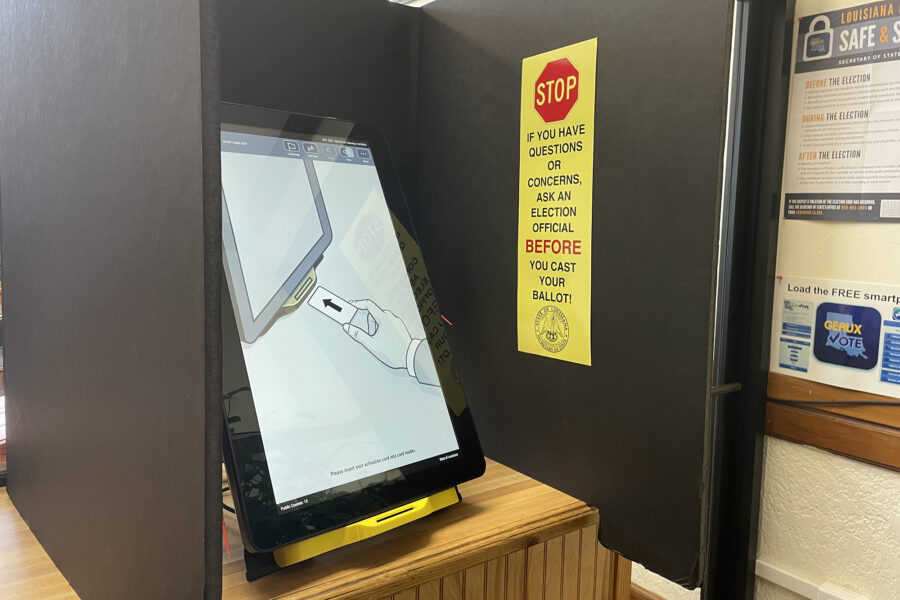
But all that presumes that Trump was legitimately elected, and on that score my doubts go back not just to 2016 but to 2002, when the Help America Vote Act (HAVA) set us on the course of faith-based computerized elections that culminated in 2024.
Proof of fraud — beyond garden-variety targeted voter suppression — is damn near impossible given the lack of access to hard data like computer memory cards, voter-marked ballots, and digital ballot images, as even Trump found out when he tried to challenge the 2020 results.
But I do have a whole file cabinet full of what you might call “receipts” — statistical anomalies and disparities ranging from the improbable to the virtually impossible; not merely recurrent, election after election, but unidirectional, virtually always favoring the right-wing candidate or proposition.
And, for good measure, often displaying what appears to be a “targeting” pattern, in which the magnitude of the “red shift” correlates with the degree of competitiveness of the contest.
I realize that that is a lot to take in, particularly for those who have remained confident that the kind of election shenanigans that we associate with “managed democracies” and tin-pot dictatorships could never happen here.
I don’t expect you to take it on faith. Still, I would hope you don’t simply dismiss it out of hand but prove sufficiently agnostic to probe further. I offer in this regard a book and a paper that pull together history, numbers, analysis, logic, and, for lack of a better term, the human element as they are bound up in our post-HAVA elections.
There is, of late, a flood of commentary to the effect that our midterm elections, existential as they are to Trump, are in serious danger of not being free and fair.
Observers have focused on Trump’s pressure on red states to hyper-gerrymander their congressional districts; on ratcheting up voter suppression laws and regulations wherever the GOP has control; on seeding federal agencies like the DOJ and state and local election administrations with Trump’s Stop the Steal zealots; on targeted intimidation of voters and election workers; and even on threats and musings about canceling the elections altogether.
Much less concern has been exhibited about the computerized counting process itself, but I would submit that it needs to take its place on this long list of potential weapons aimed at subversion of the electoral process and the democracy that depends on that process more than on any other.
I know we’ve come a long way from the heat pump — which was installed without a hitch — and the 40 bags of Trumpocene documentation that I drove off with that morning.
My point in “going there” on election theft — against the perennial sage advice of the marketing department — is that, for me, that whole decade of news and commentary clogging up our garage had a certain shimmer of unreality about it.
I had an abiding suspicion that the story it told was not entirely organic — that is, the product of the political rough and tumble, resulting in votes counted as cast, the public will (bless its little heart) more or less honestly translated into leadership and national direction.
Instead, two decades of diligent work suggested that there was a synthetic element — thumbs, possibly including digital thumbs, on the electoral scales — which had everything to do with the outcome, yet was almost entirely missing from the whole voluminous accounting I was, with some misgiving, bagging up.
As a sky-is-falling Trump alarmist since the beginning, I’m having my moment — bitter though it is.
As an evidence-based election forensics specialist and election integrity advocate, however, I’m not sure such a comparable moment of vindication on that score will ever come: either because I’m wrong and our wayward politics will be able to course-correct through free and fair elections after all, or because I’m right and our days as a democracy are numbered.
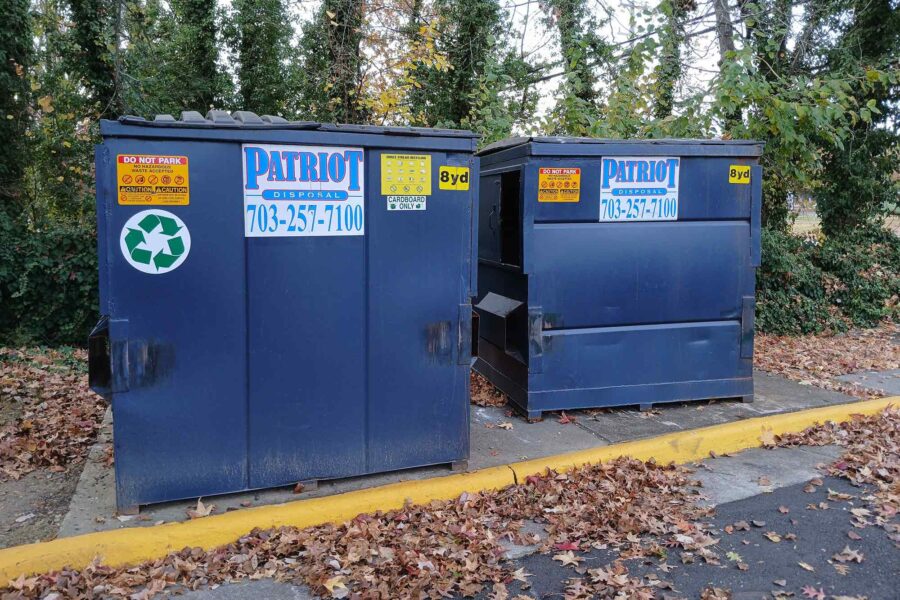
As for the 40 bags, like Trump himself, they took up too much space. And brought me no joy. They, and what they stood for, belonged in the big, blue recycling bin down at the town dump. I’ll just leave it there.