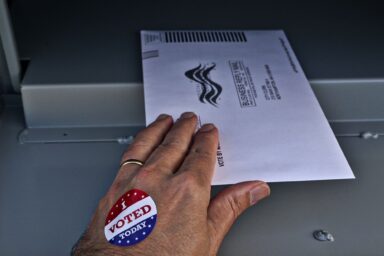
Mail-In Voting: SCOTUS Drops Another Elections Bomb
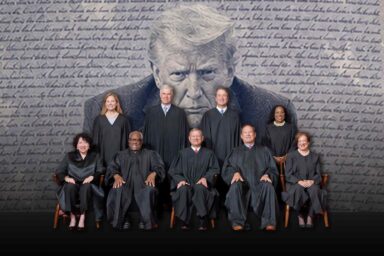
However Trump and his Supreme Court work together to make it more difficult and keep you from doing it, in this election voting is not optional.
|
Listen To This Story
 |
Yesterday, the US Supreme Court detonated an IED. Whether it turns out to be a squib or a nuke will unfold over the next couple of months, but there is no mistaking the “improvised” nature of the device, an emergency order allowing Donald Trump’s assault on mail-in voting to move forward again.
It’s complicated and procedural, but the all-too-familiar 6–3 unsigned ruling overturned a lower court’s stay on Trump’s March 31st executive order severely restricting mail-in voting, agreeing with Trump’s position that the challenge to that order by 23 states and the District of Columbia was not yet, in the legal term of art, “ripe.” (The high court also invoked lack of “standing” as a likely defect in the states’ suit.)
SCOTUS’s reasoning is that no federal rule or regulation had yet been drafted at the time of the federal government’s appeal to the high court. Which is interesting, given that the US Postal Service drafted just such a regulation late on Friday; it is due for formal publication this Wednesday; and its terms and mandates are there in black and white for the court to see. Concrete, impactful, ripe.
So the Trump-enabling SCOTUS majority is improvising, as it so often does on its shadow docket — that growing stack of cases neither fully briefed by the parties nor fully explained and referenced by the court — especially when it finds itself called upon to give Trump a needed boost in his battles with the Constitution.
Part of the complication resides in the fact that there are two separate cases addressing the mail-in ballot battle and today’s decision applies to only one of the two. The block issued by the same lower court in the other challenge remains in force and applies nationwide, though its scope is slightly narrower than the block SCOTUS overturned.
So there will be more litigation — lots more litigation — in a very tight window, while the Trump administration pulls out all the stops to make Trump’s order and the USPS’s new rules apply to this year’s midterms. And that very likely means chaos — for states, counties, election administrators, and voters alike — as a best-case scenario.
The President Picks His Voters?
Specifically, Trump’s March 31st order bars the USPS from mailing ballots to voters not included on lists of citizens drawn up by federal agencies, thus giving Trump’s minions effective control of which voters will be allowed to vote by mail. Serious repercussions lie in wait for any state or county that attempts to circumvent such restrictions.
Two observations are in order:
1) Conduct of elections is constitutionally vested primarily in the states, with Congress empowered to weigh in on certain aspects, while the president and the executive branch have little if any constitutionally vested power (this was by the design of Founders of a republic all too recently under a king’s thumb).
2) In the context of Trump’s virulent, multi-pronged attacks on the freeness and fairness of the electoral process, the arrow(s) aimed at mail-in voting cannot be understood as anything but attempts to alter process to gain a major outcome advantage.
The SCOTUS majority is, for now, silent on #1 but signals its disagreement on #2, writing, “President Trump issued an Executive Order designed to maintain public confidence in federal elections.”
To which a reasonable response might be “Yeah, right.” Or “Surely you jest.”
I strongly doubt that even the most Trump-besotted and MAGAfied of the six conservative justices believes for one split second that Trump’s goal is maintaining public confidence in federal elections.
But SCOTUS is not kidding; it’s improvising. I strongly doubt that even the most Trump-besotted and MAGAfied of the six conservative justices believes for one split second that Trump’s goal is maintaining public confidence in federal elections.
Presumably, if such were his goal, he wouldn’t have gutted the two federal agencies — CISA and the EAC — most responsible for protecting our country’s elections from interference and fraud.
Nor would he have spent the last six years undermining public confidence in our elections by ceaseless baseless caterwauling about the “theft” of his “sacred landslide” in 2020.
Nor would he be insisting that millions of non-citizens cast illegal votes, when no one — including GOP-controlled congressional committees, GOP state attorneys general, Trump’s own Kobach Commission, and the Heritage Society, to name just some — have uncovered more than a handful of such voters, most the result of misunderstanding or administrative error.
The SCOTUS majority sees this and knows this — whatever else they may be, those six justices are not idiots.
They know Trump’s goal is putting enough red thumbs on the electoral scales asap to get through the midterms with his wholly-owned party still in control and without the threat that his ever-bloating powers will be thwarted by congressional opposition.
And we might as well add — as it is of interest to the SCOTUS majority — that holding the Senate would allow Trump to shape both the lower courts and SCOTUS itself for yet another generation.
The majority also knows that, in Trump’s view at least, mail-in ballots pose a mortal danger to these happy outcomes. So it will be looking for ways to give Trump the power that the Framers of the Constitution wisely withheld.
The Key is Timing
There’s no straightforward way of doing so that would pass the jurisprudential smell test. But the SCOTUS majority has demonstrated great agility in procedural workarounds that get them where they want to go.
In this case, it certainly looks like the game involves timing.
The executive order has been kicking around for five months. But according to SCOTUS, no challenge to it can be ruled upon on the merits until federal agencies concretize Trump’s mandates into actual rules and regulations.
Tick tock.
The USPS just did this. But after the DOJ filed its appeal, so the court allowed DOJ to argue “not ripe” and win.
Tock tick.
The USPS and other federal agencies will now go ahead and prepare to implement Trump’s executive order — which, incidentally, also includes a requirement that ballots be mailed in trackable envelopes to “prevent fraud,” a recipe for logistical disaster in the two-month preelection time frame.
States and pro-democracy groups will pursue existing challenges and probably file new ones. The surviving injunction will come into play.
It will all wind its way back up to SCOTUS and back onto its shadow docket.
Hickory dickory dock.
Only, by that time, the USPS will be implementing its regulations, grounded in the almost certainly unconstitutional executive order, and we’ll be really close to the election.
This game of timing requires that an exquisite procedural pas de deux be danced by Team Trump and the SCOTUS majority. And that is what seems to be unfolding.
Too close — according to the very Purcell Principle SCOTUS has taken to ignoring when it would impede something like a last-minute GOP gerrymander — for the courts to get involved.
Ta dah! I’ll pause here for any constitutional scholars in the room to find a large bucket and use it.
This game of timing requires that an exquisite procedural pas de deux be danced by Team Trump and the SCOTUS majority. And that is what seems to be unfolding.
There should be no way that Trump’s attempt to give his own forces the power to decide who can vote by mail should succeed. And yet it’s very much alive and kicking, with yesterday’s SCOTUS ruling a signal to prepare for the worst: not necessarily a ruling that Trump’s scheme is constitutional, but rather a teary confession that Purcell has come back to life and, alas, the court’s hands are tied.
Related: Political Total War: The US and Virginia Supreme Courts Tilt the Electoral Table
What to Do if Trump Gets His Way
If it does go that way — if mail-in voting is made subject to Trump’s restrictions, such that targeted thousands or millions find themselves unable to vote by mail — then it is on us to vote in person. Everyone who is in any way able.
Whatever chaos does or does not ensue, our watchword cannot be “convenience” or “ease” or “too busy.”
We must — to beat back Trump’s all-in assault on democratic process, the Constitution, and the rule of law — work harder and do more than we’re accustomed to doing.
We must ensure we are legally registered, and we must check and recheck that status throughout the preelection period. We must find and be able to produce whatever identifications are required. And we must, if voting by mail is taken away as an option, arrange to vote in person, whether early or on Election Day.
Voting is a pure numbers game. Meaning that winning an election can come down to barring or discouraging even a small proportion of those who would vote against you from voting.
The country is polarized; competitive state and congressional district margins are tight. Trump and the GOP know they are in deep trouble; they cannot abide a free and fair election. They are working feverishly to get every red thumb on the scales they can — overt and quite possibly covert.
We’re not about to change what the SCOTUS majority does to make this election less free and less fair.
Trump’s cynical mid-decade redistricting has already shifted up to a dozen House seats in the GOP’s direction.
ICE may (or may not) turn up at the polls.
Tabulations may (or may not) be honest and accurate.
Emergencies may (or may not) be declared, the Insurrection Act invoked.
Yet, with all the unknowns, all the uncertainties, all the potential chaos, and every possible wrench a desperate Trump can throw, we know what we have to do.
I won’t hide the ball here. As I’ve observed before, Donald Trump has picked up election “integrity” like a loaded gun left lying on the kitchen table and used it with bad intent.
As a result, we’ve reached a place where American elections can be challenged (by Trump & Co.) without having been rigged, and rigged (by Trump & Co.) without being challenged.
That’s the direction in which all the data I’ve analyzed points — the warfare has been, and gives every indication of continuing to be, asymmetrical.
And it is — don’t kid yourself — warfare: a cold Civil War with elections the main theater of battle.
Voters are not generals or colonels. We’re not even foot soldiers. We don’t (yet) have to risk our lives. And yet it is on us that the outcome of this war will depend.
We have one primary mission, one bedrock responsibility.
We may — and should, if possible — do other things: offer money or support; communicate with and encourage others, however we best can do that; assist in or observe the conduct of an election.
But in this election, if we give half a damn about our country and our democracy, voting is not optional.