Living Next Door to the Predator
They’re booing “The Star-Spangled Banner” in Canada. What’s happening to our closest neighbor is a preview of what Trump does to both countries and companies.
They’re booing “The Star-Spangled Banner” in Toronto. At hockey games. In Canada.
Not because Canadians have suddenly turned anti-American, but because for the first time in 150 years, they’re genuinely afraid of us. And that fear, says Andrew Coyne, is reshaping everything — their politics, their economy, their identity, their future.
Coyne is a long time Canadian political observer and columnist for Toronto’s Globe and Mail, and our guest on this week’s WhoWhatWhy podcast.
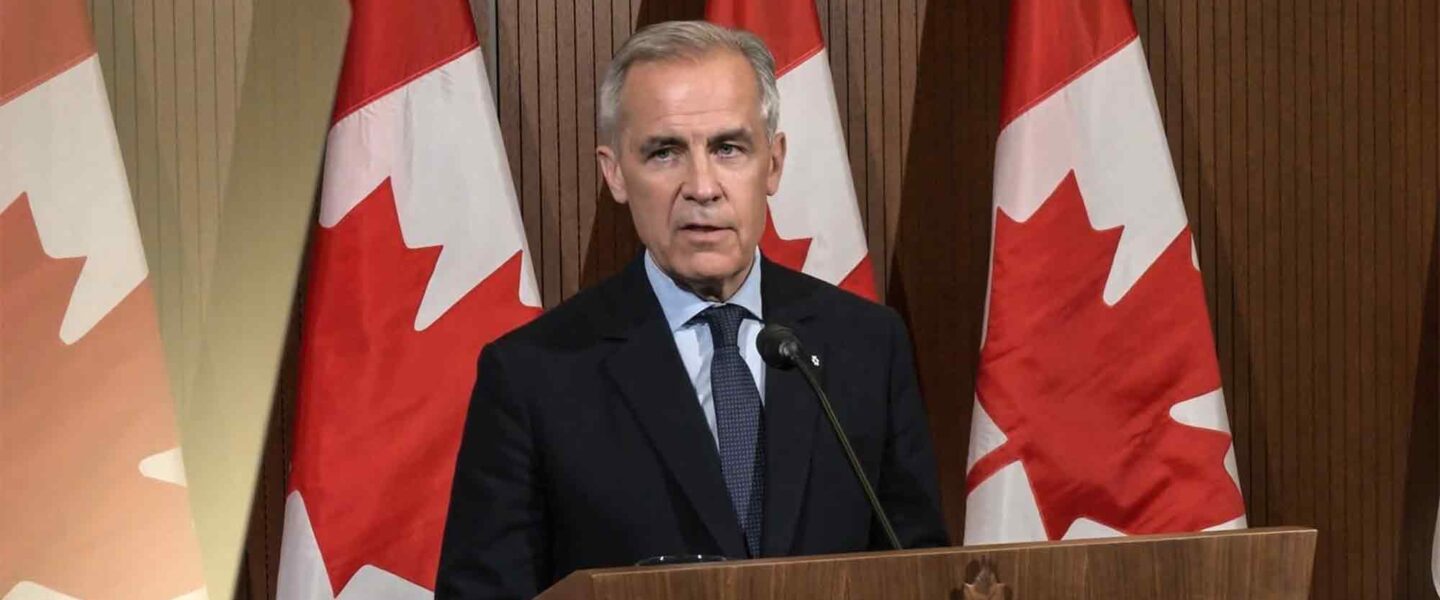
When Canadian Prime Minister Mark Carney stood at Davos and declared “the old order is not coming back,” Coyne heard something most people missed. Not a speech — a death notice.
The assumption that had anchored Canada’s international strategy for 150 years — a stable, democratic United States to the south — was gone.
What makes this shift so revealing, Coyne says, is that it displays the Trump playbook up close and in a language we understand. The battle now raging in Toronto boardrooms — between those who advise stay quiet, don’t provoke him, ride it out, and those who argue accommodation is just surrender with better manners — is the same fight playing out in every country and corporation Trump has in his sights.
Whether it’s corporate CEOs trying to adjust to Trump’s on-off, up-down tariffs or NATO allies trying to reconstitute the West’s key military alliance without its long-time American linch-pin, Canada happens to be the place where Trump’s destabilizing effect can be seen most clearly.
When the US president starts talking about making you the 51st state, cozying up to your separatist movements, turning economic integration into a weapon — there are no good options, Coyne says. And anyone who thinks there are is deluding themselves.
This isn’t just Canada’s crisis. But if you want to imagine what a post-Trump future for traditional Western democracies could look like, Canada might just be the place where solutions — if there are any — first appear.
 Apple Podcasts
 Google Podcasts
 RSS
RSS
Full Text Transcript:
(As a service to our readers, we provide transcripts with our podcasts. We try to ensure that these transcripts do not include errors. However, due to a constraint of resources, we are not always able to proofread them as closely as we would like and hope that you will excuse any errors that slipped through.)
[00:00:10] Jeff Schechtman: Welcome to the WhoWhatWhy podcast. I’m your host, Jeff Schechtman. For decades, the relationship between the United States and Canada was the ultimate geopolitical assumption. Steady, predictable, and rarely questioned. Disagreements came and went. Governments changed, but the rules held. The system worked, or at least it seemed to. Then Donald Trump came along. Tariffs replaced trust. Alliances became transactional. And for the first time in living memory, Canada had to seriously confront the possibility that proximity to American power wasn’t just an advantage, it was a liability. At Davos last month, Mark Coyne, the Prime Minister of Canada, put words to what many Canadians would rather not hear. The old order isn’t coming back. The rules that protected middle powers like Canada for 80 years are gone. What replaced them is something darker. A world where economic ties become weapons, and closeness to power turns into vulnerability. Coyne didn’t create this moment. He’s reacting to it. And in so doing, he’s helping force a reckoning inside Canada about sovereignty, security, trade, and identity. That’s now reshaping Canadian domestic politics. Few people have been more clear-eyed about that reckoning than my guest, Andrew Coyne. A longtime columnist for The Globe and Mail, Coyne has been writing about how Trump’s America has upended assumptions Canada once took for granted. And how that destruction is echoing through everything from election politics to national mood. Today, I’m joined by Andrew Coyne to talk about what Trump broke, what Canada is trying to adapt to, and whether this fracture in a relationship is a passing phase or the beginning of something permanent. It is my pleasure to welcome Andrew Coyne back to the WhoWhatWhy podcast. Andrew, thanks so much for joining us.
[00:02:10] Andrew Coyne: Pleasure to be with you. My goodness, that was a very good introduction. I don’t know if I can really add anything.
[00:02:15] Jeff Schechtman: Well, it’s a pleasure to have you here. First of all, talk a little bit in a general sense before we get into the politics of it on so many levels, about what the mood is, the public mood is in Canada today about Trump and about what has transpired in the unfurling of this relationship between the United States and Canada.
[00:02:37] Andrew Coyne: Well, it’s apprehensive, it’s baffled, it’s a bit angry, it’s wary, it’s worried, all those things. I mean, you could probably describe a lot of Americans that way these days for somewhat similar and somewhat different reasons. But as you mentioned in your introduction, you know, the absolute bedrock assumption of Canada from our founding in 1867, admittedly, in the aftermath of the US Civil War, was that we would always have a stable, united, democratic republic to ourselves. And that at the very least, we wouldn’t have to worry about you. You might, you know, might not pay enough attention to us for our liking, or you might occasionally throw your weight around, but you know, basically, it wouldn’t have to worry about you. And at best, you would also be our protector, you know, largely in your own self-interest, that you didn’t want any, if anybody’s attacking Canada, they’re probably on their way to the States. But that was certainly part of our assumption as well. So, all of our policies, not just foreign policy, not just defense policy, but economic policy, social policy, everything is basically, that’s the foundation on which it’s laid. It’s the reason why we’ve been able to bask in this belief that we had no natural predators, that with the three oceans on various sides of us, and the Americans to the south, you know, we just have this lovely, secure feeling, have had for 150 years that, you know, that we were just blessed beyond measure. And as you mentioned, again, the introduction, living next door on top of all that to the world’s largest consumer market that we could sell into, that spoke the same language as most of us, that had the similar legal system, similar customs, et cetera. All these things were just incomparable blessings. When people were grousing about the United States from time to time over the years, people would stop them and remind them and say, look, if you have to live next door to a superpower, which superpower would you rather live next door to? And all of a sudden, that’s actually an open question.
[00:04:57] Jeff Schechtman: And how is this playing out, not in terms of the public mood, which we’ve been talking about, but how is it playing out in terms of domestic politics in Canada? When Coyne made his speech in Davos, there was much talk about that it certainly had international ramifications, but that it was also playing to domestic political issues within Canada.
[00:05:19] Andrew Coyne: Yeah, I mean, it played well in Canada. He got a boost in the polls out of it. He caught the mood in the room at Davos, and that’s, I think, why it had such impact. But he also caught the mood to some extent, I think, in the country. The people are a bit at sixes and sevens because there is a lively debate going now, largely kicked off by that speech, but also pre-existing, which is, okay, we’ve got this trade agreement with the United States. It’s been the foundation of our prosperity for 40 years, going through various iterations, originally the Canada-US agreement, then the North American agreement, now whatever Trump called it, the US-Canada-Mexico agreement. So should we be putting all of our eggs in that basket? Should we be doing whatever we have to to get a deal now that we’re plunged into renegotiations of it at Trump’s insistence? Or is that, in fact, the trap and the snare, which was part of the point of Coyne’s speech, is when you are so heavily dependent on trade with a superpower, with a major power, particularly one that’s in kind of predatory mode, if you don’t mind my saying, is that such a great thing? Because that can be used against you. We’ve seen how the Russians have used Europe’s dependence on Russian oil and gas against it. We’ve seen how China has used trade as a weapon and investment as a weapon against various countries, including Canada. And we see how Trump is trying to use it, trying to monetize the relationship, as they say. And so, do we want to be that dependent on one country for 75 percent, or I think it’s down now to 70 percent of our exports? Until recently, I would have said, sure, that’s the natural and normal thing. They’re so close to us. It’s so much cheaper to trade there. You’re rowing against the tide if you try to diversify to other countries. The people have tried over the years in Canada. But that’s changed now. It’s worth suffering a bit of cost to try to diversify your trade, because there’s a national security implication to it. As long as we’re so beholden to a regime like Trump’s, then they’re going to use against us in ways that we’re not going to like. But one of the questions that raises is, who do you diversify with? And so, shortly before that speech in Davos, Coyne went to China and struck an agreement there, a very limited scope. It was just to deal with a couple of nagging irritants in the relationship, but it had huge symbolic significance. And some people in this country were, I think, rightly worried. How far does this go? We don’t want to get overly dependent on China either. I don’t think that agreement means we are, but it’s something you have to be thinking about, because China will use it against us as well.
[00:08:06] Jeff Schechtman: There’s also the aspect of that speech in Davos, that while it played well in the room, it played well internationally, some thought that it was overly provocative. Talk about that.
[00:08:18] Andrew Coyne: There’s a school of thought, particularly amongst large businesses in southern Ontario, that is very fearful and says, look, just don’t antagonize him. Don’t say anything that he’s not going to like. Let’s just get through this agreement. And I understand where that’s coming from. I think they’re deluding themselves. It’s a bit craven to begin with, but even if sometimes maybe you have to be craven, but then you’ve got to actually get a payoff for it. And what’s the payoff here? We renegotiated a deal we already have, a deal that we already made concessions to maintain, that was on top of the concessions we made to get the original deal. Every deal involves concessions, but okay, so we had a set of concessions to get the deal we have now. We make further concessions to renegotiate it, and you best believe that Trump’s going to come with all kinds of extravagant demands. And what do we get in return? Do we get any undertakings of any kind to begin with, or is Trump just in a mood to flex his muscles? And if he does make any concessions, how do we know he doesn’t just renege on them the next day? He’s done that with agreement after agreement. The South Koreans thought they had a trade agreement with him, and he slapped a 25% tariff on them because, you know, they weren’t being quick enough about it. So I think the people who are saying, you know, be very, very quiet, are deluding themselves. You’re selling out your soul, and you’re not getting anything in return for it.
[00:09:50] Jeff Schechtman: In many ways, Coyne identified the problems in the relationship, the problems in the global order right now, and the changes, the rupture that’s taking place, but really there were no concrete solutions. He didn’t really put forth anything with respect to what should be done about it. Talk about that.
[00:10:09] Andrew Coyne: Yeah, well, he proposed generally, which is that, first of all, what we should avoid doing, if we’re trying to avoid being sucked into the orbit of one great power or another and having it used against us, what we should avoid doing is going the other extreme and just putting up walls at the national level, just retreating into our own borders. That sacrifices all the gains from trade, makes us all poorer, all more fearful, etc. That’s point one. Point two is we shouldn’t be trying to play off against each other, trying to suck up to the great powers, hoping that if we’re nice to them, they’ll treat us better than the other guys. We’ve tried that. All the countries have tried that, and to our shame, and all it does is you just wind up getting played off against each other, and nobody’s better off. So we’ve got to work together, we’ve got to stand together to have any chance as the middle powers against any of these great powers. And one particular aspect of that that fits with the need to diversify our trade is to form trade alliances with each other and to buttress the ones that we have. And there’s a lot of that going on. So just as Trump has been slapping tariffs on people and basically teaching everyone not to trust any trade relationship with the Americans, you’re seeing a flurry now of large trade agreements being signed. The European Union signed a deal with the Mercosur group of South American countries. It completed an agreement with India that had been 20 years in the works. There’s a free trade deal between Europe and the Trans-Pacific Partnership of Asian, mostly Asian countries, that the United States was originally a part of and then Trump pulled out of. So the world is kind of firming up around America, trading around America, finding ways to get along without America, and that’s very much in keeping with what Coyne was talking about. But of course it leaves the question of where does Canada fit into that, where do countries like Canada that aren’t part of the European Union, for example. We’ve got to be very nimble in our trade diplomacy and make sure we’re a part of everything we can be. So that’s one part of it. I don’t think he said this out loud, but I think it also talks about, it suggests we’ve got to be thinking about different types of defense alliances. One of the reasons that the speech landed with such force was the Europeans in that same week had really come to the conclusion that they were done trying to appease or accommodate Trump, that all that that had got him was this craziness over Greenland, where we came perilously close, and the history books will tell us how close, to a shooting war between the United States and Europe. And certainly if it weren’t going to be that, it certainly was headed towards a massive economic war, which would have made everybody poorer. So coming out of that arrangement, that contretemps, I don’t think I’m the only one saying, NATO I think is now effectively dead. Trump more or less explicitly said, look, I’m not going to, the United States is not going to come to the aid of a European country that’s attacked by Russia. He’s basically reneging on the foundational purpose of NATO, the article embodied in Article 5 of the NATO Charter, that an attack on one is an attack on all. If that’s the case, if NATO is kind of limping along in name only, then you’re seeing in Europe, talking about a European army, you’re seeing people talking about an alliance of the democracies. So NATO minus the US, but plus Japan and Australia and some other of these democracies. So there’s all kinds of things in flux. Did Coyne map out all the details of this? No. And there will continue to be a collective action problem. You saw some like Keir Starmer in Britain and Christine Lagarde, the European Central Bank Chief, demurring a bit from what Coyne was mapping out. So there’ll be debates and people will be tempted to break ranks and cut a deal with the states. This is a classic collective action problem of getting everybody to do what is collectively in their interests, like a prisoner’s dilemma. But even if there might be the short-term temptation to try to get a special deal for any one country. So there’s a lot still that has to happen before the vision that Coyne mapped out is actually realized.
[00:14:49] Jeff Schechtman: Talk about that vision in the context of Coyne and who he is and what your sense is of what he hopes to accomplish, both for Canada and globally.
[00:14:59] Andrew Coyne: Yeah. Well, I mean, he’s in some ways uniquely placed. He has, we still call it a Rolodex, but he has every world leader. He’s probably met them several times in his previous capacities as the central bank governor of not one, but two countries, Canada and the United Kingdom. So it’s a pretty extraordinary resume. It’s very comfortable in those circles. So he’s, you know, would have been a habituary of Davos long before this. So he’s got some cache, some ability to try to move this conversation along. People will tend to listen to him. And the speech, again, I think had some impact because of who he is. I should add also, I think it had some impact because he’s got skin in the game. We are as a country, almost uniquely exposed to one particular great power with 70, 75% of our trade with the United States. So he wasn’t preaching anything to others that we weren’t going to have to face ourselves, that the risk that we’re taking as a country, even talking about this to go back to one of your previous questions is pretty profound. But I think he came to the conclusion that there was no alternative. So I think he’s looking at Canada’s strategic situation, realizing that Trump has changed everything, at least for the time being. And one of the open questions is how long is the time being? You get some voices in Canada saying, look, let’s not make any permanent or longstanding moves here in response to a president who might only be, constitutionally, should only be here for another two and a half years. And again, I think that’s short-sighted. A, because we really don’t know whether Trump will leave in 2028. And B, we don’t know what will follow. We don’t know whether a Republican successor would be just as crazy in my submission as he is, and J.D. Vance would fit that description. And even if the Republicans are driven from power, how much of that legacy remains, even under a Democratic president? How much of the sort of America first thing, maybe you rub off all the raw edges, but you keep some of the concerns. And do the Democrats stay in power long, or are they replaced by the Republicans? So I don’t think we can really assume that this is just a short-term phenomenon. So I think Coyne is certainly acting on the supposition that this is at least with us for the short to medium term. It changes our strategic calculus in all the ways that I mentioned. It changes it for the world at large. There is an opportunity for Canada to show some leadership here, but there’s also a real necessity, because we’re not automatically a part of things like the EU, then our strength has got to be statecraft. Our strength has got to be nimble diplomacy, where we make ourselves useful to other countries. Now, we’ve got a lot of things to do to accompany that. We’ve got to be a much more robust, have much more robust defense capacity. We’ve been one of the free riders in NATO. We were not bearing our share of the load. We were spending far below the NATO standard of 2% of GDP on defense. We’re now up to 2% thereabouts. We’re heading for 3.5%. But we’ve got to do things like that to show that we’re a responsible ally, and that so that people will want to listen to us beyond having a personal liking for Mark Coyne. They’ve also got to look at us and see us as a responsible ally that they need, because we’re going to need them, chances are. If we’re looking at our north, which is becoming more and more vulnerable with climate change, we’ve got to be able to establish that we control that territory, we can defend that territory if need be. We’re going to need, certainly in the short term, we’re going to need help if we’re going to do that. And if we’re going to need help, then we’ve got to be there for other countries that need help.
[00:19:04] Jeff Schechtman: Talk about the Canadian economy at the moment, how strong, how weak it is, and the degree to which, while this has always been true to a certain extent, the economy becomes so much more of a national security issue at the moment.
[00:19:18] Andrew Coyne: Yeah, well, it’s stronger than I think people thought it would be. I wouldn’t say it’s strong, but I think we thought the tariffs were going to do a lot more damage. But as with a lot of other things, because the tariffs were so uncertain, they were up on a Tuesday and down on a Wednesday and up again on a Thursday, and ultimately wound up not applying nearly as broadly as we’d feared, partly thanks to the existing trade agreement. So the uncertainty has certainly not helped, I think, its deterred investment. We already had very weak economic growth in a long-term sense. I don’t mean in terms of recession, but just our long-term growth rate has been declining for years. It’s been a rising source of concern in the country, for obvious reasons, particularly as we have an aging population, we need to pay for their health care and that kind of thing. But it’s become even more necessary to boost our economic growth rate in the face of these headwinds that we’re facing, periodic threats from the President of the United States, either to put tariffs on us or to annex us or to cause trouble for us. So strengthening your economy is the foundation of everything else. It’s the foundation of your ability to pay for defense. It’s the foundation of your ability to withstand economic threats. But we’re going to have to do a lot more. One of my sort of rules of thumb with Trump is he’s always going to get worse. We’re on a trajectory here. We’re on an exponential curve. And the things that he might think to do to try to impress his will upon us are wide-ranging. I don’t anticipate military invasion anytime soon, but kind of disruptive tactics with our economy or with our infrastructure, I think, are certainly not beyond him. And of course, hovering over all this is we’re facing the possibility, not the certainty, but the possibility of not one but two referendums on secession in this country, one in Alberta, one in Quebec, depending on events in those two provinces. And even if there are referendums, it doesn’t mean they’ll pass. But even if we get anywhere into that process, we’re already hearing, we’re seeing news reports now about Trump officials meeting with the Alberta separatist leaders. I can only imagine the kind of mischief that he and his officials might make with a referendum and with basically playing on our divisions and trying to make them worse. So that’s a huge concern that we’re now facing. We’ve faced secessionist crises in the past in the one province, but to have two at once with the president of the United States egging on at least one of them is a nightmare that I’m not sure we’ve really wrapped our minds around yet in this country.
[00:22:19] Jeff Schechtman: Explain to our American listeners what the Alberta secession effort is really about.
[00:22:24] Andrew Coyne: Well, that’s an interesting question. There’s a history of, first of all, Alberta is by far the wealthiest province in the country. It has this enormous reserves of oil and gas. It has a very strong economy, great entrepreneurial investor class. And as a result of that, if you have a lot of wealthy people, you’re going to tend to pay in more in taxes than you receive in benefits. That’s true of any part of any country that has a disproportionate number of wealthy people. So to some extent, some Albertans have converted that into a grievance that somehow Alberta is paying the load for the rest of the country, as if it were being treated unfairly as a province. For the most part, that’s untrue. There are legitimate grievances. The federal government in the 1980s brought in something called the National Energy Program that had many parts of it. The chief thing as far as Alberta was concerned is it suppressed oil prices below the world price. So it basically cheated Alberta out of getting the full value of its oil at that time. It was a huge, needless, divisive, economically illiterate policy that we’re still paying the price for because it helped to really entrench this idea that the federal government, particularly when the liberals are in power, is kind of out to get Alberta. There have been other things in the policies brought in to try to deal with climate change, to try to reduce our carbon emissions, some of which were not terribly well thought out and looked and felt discriminatory against Alberta. So that has certainly also contributed to it. So it’s mostly an economic basis, but there’s also an identity thing there. Some Albertans think of themselves as being more conservative than the rest of the country, more entrepreneurial. The rest of the country, as I say, is kind of riding on their backs. And that has an identity aspect to it. It’s not as strong or as profound as the identity questions surrounding Francophone Quebecers, French-speaking Quebecers, who feel quite, some of them feel quite apart. But I don’t want to overstate this in either case. Most Albertans by far want to remain part of Canada. Most Quebecers want to remain part of Canada. And as long as we don’t do something stupid, I think we’ll get through this. It’s slightly volatile in that when you’re dealing with questions of identity and respect, if people don’t feel like they’re being respected, public opinion can move in a hurry. So that’s the wild card, is you want to make sure that people don’t feel like the rest of Canada is looking down their noses at them or laughing at them.
[00:25:07] Jeff Schechtman: I want to come back to this idea that Coyne talked about in his Davos speech about the middle powers. Talk about how you see that.
[00:25:16] Andrew Coyne: Well, it’s been something that’s been on the plate for some time. There have been talks about the middle powers, and Canada is definitively a middle power. There have been talks about this over the decades, that the middle powers need to work together, that we cannot have, it used to be we cannot have the American empire dominating things, the Pax Americana. The trouble it ran into is the Pax Americana worked, for the most part. It wasn’t perfect. One of the sort of sub themes in Coyne’s speech is the rules-based international order that America oversaw was far from perfect. It’s certainly, if you’re looking at from the global south, there was a certain hypocrisy in that we were very keen on them opening their trade to us, we in the rich world, we weren’t quite as quick to open our markets to them. And similarly, when it came to international law, sometimes we weren’t as consistent as maybe we might have been in our application of the idea of non-intervention. Certainly, you know, the United States, in particular, had some episodes in the past where it intervened in countries’ internal affairs during the Cold War. Maybe you can make a case for it, but it left a bad taste in a lot of people’s mouths. So there was always a certain element of hypocrisy to it. But that being said, it certainly mostly worked for us, for the middle powers, for Canada and countries like us. We might be irritated by this or that high-handed move by the Americans, but we benefited from the Pax Americana. We benefited from the willingness of America to act as the reserve currency, to act as the defender of last resort, to keep the sea lanes open, etc. So, those efforts to try to organize some kind of middle power alliance usually came to naught in the past. And you get some people saying, well, you know, this is all talk, nothing’s going to come of it. I think the difference now is there isn’t a reliable, democratic, necessarily democratic, necessarily benevolent enforcer to backstop it. You know, if the United States has changed as fundamentally as some of us fear, then that changes the equation, or it ought to. And as I mentioned, there’ll still be this temptation to run back to Uncle Sam and hope to cut a deal. But I think the smarter middle power leaders understand that that’s not going to get them anywhere, that this time it really has to happen. And looking at the conversations in Europe now, again, talk’s cheap, so we’ll see whether it’s followed up, but it’s of a different character than I’ve heard from them ever before, both in their willingness to spend more on their own defense, again, like Canada, and in the types of talk that’s going on about a more genuinely federal Europe with a common borrowing authority, for example, people are talking about, with a common defense policy, with a strengthened executive. This is the sort of shock and crisis that can sometimes break down barriers and make things possible that weren’t possible before.
[00:28:36] Jeff Schechtman: I agree with you that there’s absolutely the sense that the Europeans are finally having this wake-up call that they are going to do these things. What about Canada? Is there a sense that it really is going to change in response to this, or is there a more public sentiment to, as bad as it may be at the moment, to kind of ride it out?
[00:28:58] Andrew Coyne: There’s a bit of both. That’s one of the things that’s now in contention. So, as I say, the big business is more in the ride it out frame of mind, I think, short-sightedly. Small business, I think, gets it a bit more, that they need to look further afield and diversify their sources. But the people who are really plugged into the existing order of things are a little less willing to let go. But I think the general public, again, this is part of what’s going to be decided in the next few years in our politics. But there’s a reason why the liberals were able to eke out that election victory last time when everyone thought they were dead. And it was partly because Justin Trudeau had left, and he was part of the things that was holding the party down. And it was partly because people weren’t terribly keen on Pierre Pallièvre, the conservative leader. And it was partly because Mark Coyne came in and had that impressive resume. But overlaying all of it was the President of the United States talking about making us the 51st state. And that has absolutely spooked people. It’s sparked a surge in patriotism and nationalism of a kind that I haven’t seen before, I believe. So, people are genuinely angry at how we’ve been treated by the President and genuinely concerned about what he might do next. So, I do think broadly speaking, there is a mood to do big things that doesn’t necessarily guarantee they’ll get done because you always have to deal with all kinds of different players seated around the table. But I think there’s more of a mood to get things done than I’ve seen. And people understanding that, for example, we cannot continue with the hundreds of internal trade barriers that we’ve sustained over the years that just make a mockery, basically, of the whole country’s raison d’etre. That’s part of the reason we were founded and where the original Canadian colonies united was to have a common market. So, I think there is a sense of willingness in the public. I don’t think, for example, you could possibly have raised defense spending as rapidly and as much as we have in the last couple of years in the past. People would have said, no, no, you should be spending that on healthcare or other things. So, the world has changed. I think Canadian public opinion has changed, but it’s still very much up in the air and it’s still going to be a contention. For example, one of the conservatives, I think, have felt that they cannot compete with Coyne, at least in the short term, on the who can stand up to Trump, who can make sense of the world order. So, they’ve been trying to drag everything back to affordability, prices, cost of living, housing, these kinds of more bread and butter concerns. And there certainly is a constituency for that. And that’s one of the things that’s going on in our mind as a public is, what’s the gravest problem we’re facing? We haven’t, as a country, tended to look outside our borders very much. We haven’t. Foreign affairs, defense policy has not typically been a big part of our politics. And suddenly, it is much more of one than it has been in the past. And the only question is, how much more is it going to be?
[00:32:07] Jeff Schechtman: And is there a downside, a darker side to that nationalism? Does anybody fear a kind of make Canada great again kind of nationalism that could have a backlash?
[00:32:22] Andrew Coyne: To the most extent, no. We have not suffered from too much nationalism over the years. We’ve tended to have too little. We’re too divided amongst ourselves. And we haven’t really considered we had to defend ourselves in the past, all these things. So, that’s definitely changed. One wild card that I’m actually reasonably sanguine about, some others are more worried. But we’ve always been an immigration receiving country. And generally, there’s been, in recent decades, strong support for that. We don’t feel threatened by that. We see that as part of our DNA, part of who we are as a country. And it’s been quite successful at much higher levels than in the United States, at least in terms of legal immigration. In the last couple of years, coming out of the pandemic, the government kind of lost control of it a bit. They tried, I think they wanted to sort of juice up the economy with more immigration. But then there was a couple of programs that just kind of got exploited. And a lot of people came in who, you know, they wasn’t supposed to be working that way. So, I’m a strong immigration advocate, but even I would say it got a little bit out of hand. And people have been very worried that there’d be a backlash against immigrants from this. There is a small party called the People’s Party that basically is an anti-immigrant, you know, European-style anti-immigrant party. I should say a Trump-style anti-immigrant party. It really hasn’t gotten any traction. It’s still at about 1% in the polls. So, yes, there’s been a mood in the country that we should rein immigration in from the levels that it reached. I think that’s far from a backlash. And I think this is an illustration of, you know, you generally have the most hostility to immigration in places that don’t have a lot of immigrants. Where you have a lot of immigration, people generally, at least in this country, people are pretty cool with it because they, you know, they work with immigrants, they, you know, socialize with them, et cetera. And we’re at a point in this country, I think we’re about to cross the 50% threshold. 50% of our population is either immigrants or the children of immigrants. It’s pretty hard to get an anti-immigrant backlash in that kind of country. So, I actually think so far you’re seeing, you know, there’s a positive side to nationalism where it’s about let’s pull together, let’s all realize that we have a common destiny and a common fate and do what we need to do to assure its survival. That’s a positive kind of nationalism. The nationalism of we are us, it hasn’t turned in so far into a nationalism of we are not you. It hasn’t turned into an exclusionary, you know, even our views of America, it’s more in sorrow than in anger. It’s, you know, I think there’s this feeling of, you know, for God’s sakes, America, come to your senses. We had this great relationship. Let’s get it back. It’s not hostility. It’s more just come home, you know, come back to the real world. And we all hope for your sake and for ours that that does happen.
[00:35:32] Jeff Schechtman: Arguably, there could be a great deal of immigration from the U.S. at this rate.
[00:35:37] Andrew Coyne: Well, this has been a concern. It hasn’t so far been realized, but depending on how crazy things get in the next year, in the run-up to the midterms, that is a concern is, are we going to see people flooding up into Canada from the states? First of all, the people who Trump’s trying to deport to Mexico, etc. And secondly, if you get, you know, civil disorder in the United States, which may sound far-fetched, but seems less and less so by the day, at some point, you start to see people starting to look for the exits. We’ve certainly been benefiting from a reverse brain drain. It used to be all the talented people were flooding south. Now you’re seeing university professors and entrepreneurs, etc., packing up and coming to Canada. And needless to say, we’re welcoming them with open arms.
[00:36:29] Jeff Schechtman: Andrew Coyne, I thank you so very much for spending time with us today. My pleasure. Very interesting conversation. Thank you. Thank you. And thank you for listening and joining us here on the WhoWhatWhy podcast. I hope you join us next week for another WhoWhatWhy podcast. I’m Jeff Schechtman. If you like this podcast, please feel free to share and help others find it by rating and reviewing it on iTunes. You can also support this podcast and all the work we do by going to whowhatwhy.org/donate.