The Casuistry of Callais: Racism, Power Politics Rolled Into One Cynical Ruling
Thank you, Sam Alito, for this reminder of why I quit the practice of law.
|
Listen To This Story
 |
Many years ago, I pulled the plug on a highly promising law career. I suppose a therapist could have a field day digging for my buried motivations, but the proximal cause was decisions resembling Louisiana v. Callais, handed down this week to much right-wing celebration and left-wing hand wringing.
Callais — which careful commentators will tell you doesn’t exactly “gut” Section 2 of the Voting Rights Act (VRA) — guts Section 2 of the Voting Rights Act.
Its impact will be to permit red-state legislatures to minimize — and in many cases eliminate entirely — congressional districts drawn, in compliance with Section 2’s language, to allow minority (read Black and Latino) voters to elect representatives of their choosing. Those minority voters will find themselves siphoned off into safe Republican districts where, vote as they may, they can do no harm to Republican prospects. Their voting power will have been fatally diluted.
When all this plays out, over the next couple of election cycles, the net result will be a shift of most likely more than a dozen seats in the US House, along with several hundred state legislative seats nationwide, from Democratic to Republican representation.
Which, given the kind of single-digit margins that have recently separated majority and minority in the House, could well be enough to usher in the “permanent Republican majority” that Karl Rove contemplated over two decades ago.
And which, legislatively at the state level, will likely turn a few purplish states red and make red states even redder.
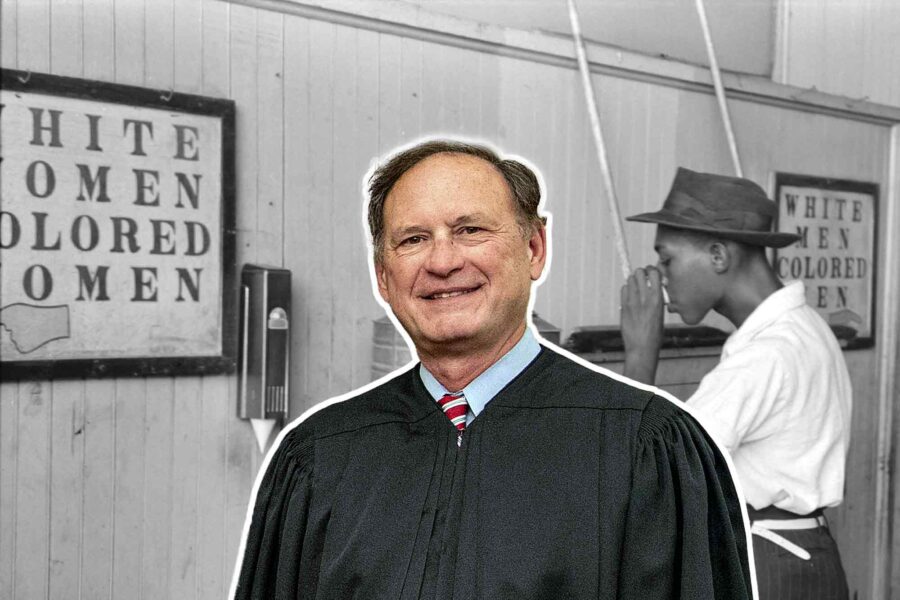
So, whether or not it is a formal gutting of Section 2, the 6–3 party-line Callais decision, penned by Justice Samuel Alito, is a partisan gut punch with profound national implications.
That is a major injustice, but it is not what made me quit the law.
A Dark Turn for the Court and the Country
What made me quit was the intellectual dishonesty of the whole operation: the dressing up of partisan and ideological bombs like Callais — and scores of other key decisions along the way — as principled doctrinal refinements. Or, to use Alito’s word, “updates.”
A bit of background, before returning to Callais and what a succession of right-wing Courts has done to voting rights, racial fairness, and democracy in America.
After a couple of heady years in DC, I matriculated at NYU School of Law in September 1980. Four months later, Ronald Reagan ascended the throne and the Long Slow Reversal of everything I held dear kicked into gear.
I chafed at the career path before me; in fact, I had cried during much of our “Welcome to NYU Law” assembly, as speaker after speaker told us how we would go out into the world armed with skills to make a difference — or make tons of money at some big law firm like Paul Weiss or Skadden.
That latter path held no appeal for me. But I didn’t really trust what the “make a difference” speakers were selling either.
My view of law was a strange amalgam of cynicism and idealism: mostly a weapon for sale on the open market, but with a truly heroic capacity to advance worthy causes, protect the otherwise powerless, and promote fairness and equity.
If God dropped everything else.
At least that was my view of law and the legal profession’s potential before Reagan took over. When he did, it seemed the idealistic lawyer’s mission shifted, quite suddenly, from offense to defense. At least at the federal level — and it did seem to trickle down to the state level as well — there was suddenly little hope of “advancing worthy causes.”
Virtually all our work, as idealistic and progressive members of the legal profession, would consist of a rearguard action striving to defend gains that had already been made in preceding decades: trying to forestall rollbacks of environmental and health and safety regulations; trying to keep the death penalty from being reinstated; trying to keep public-oriented programs like the Legal Services Corporation alive; trying to stave off wholesale changes in the tax code designed to benefit the already wealthy; etc.
It was going to be disillusioning even for those of us without illusions.
A Permanently Tilted Table
What I couldn’t foresee at that time was that justices who shared my outlook and values — or at least were not diametrically opposed to them — would never again, for the rest of my life, form a working majority on the nation’s highest court.
Or that this court, in the hands of right-wing ideologues and tainted by corruption, would grow in power and brazenness to shape not just the policies but the processes of governance, with its tentacles in every aspect of electoral politics.
Such that electoral politics would be played on a more and more tilted table, producing election results that in turn served to perpetuate right-wing judicial hegemony, the vicious circle being complete.
Decision by decision by decision, over decades, the Court’s antidemocratic, and anti-Democratic, agenda has rolled out — shaping our politics, leadership, and national direction, turning America into a mean and angry nation filled with inchoate and often misdirected discontents.
In her examination of Callais, legal analyst and former US Attorney Joyce Vance asks, “Why are conservatives so afraid of democracy? Why are they afraid to let the voters decide elections?”
There’s no real mystery to this. They’re afraid of democracy for precisely the same reasons that Louis XVI and Marie Antoinette were afraid of democracy. They’re afraid of voters because they know they’re systemically screwing the majority of them and, without a tilted electoral table and heavy red thumbs on the electoral scales, they wouldn’t stand a chance in hell of holding onto power. And because they can’t bear even the thought of sharing power, of the swinging pendulum that has characterized American political history.
So, decision by decision by decision, over decades, the Court’s antidemocratic, and anti-Democratic, agenda has rolled out — shaping our politics, leadership, and national direction, turning America into a mean and angry nation filled with inchoate and often misdirected discontents.
Decisions like Citizens United v. Federal Election Commission (2010), the most notorious of a series of decisions that, equating money with speech, drowned our electoral politics in torrents of corporate and oligarchic cash, often “dark money,” meaning the source could remain undisclosed and unaccountable.
Like Shelby County v. Holder (2013), which gutted Section V of the VRA by freeing Jim Crow states from its preclearance requirements and thereby permitting a significant reversion to their Jim Crow ways of yore.
And like Rucho v. Common Cause (2019), which greenlighted all species of partisan gerrymandering by concluding that federal courts could have no role in second-guessing the good faith of state legislatures that drew legislative districts both to favor the majority party and to protect the incumbents of both parties (i.e., their own seats!).
There were scores of such decisions, critically bearing on the processes through which the public will is supposedly translated into representative governance. (I’m not counting here such nonelectoral or electoral-adjacent miscarriages as Trump v. United States [2024], ginning up near-absolute presidential immunity for the criminal president who needed it most. Or Trump v. Anderson [2024], making Section 3 of the 14th Amendment effectively disappear to keep insurrectionist Donald Trump on the 2024 ballot.)
Virtually all of these decisions split the Court on partisan lines; many were 5–4, others 6–3. In “the cases that matter the most (a real category that can meaningfully be distinguished from the rest of the Court’s docket),” to quote analyst Steve Vladeck’s distinction, the Court has, for decades, been nothing if not predictable.
Rule First, Reason Later
Genuine principle and good-faith reasoning occasionally wander into some nook or cranny of these decisions. But one must be terminally naive to believe that if the political impact of such decisions had been reversed — if, for example, greenlighting partisan gerrymandering in Rucho or gutting Section 5 of the VRA in Shelby or Section 2 in Callais had resulted in electoral advantages for the Democrats — the decisions would have come out the same.
It is patently obvious that, in most cases that matter most, rather than following a set of principles toward a result, the Court majority’s process has been to decide first where it wants to end up and then backfill whatever “principles” it needs to stitch together to get there.
No, one suspects to the point of certainty that the Court’s decisions would have all been effectively the opposite of what they were, with a new set of “principles” and a new train of “reasoning” dragged in to support them.
Indeed, it is patently obvious that, in most cases that matter most, rather than following a set of principles toward a result, the Court majority’s process has been to decide first where it wants to end up and then backfill whatever “principles” it needs to stitch together to get there.
This “flexibility,” reverse logic, or sophistry — common in the legal world to the point of ubiquity — is what soured me on the practice of law all those years ago.
In Callais, it reaches an apotheosis.
The ‘Logic’ of Callais
Here’s Callais’s “logic,” boiled down. It says if you are a red state and want to draw a map eliminating any majority-minority districts, you are perfectly free to do so, as long as you don’t say that your purpose is to eliminate those districts because they empower and tend to elect minorities. No, you have to say you’re eliminating them because they elect Democrats.
Get it? Alito is very specific that if a legislature simply claims that it’s drawing or redrawing the lines either for partisan advantage or to help incumbents keep their seats, it’s good to go. Snug in the Rucho safe harbor, where gerrymandering for mere partisan gain is untouchable.
I can’t begin to tell you how wrong this is, how unprincipled, how cynical — the very pinnacle of intellectual corruption.
What Is Wrong With Rucho
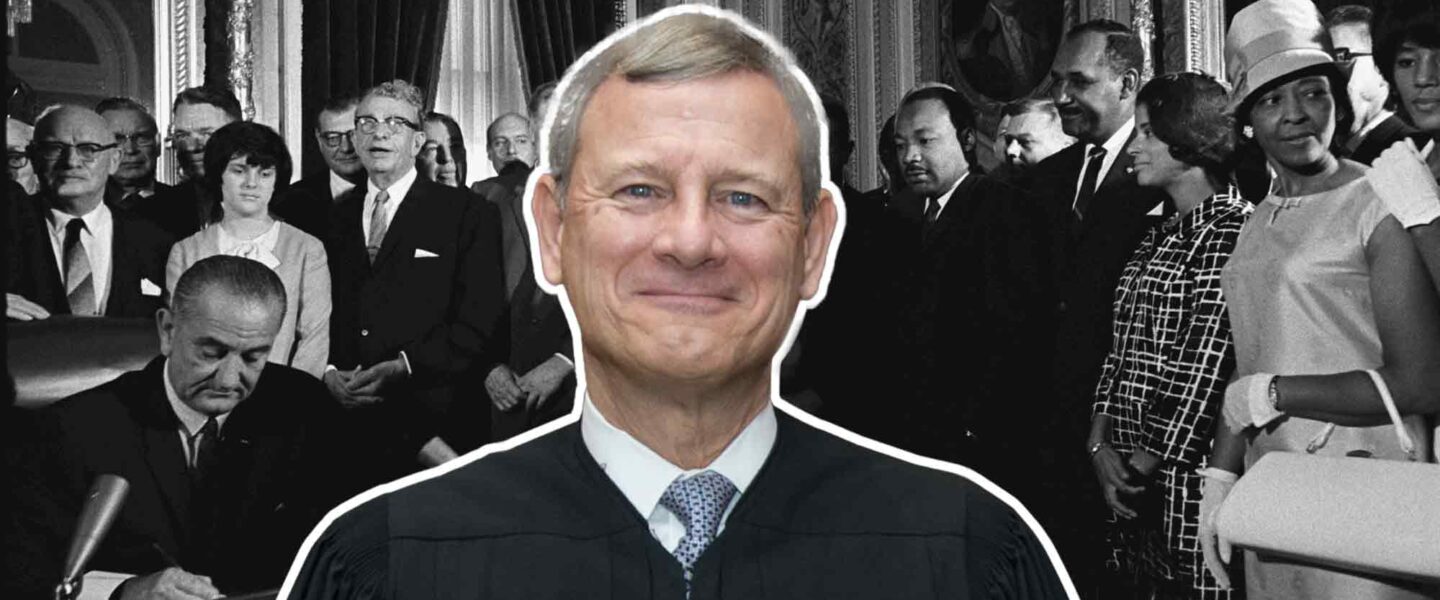
Rucho itself was a judicial catastrophe. Presented with the opportunity to rein in at least the most corrosive excesses of maximalist gerrymandering, Chief Justice John Roberts, writing for yet another 5–4 majority, said, in effect, “Who, us? Nope, that’s a ‘political question,’ beyond the judicial power and to be left to the political branches, in this case legislatures.”
Literally nothing in the Constitution or centuries of jurisprudence compelled Roberts and his majority to take that tack and make that decision to greenlight partisan gerrymandering. It’s worth noting that, in the modern era, just about nothing is beyond the judicial power unless the Supreme Court majority wants it to be.
It was clear as day that the compelling self-interest of legislatures is to protect their own seats by making as many of them “safe” (i.e., where everything gets decided in primaries and there’s no point in bothering to vote in the general election) as possible, and for legislative majorities to lock themselves into power at the state level and maximize their party’s control of their states’ US House delegations.
Gerrymandering, which I examined in depth in a column last August, has long been a powerful antidemocratic weapon. I have yet to meet anyone who thinks it’s actually good for our country.
And it has only gotten worse, as Big Data (and now AI) has been harnessed to draw lines with a granular precision unattainable 50, or even 15, years ago. Both parties do it — if either one didn’t, it would get permanently rolled.
For various complex reasons at the intersection of principle, geography, and demography, the overall net effect of maximalist gerrymandering favors Republicans. Not by much, but by enough to have profound political and electoral bottom-line impact.
This fact was surely not lost on Roberts and the Rucho majority.
And quite apart from its table-tilting tendencies, there’s the fact that creating such a plethora of safe seats (in the US House for example, in any given election, only about 10 percent of the contests, 40 or so out of 435, are realistically competitive; in many state legislatures, the ratio is even worse), is really, really bad for politics — and therefore for the country.
We have watched this all play out — in both parties but, again, far more dramatically and destructively among the Republicans, with Trump acting as adjuvant to the toxic brew — and no one much likes it. At least no one who cares a straw for democracy.
The fact that for the vast majority of legislators their only serious competition comes in party primaries, generally from more extreme challengers that have appeal for the party’s highly motivated primary-voting “base,” means that moderation and political compromise pose the only real threat to reelection.
With the only real pressure coming from the prospect of more extreme intraparty challengers, the parties vote in lockstep, moderates and disloyalists are purged, and legislatures wind up, as the 119th Congress has been, manifestly dysfunctional and publicly despised.
We have watched this all play out — in both parties but, again, far more dramatically and destructively among the Republicans, with Trump acting as adjuvant to the toxic brew — and no one much likes it. At least no one who cares a straw for democracy.
It would have been easy for the Court to put a stop to it, to rein it in, for the health of the whole system.
In Rucho, it said “We can’t do that,” when what it really meant was “We don’t want to do that.”
Finishing the Job
In Callais, the Court goes further: It celebrates gerrymandering for partisan advantage and to protect incumbents as a swell thing.
So swell that it sweeps away what was left of the VRA, itself the culmination of more than a century of struggle, first against slavery itself, then against rank Jim Crow discrimination.
But of course Alito doesn’t say the Court is overturning the VRA, or even “eviscerating” it — that observation was left to Justice Elena Kagan in a rather frank dissent.
No, Alito simpers, we’re just engaging in a little doctrinal refinement, bringing Section 2 of the VRA into alignment with the equal protection provisions of the 14th Amendment, which — don’t you know — protect those discriminated against only when those doing the discriminating say “We’re discriminating!” Nice and loud, on the record.
Because that is now the only way to prove the intent now necessary for a legal challenge under the VRA. Even though Congress, with the signature of President Reagan, amended the VRA in 1982 explicitly to make it clear that such an impossible demonstration was not needed to prevail.
Got that? Under Callais, it doesn’t matter how discriminatory the impact. It doesn’t matter that states can — and have instantly started to — carve up Black and Latino neighborhoods and mix those voters into big pools of whiteness where their chances of electing a Democrat, let alone someone who might share their skin tone, to represent them are nil.
Sure, litigants can still “use” the VRA’s Section 2; they just have to meet an impossible standard to succeed with it.
In a particularly grotesque twist of the knife, Alito tells us that anyone challenging a racially discriminatory map presented as a partisan-advantage map must provide the courts with alternative map(s) that preserve the partisan advantages secured by the original map. (Of course, given what is often the extremely strong alignment between race and partisanship, such a map most likely cannot be drawn.) Behold this fervent endorsement of partisan gerrymandering from essentially the same majority that seven years ago in Rucho declared gerrymandering for partisan advantage was no business of the federal courts! Now, it seems, it is.
In a sense, Callais completes the work of Rucho, as well as the other “landmark” cases that have seen the Roberts Court fulfill his personal mission to kill off the VRA, section by section. (The fact that Roberts assigned this crowning opinion to Alito, instead of taking it himself, I’m guessing, has the prediction markets shifting toward Alito’s retirement this year, with Callais as his illustrious swan song.)
What Happens Now?
The impact of Callais will be bad. How bad and how quick are open questions.
It lands in the middle of what has been described as a “nuclear” redistricting war, set off by Trump when he leaned on the Texas GOP to find him five more seats, to which he had decided he was entitled.
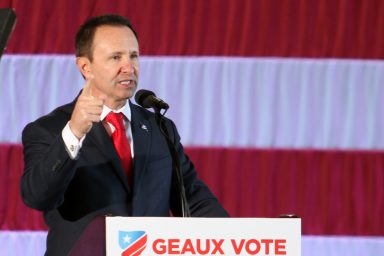
Louisiana itself wasted not a day in declaring a “state of emergency” and canceling its primary election already underway, with ballots already cast, to redraw its lines to eliminate one of its two Black-majority districts, which will almost certainly have the effect of shifting another seat in the House to the GOP. Hence the cheers from House Speaker Mike Johnson (R-LA), into whose dim prospects of remaining speaker Callais has breathed a bit more life.
The racism and electoral table-tilting go hand in hand, you see — a reality that the Callais majority both exploits and pretends not to see. As UCLA law professor Rick Hasen put it, “Under the Supreme Court’s approach to voting now, naked partisanship is more of a defense than an indictment.”
Other states are revving up, again with Johnson’s encouragement, for either 2026 or 2028 redraws. Tennessee Sen. Marsha Blackburn (R) has called for a redraw that would make every one of her state’s House seats Republican, which, she wrote on X, is “essential to cement @realDonaldTrump’s agenda and the Golden Age of America.” Tennessee Gov. Bill Lee (R) quickly assured Trump his will would be done.
On the Democratic side, I saw a proposal to make every one of California’s 52 House seats Democratic!
Welcome to the Trump-built political total-war madhouse. All it’s missing is that giant poster with his mugshot hanging in front.
A consensus has emerged that Callais will be good for Republicans, bad for voters of color and their would-be representatives, and another dose of poison for the political system as a whole.
It should be noted that there are short-term dangers for Republicans in getting too aggressive in their line-drawing. With the 300-pound electoral albatross of Trump draped around their necks, they may find that spreading their own voters too thin leaves them more vulnerable to the impact of a blue midterm tsunami.
But in the long run, a consensus has emerged that Callais will be good for Republicans, bad for voters of color and their would-be representatives, and another double-dose of poison for the political system as a whole.
Well played, sirs and madam!
Dred Scott, Except Less Honest
In 1857, Chief Justice Roger Taney authored the Dred Scott decision, at or near the top of just about every legal scholar and historian’s list of judicial abominations.
In addition to invalidating the Missouri Compromise, which had helped keep under control the enmities that were soon to lead to the Civil War, Taney, with the concurrence of six of the court’s nine justices, reached beyond his holding to state bluntly that people of African descent:
are not included, and were not intended to be included, under the word ‘citizens’ in the Constitution, and can therefore claim none of the rights and privileges which that instrument provides for and secures to citizens of the United States.
Dred Scott was, to put it mildly, controversial. It more or less sparked the Civil War.
But whatever else you can say about Taney and his racist Court brethren, he made no attempt to hide the ball. He said what was on his mind, straight up, ugly as it seemed then to many and today to even more.
The same cannot be said for Alito and the Roberts Court more generally.
They tell you that the Voting Rights Act lives when they’ve just thrust a bloody stake through what was left of its heart.
They tell you that if we just stop acting as if our country has been entwined with racism for all its long history, then there won’t be any racism.
They tell you that it’s whites who need the Constitution’s protections, because racial equality means white folks having to give a little ground and they’re not having it. (Here’s a little tell: Since October, the US has admitted 4,499 refugees; 4,496 were white South Africans, and three came from the rest of the world combined.)
Worst of all to this lapsed lawyer, they function almost invariably, in the cases that matter the most, when the political chips are down, as partisan hacks and lackeys dressed in the august robes of high-minded legal reasoning and principle — originalism, textualism, doctrinal refinement, … whatever.
When I was a law student in NYC, three-card monte was a popular street attraction — and scam. If I wanted to watch a shell game, I could head down to the corner.
Now I just go to supremecourt.gov.