Kyiv Fights the Cold With Emergency Shelters and Hard-Earned Fortitude
For many in Kyiv, the outages have revived an old wartime calculation: How long can you endure before you go?
|
Listen To This Story
 |
KYIV, Ukraine — As night falls early over the west bank of the Dnipro River in Kyiv, the sky hangs low and opaque. Winter swallows the streets before the day has even finished, and January’s weak light dissolves into a thick haze. The thermometer reads minus 4 degrees Fahrenheit.
The cold bites. But the darkness is worse. Not a single window, nor the streetlamp at the corner, is lit. Everything is black, or at best, gray.
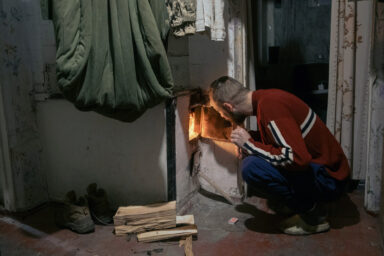
Between rows of Soviet-era apartment blocks, silhouettes move in silence, blankets tucked under their arms, bodies wrapped in heavy coats. People walk quickly, as if trying to outrun the frozen stillness in their homes. It’s been two days now since the electricity stopped. With it, the heat that makes the winter liveable has gone. There is no hot water. Sometimes even the cold water has stopped running.
Inside the apartments, the temperature drops hour by hour. The walls turn cold. In parts of the capital, life seems to seize up a city that, by turns, is plunged into blackout.
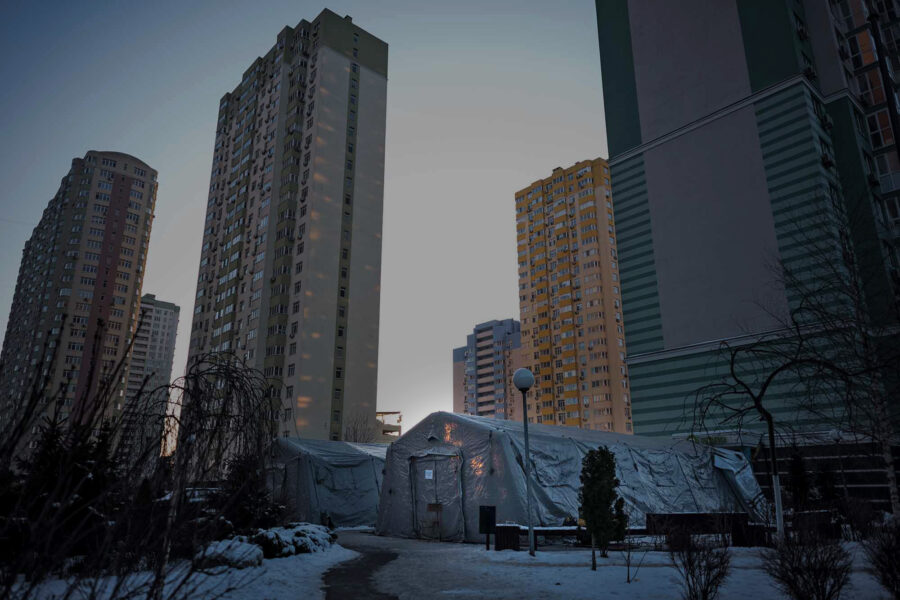
Tatiana, 46, stands quietly inside the heated tent, motionless, her gaze empty. She wears a long black coat, the head of a small poodle poking out from under the fabric.
“I live in the building right up there,” she says. “It’s been two days without electricity. But the worst part is that we have no heat, no running water.”
For the first time since Russia launched its full-scale invasion in February 2022, Kyiv was plunged into darkness and cold, alongside other major Ukrainian cities. The blackout is the result of two converging forces: one of the coldest winters in nearly a decade, and sustained Russian strikes against Ukraine’s energy infrastructure.
“There is not a single power plant in Ukraine that hasn’t been hit by the enemy since the beginning of the war,” Deputy Prime Minister of Energy Denys Shmyhal admitted in mid-January. “Thousands of megawatts of generation capacity have been knocked out. No one in the world has ever faced a challenge like this.”
Then, in the middle of the darkness, a glow appears.
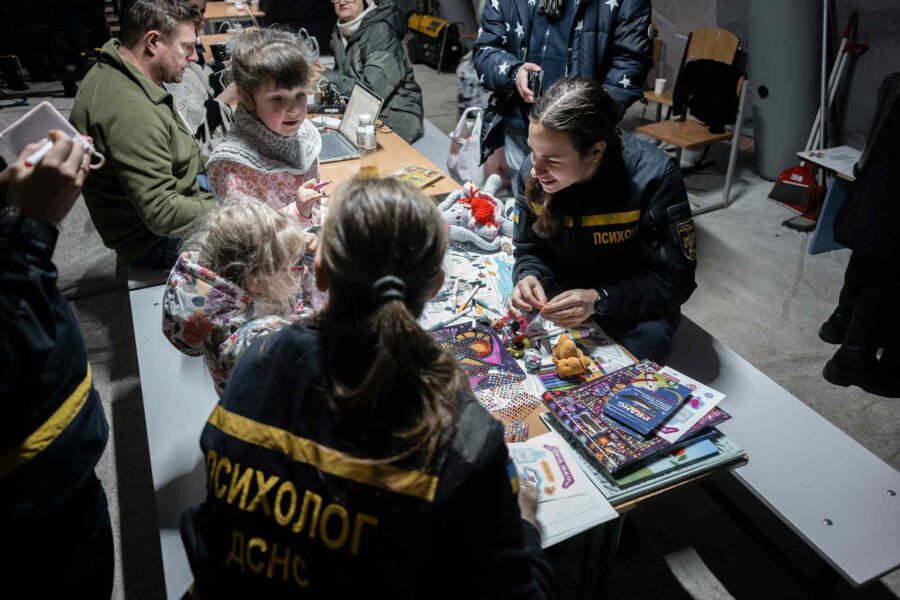
A long, military-style canvas tent, lit from within, throws orange reflections onto the surrounding gloom. Residents call it a “Point of Invincibility.” Set up by Ukrainian authorities, these emergency shelters, powered by gasoline generators, offer a few hours of warmth, light, and the chance to recharge a phone or drink a cup of hot tea.
Psychologists sit inside. So do medics, volunteers. The tent has become a temporary island.
On January 20, a new wave of strikes hit the capital. Kyiv’s mayor, Vitali Klitschko, said that around 70 percent of residential buildings were disconnected from the grid. In total, some 4,000 of the city’s 5,635 high-rise apartment blocks were left without heating. Days later, hundreds of buildings were still without power, heat, or water. City officials estimate that nearly 600,000 residents, out of a population of roughly 3 million, left the capital to seek temporary refuge with relatives or in less exposed regions.
For Tatiana, the hardest part has been the cold.
“For now, we adapt,” she says. “We’ve sealed off several rooms. We all live together in one bedroom. We sleep in big sleeping bags.”
Daily life has reorganized itself around outages.
“We eat when there’s gas. We shower as soon as the water comes back. We charge our batteries here, then we go home. We prepare for the next blackout.”
Stay or Leave?
Inside the tent, a long table runs through the center. On its surface, an EcoFlow battery powers a handful of outlets. One by one, residents come forward to plug in phones, flashlights, and cell phone chargers.
Some remain standing, shifting from foot to foot. Others sit for a few minutes, hands wrapped tightly around a paper cup of tea.
It may be their only chance to recharge before the next cut.
Two children, under the watchful eye of their mother, Oleksandra, draw quietly and work on a puzzle. Oleksandra serves in the Ukrainian army and has just returned from the front. Her arm is wrapped in a cast. She accepts a cup of hot tea from a volunteer.
“I was injured recently in the Donbas,” she says, gesturing toward her arm. “Nothing serious. A drone spotted our vehicle. I jumped out and broke my arm.”
Oleksandra is 32. Her husband also serves in the military. Their two children are being cared for by her mother.
“When you come back from the front, you hope for a little comfort,” she says. “But that’s gone too. Our apartment is freezing.”
She isn’t worried about herself. She has learned to endure the cold. But her children, she says, don’t have that kind of resistance. “My son is four, my daughter six. They’re small. They really suffer. Me, I’m used to it. But I worry most for them.”
For many in Kyiv, the outages have revived an old wartime calculation: How long can you endure before you go?
Tatiana, too, is thinking of leaving the city for a few days, until conditions improve. “I have family in Zhytomyr,” she says. “We could go there with my daughter and my husband.”
But she hesitates. For now, she says, the cold and power cuts have not been severe enough to abandon her neighborhood.
“At the moment, it cuts for two days, then it comes back. We charge, we shower, we warm up. And we wait for the next outage,” she says. “But if it lasted an entire week, with no hope of return, then yes, we would leave.”
Oleksandra doesn’t have that option.
“I don’t have anyone outside Kyiv,” she says. “And renting something in the west is too expensive. We just hope it will be resolved quickly. We don’t have a choice.”
On the Ice of the Dnipro
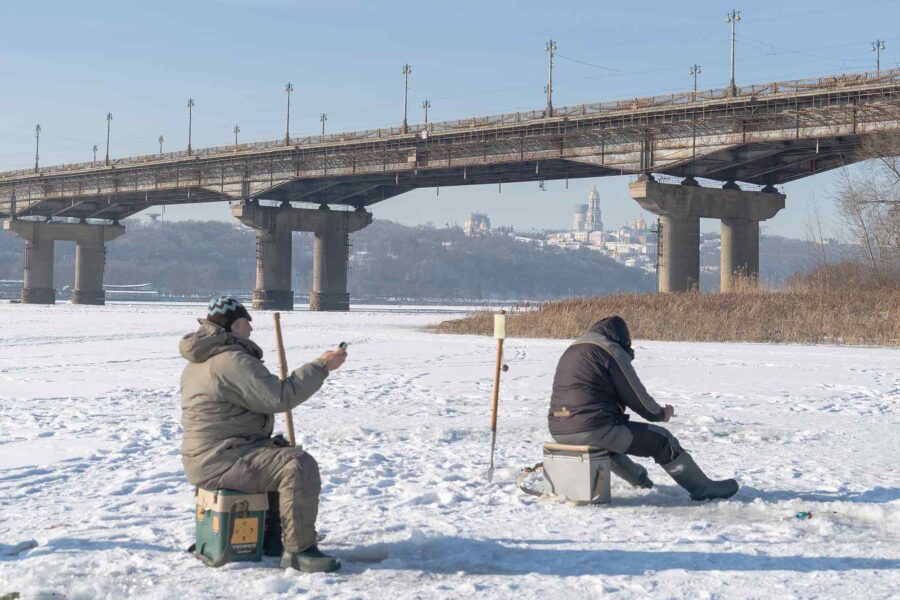
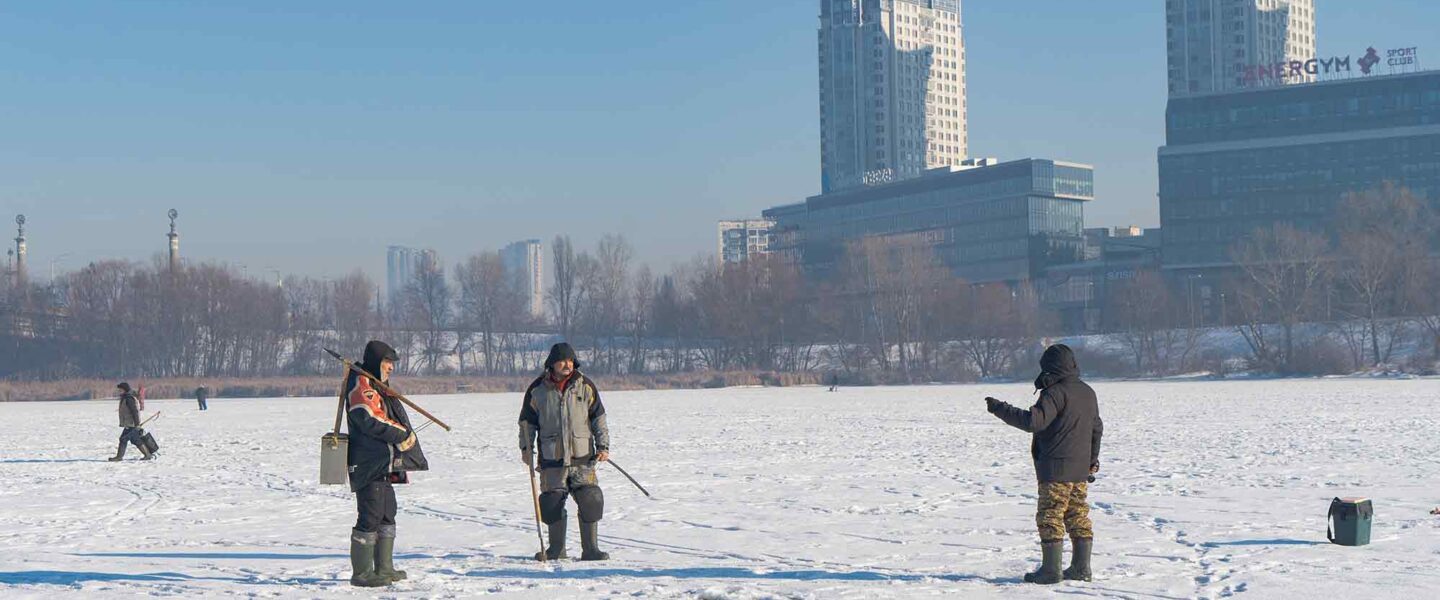
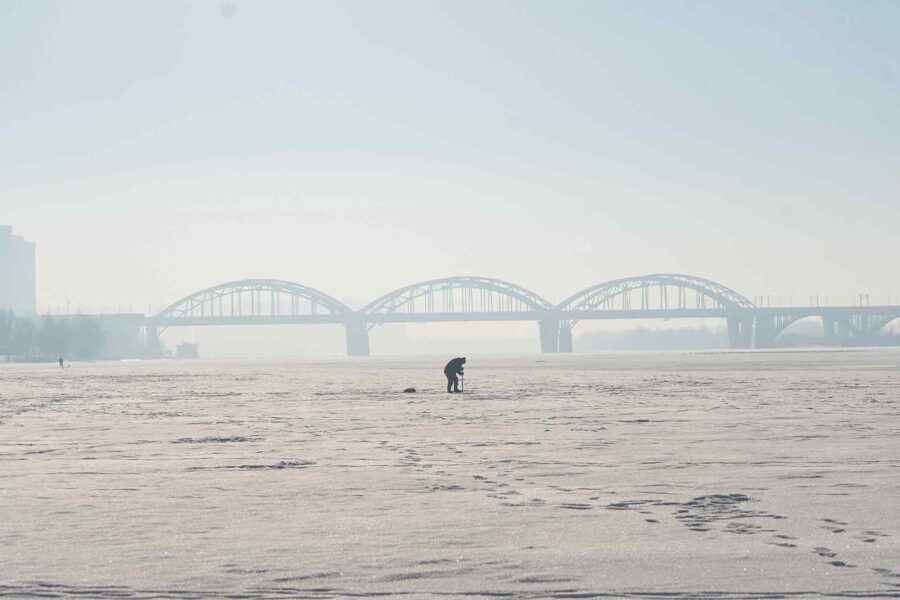
Along the banks of the Dnipro, winter has frozen the river solid. A white expanse stretches beneath a pale sky.
Oleksandr, 65, grips a long ice pick in his hands and slams it down with all his strength onto the frozen surface. “In some places, there are six meters of ice,” he breathes between strikes. “Once the hole is dug, you drop the hook, and you wait for a fish.”
His cheeks, reddened by the cold, burn with effort. Last night, the mercury fell again to four degrees below zero Fahrenheit.
“At least it’s sunny today,” he mutters.
In eight years, he has never seen the Dnipro, the second-largest river in Europe, frozen like this. Oleksandr lives on the top floor of a Soviet-era building that runs along the embankment.
“Sasha!” a man shouts from the shore. “You still have some of your moonshine?”
Oleksandr smiles.
“Of course, Vasily. Homemade,” he replies, lifting his glass. “In winter, it’s the best way to stay warm.”
“And we need it right now,” adds Vasily, 63, his longtime friend. “I haven’t had electricity, heat, or running water since January 11.”
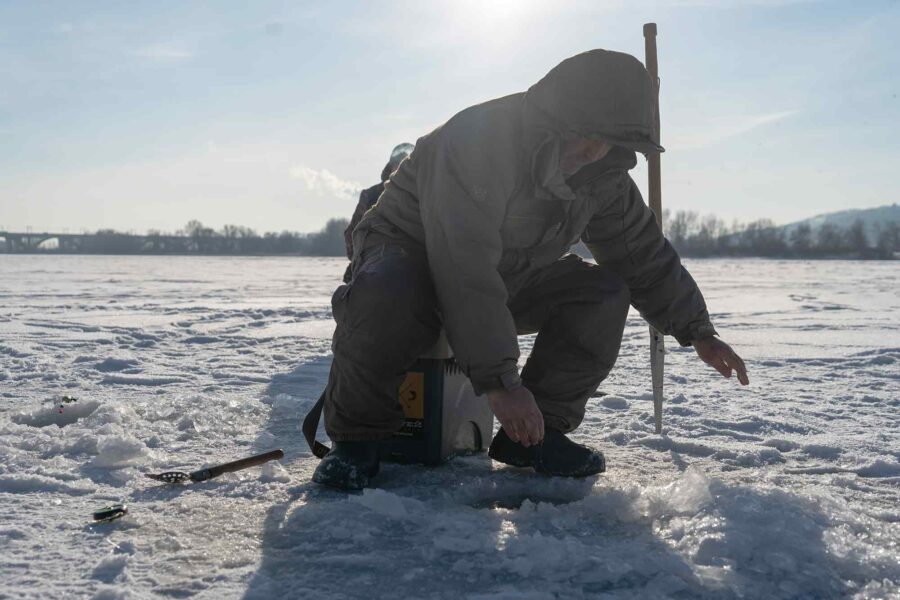
Vasily goes sometimes to a Point of Invincibility, like everyone else. But he prefers fishing, he says.
The two men have known each other for more than 35 years. Originally from Poltava, Oleksandr met Vasily after his military service in the Red Army in East Berlin. “We never separated after that,” Oleksandr says.
Over the years, with their neighbors, they have formed a small circle of friends. Oleksandr says proudly that he knows everyone here.
“Fishing is a kind of meditation,” he continues. “You dig your hole, and then you wait. We’re in Kyiv, but it feels like the end of the world.”
It helps, he says, to forget the war. To forget the problems.
“Besides,” he adds with a shrug, “it’s almost as cold inside our apartments as it is out here.”