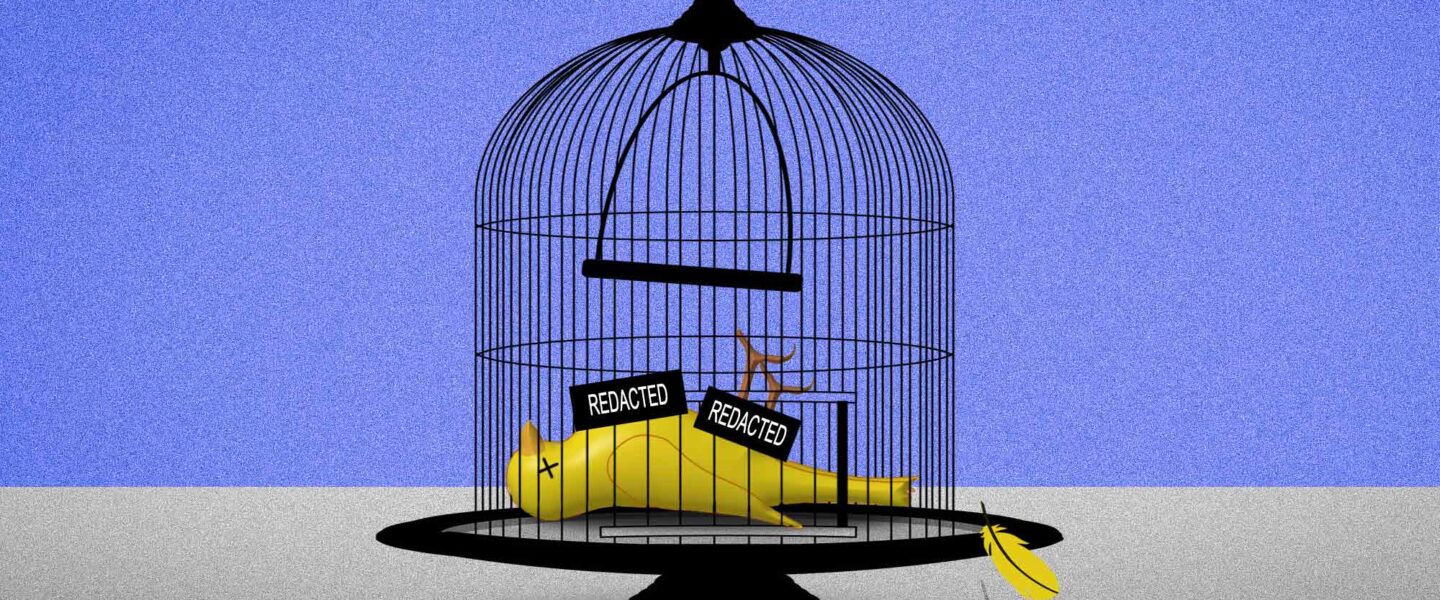
Saturday Hashtag: #PornIndustryCanary
Welcome to Saturday Hashtag, a weekly place for broader context.
|
Listen To This Story
 |
If you want a glimpse of artificial intelligence’s future, look at the $97 billion adult industry, which has long driven social media innovation, from video-on-demand to micropayments and live cam models.
The current major players are Pornhub, run by MindGeek but owned by the ironically named Ethical Capital Partners, led by Solomon Friedman, and OnlyFans, founded by Tim Stokely.
Under the late and notably secretive owner Leonid Radvinsky, an estimated 32 percent of Onlyfans’s 4.63 million creators are aged 18–24 and roughly 71 percent are female, fueling what remains a largely unregulated digital frontier. And then there’s the self-styled “Mr. Innovation”: Elon Musk joined the porn race in 2024 with his aptly named X platform.
An Unchecked Digital Petri Dish
The adult industry has fueled social media innovation, operating like an unchecked digital petri dish. Freed from the oversight and norms that constrain mainstream platforms, it relentlessly extracts data, attention, and profit from both users and creators.
Virtual performers, AI-generated videos, and chatbots have been expanding and reshaping content on adult platforms for years. The digital takeaway seems clear: Humans are not required, only experiences that feel real enough.
However, even after surpassing the uncanny valley, the perception of being “real enough” remains tenuous. Fully synthetic creators have struggled to achieve widespread adoption. Instead, hybrid models, where humans collaborate with AI, have become dominant. Over 80 percent of creators now incorporate AI into at least part of their workflow.
This dominance may be temporary. As AI advances, fully synthetic creators, projected to reach $143 billion by 2035, could replace humans in certain areas, threatening the broader social media economy.
Digital Stumble
For now, however, adult AI content is faltering and tripping over itself, with research showing that users prefer authenticity. Technology alone cannot replace human nuance and engagement, especially when “innovation” risks turning reality into a hollow and unsafe simulation.
Historically, these adult platforms sold intimacy and attention, not just content. Their appeal, especially on OnlyFans, relies on the perception of authenticity. AI can mimic appearance and responses, but it cannot yet replicate deeper emotional nuance or genuine human dynamics.
Pushback
Even though research shows the industry is harmful, adult content creators are adapting rather than quitting. Some automate messaging or content production, while others lean into spontaneity, vulnerability, and empathy to be competitive.
Extrapolating from user pushback in the adult industry, AI saturation could threaten to destabilize the entire social media ecosystem that it depends on for growth and profit.
AI adult content is also raising serious concerns around consent, copyright, and identity. Deepfakes have triggered backlash, and regulators are starting to act. The notion that AI content will scale freely is quickly fading.
Adoption?
Meanwhile, on mainstream platforms such as Instagram, TikTok, and YouTube, AI influencers are proliferating as these companies quietly tighten control over both content and creators, raising questions about authenticity and manipulation.
Expanding AI content while tightening control risks a platform exodus, as the adult industry has already demonstrated. Synthetic personalities, along with manufactured consensus, distort reality, undermine trust, and blur the boundary between genuine interaction and manipulation to a dangerously fragile edge.
The adult industry, while exploitative, reveals what profit and innovation can achieve but at a cost to social and ethical sustainability. AI content is already here, yet its future will hinge as much on the choices of creators, audiences, and regulators as on the technology itself.
A reflection of this AI inauthenticity backlash is already playing out in real life. Automated personalized “Happy Birthday” or holiday messages from various institutional entities are increasingly seen as creepy intrusions, highlighting how AI’s trust gap is producing tangible social consequences.
Hashtag Picks
From VHS to Virtual Reality: The Technological Legacy of the Adult Industry
The author writes, “At some point in life, almost everyone has watched a pornographic movie. In our society, watching porn is considered wrong for several reasons, both cultural and religious. However, porn is the only industry where almost every technology has been tested, whether it’s VHS or Blu-ray.”
‘Unlimited Realm of Exploration and Experimentation’: Methods and Motivations of AI-Generated Sexual Content Creators
The authors write, “AI-generated media is radically changing the way content is both consumed and produced on the internet, and in no place is this potentially more visible than in sexual content. AI-generated sexual content (AIG-SC) is increasingly enabled by an ecosystem of individual AI developers, specialized third-party applications, and foundation model providers. AIG-SC raises a number of concerns from old debates about the line between pornography and obscenity, to newer debates about fair use and labor displacement (in this case, of sex workers), and spurred new regulations to curb the spread of non-consensual intimate imagery (NCII) created using the same technology used to create AIG-SC.”
The Creator Economy in 2026 : The Era of Consolidation
From Forbes: “For most of its existence, the creator economy expanded without much structure. Independent creators, boutique managers, influencer agencies and software vendors all grew at the same time, often in parallel rather than in coordination. That fragmentation helped the market scale quickly. It also postponed the kind of operational discipline that large brand budgets ultimately require. In 2026, that phase is over.”
The Next Social Wave: The Top 6 Predictions That Will Shape Social Media Strategies in 2026
The author writes, “It’s commonly understood that a successful e-commerce strategy requires a paralleled social media strategy. Today’s consumers look to social media for detailed product information, proof of value and use in their cohort population. In 2025, we saw key social commerce trends emerge that will drive major gains in the coming year. These include generative AI’s integration into social marketing workflows, short-form video’s domination of attention spans, and the increasing impact of user-generated content (UGC) on a brand’s revenue goals. A careful analysis of these trends, along with an evaluation of social media performance across tens of thousands of global brands, suggests six predictions that will shape the future of social media in 2026 and beyond.”
How AI Is Changing Social Media in 2026 (And What It Means for You)
From Articsledge: “Every time you open Instagram, TikTok, or LinkedIn, an AI system is watching. It tracks every scroll, every pause, every like—and it uses that data to decide what you see next. That same AI writes captions, generates images, moderates hate speech, and sometimes even plays the role of a human influencer. In 2026, AI and social media are no longer separate things. They are the same thing. And whether you are a creator, a brand, or just someone trying to keep up with friends, this shift is already reshaping your digital life in ways that are hard to see but impossible to ignore.”