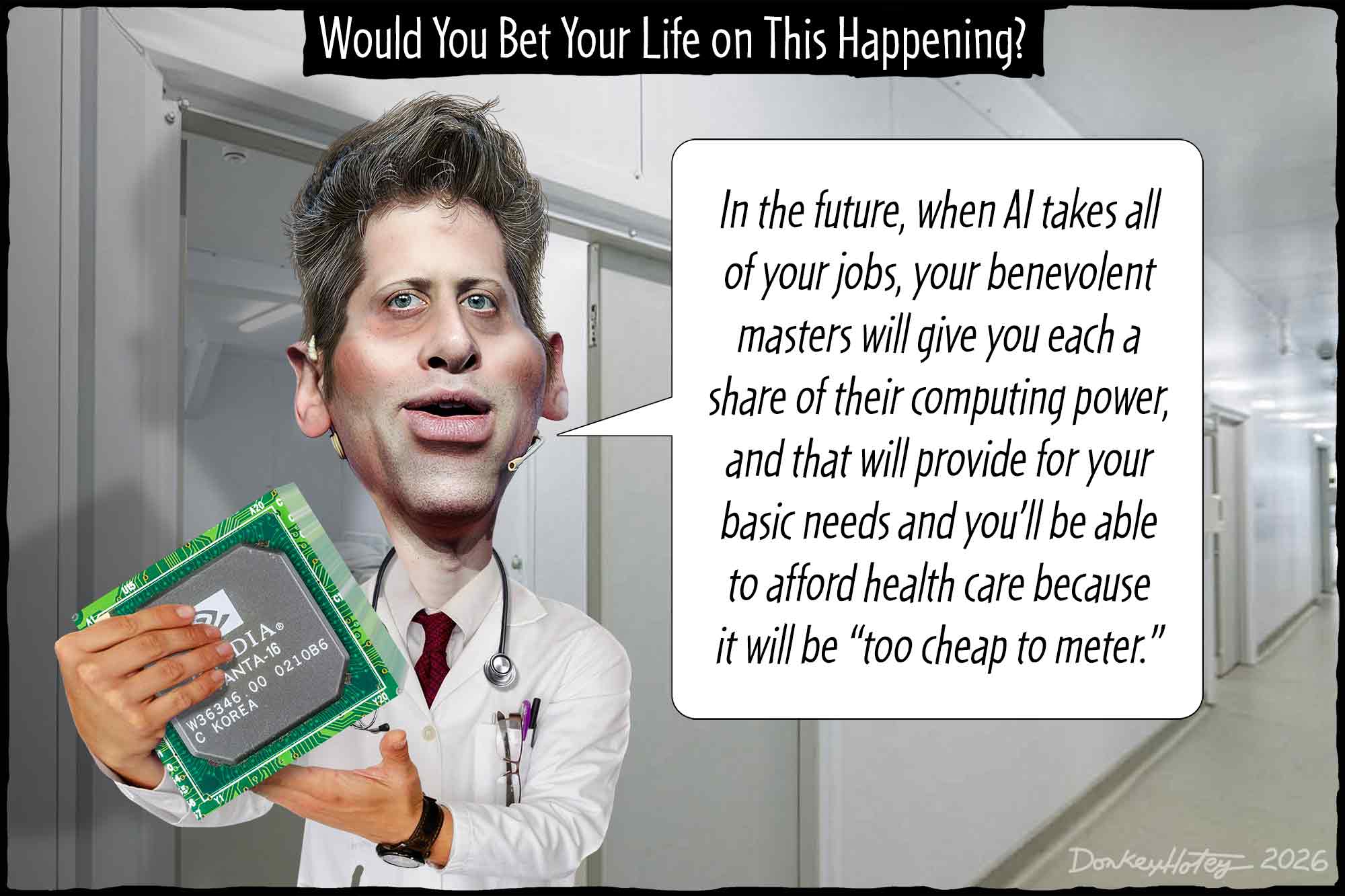
Tech Moguls Promise You’ll Be So Rich You Won’t Need Health Insurance
Sam Altman and his fellow tech bros swear that AI will make health care “too cheap to meter.” So why not start universal health care now?
|
Listen To This Story
 |
As we enter the age of artificial intelligence, robotics, and quantum computing, the men leading the largest corporations are vying to own the world.
They keep warning that AI will replace most white collar jobs very soon and, when it’s combined with robotics, blue collar job replacement will not be far behind.
How will citizens support themselves and their families without jobs? Who will pay for health care?
The AI CEOs want to reassure the public that their lifestyles will still be possible because this new system will bring abundance beyond measure. The billionaires want you to believe that they’ll share this abundance with everyone rather than keeping prices up and controlling access to continue hoarding wealth.
But experience and history tell us that the ultra-rich can be relied on to continue their efforts to enrich themselves at the expense of the nation. The only real solution is the government collecting taxes and paying for health care.
If health care is going to be “too cheap to meter” in the coming decades, why not move to a Medicare-for-all type system now? This will give people more freedom to navigate this rapidly advancing revolution. And as the cost of health care delivery is reduced, the cost to the US Treasury will shrink.
Most Silicon Valley types talk about universal basic income (UBI). Now OpenAI CEO Sam Altman envisions a system of universal basic compute (UBC).
With UBI the idea is to trash the current safety net and replace it with the smallest monthly allotment that will keep the masses in line while minimizing the overall cost of the safety net.
UBC proposes that everyone will be given ownership of some small portion of AI computing power. With that power, citizens can interact with all the AI doctor agents they need to diagnose illness. The “doctor” on their phone will prescribe drugs for them or recommend treatment or surgery. Then that ownership of “compute” will somehow get you a ride to a hospital where AI surgeon robots or other AI specialist robots will perform life-saving procedures.
I can grok that AI and robotics could bring down the cost of delivering medical care, but all of these pie-in-the-sky solutions to keep workers whole seem destined to fail.
Any basic income will raise the floor of wealth and soon be swallowed by inflation. It will be subject to the same types of sabotage that legislators use today to reduce Social Security and other benefits. If everyone gets a bit of “compute,” then byte-sharks will be trying to buy up as much of it as possible from desperate people. Many people will be left with nothing.
Look to past efforts along these lines, such as the Homestead Acts beginning in 1862, which were designed to democratize land ownership. The plan was to turn the working class into land-owning farmers by giving them 160 acres for free. But most individual settlers lacked the capital to wait out a bad harvest or buy machinery. Speculators, railroads, and timber companies hired straw buyers to file claims and then immediately sell the land to the corporation for a pittance. By 1900, the vast majority of the “free land” ended up in the hands of giant corporate syndicates, not the families for which it was supposedly intended.
It’s hard to believe these tech bros have ever experienced a serious medical problem, or else how do you explain their combination of ignorance and arrogance around the issue? People don’t shop for health care. They have relationships with doctors whom they trust, and they do whatever the doctor tells them. There is no opportunity to negotiate with anyone about pricing. You either have insurance or you don’t. I guess the doctors of the future will be AI agents, but patients still won’t be in the power position to negotiate a deal. When people have a serious illness, they don’t want to have to think about anything but getting well.
The current health care system in the US is built with layers of profit-takers — including health insurance providers and pharmacy benefit managers (PBMs) — who provide services that could easily be replaced by the government. Then we have the outrageous prices we pay for drugs in the US while the rest of the world negotiates for lower prices. The average American knows this system is corrupt and doesn’t serve the needs of all the people.
Unions have long been opponents of universal health care. One of the benefits they offer members is health insurance. Making health care independent of employment reduces their power. If you listen to the tech prophets, all those union jobs are going away along with their health insurance.
If the titans of tech want to get the populace behind their plans, then they should start supporting taxing themselves to implement universal health care and strengthening benefits now. This will be some proof that they really care about all those people who are going to lose their jobs, and are willing to sacrifice profits to help them. If, as they predict, the eventual cost of health care will be too cheap to meter, then their contributions will move towards zero over time.
Here, Sam Altman talks about UBI and UBC:
While you’re here enjoying DonkeyHotey’s latest cartoon, please take a moment to read these articles on related topics:
- Artificial Intelligence Combined With Human Stupidity Is a Recipe for Disaster
- Social Media Had Gun-Level Immunity. That Just Ended
- Other DonkeyHotey cartoons
The cartoon above was created by DonkeyHotey for WhoWhatWhy from these images: Sam Altman caricature (DonkeyHotey / Flickr – CC BY 2.0), stethoscope (Hassan Baloch / Pixabay), body (PublicDomainPictures / Pixabay), chip (Raimond Spekking / Wikimedia – CC BY-SA 4.0), and background (Mos.ru / Wikimedia – CC BY 4.0).

.jpg)