Where’s the Labor in Labor Day?
Robots won’t be needing any holidays, so let’s enjoy this one while we can.
|
Listen To This Story
 |
It may have passed unnoticed, but this Labor Day heralds what promises to be a radical change in the definition of labor. A good deal of our low-level work is being handed off to robots; tasks that might previously have been assigned to an unskilled worker can now be handled more efficiently and cheaply by a machine.
In Atlanta, where I currently live, Uber Eats, partnered with Serve Robotics, has unleashed a herd of rather cute robots, with what appear to be seductively flashing eyes. They’ve become a routine presence in Center City, scrambling about on their way to deliver sandwiches and burritos to adventurous clients.
Each robot has a name. “Deandre” was recently paralyzed after a sudden encounter with a “smart” recycling trash bin. But the fact that these mini bumbling machines occasionally run into obstacles that befuddle them only makes them seem closer to being human.
Deandre has a top speed of 4 mph, and can cover 48 miles before it needs to be plugged in for a fast recharge. The burrito-delivering robots are cheaper and generally more appealing than the often surly bicycle messenger guys who used to drop food off at your door and demand a tip.
Atlanta’s Big Bang Pizza has replaced its human hostess with a humanoid robot named “Pepper” and another robot, “Amy,” who serves tables. Big Bang has kept a few human beings around, but they are mostly there to help the robots handle difficult maneuvers.
Paschal, another Atlanta restaurant, deploys robots that resemble moving tray racks that discreetly follow human servers around the room.
The big changes, however, are out of sight of the customer, back in the kitchen.
They haven’t reached Atlanta yet, but they are fast approaching. The Nala Robotics’s monster Nala Chef multicuisine robot consists of disembodied robot arms — the kind you are likely to see handling sheets of steel in an automobile factory. Driven by artificial intelligence, like all the robots and labor-saving machines cited here, Nala Chef can handle 10 different cuisines, and select ingredients from 106 different food bins. It prepares 40 to 50 meals per two-hour seating without breaking a sweat.
Nala Robotics’s Pizzaiola robot operates on seven axes and can flip up to 50 pizzas an hour. It uses five different types of dough and can choose from 35 different toppings. Even better, it takes orders in plain language the way any short-order cook would. You can talk to it.
Although the robot does the complicated tasks, in this brave new world, humans are still needed. The difference is that they only serve as assistants, filling the food bins and carrying out other menial tasks. The robot is in charge, and humans are its helpers.
The initial cost isn’t cheap. A Nala Chef installation can run $150,000. Robots handling more specific aspects of cooking can cost around $40,000, or be rented for around $3,000 a month. That may seem pricey, but when you compare it to paying minimum wage, and possibly health insurance, for multiple workers, and then having to fight off attempts to unionize the whole operation, it can look more than affordable to management over the long haul.
The larger message is that if you can automate cooking, you can automate anything.
Restaurants aren’t the only ones that are automating. Driverless “Waymo” cars (“Way mo’ than we need,” as one colleague recently put it) are an increasingly frequent presence on Atlanta streets. The city has its share of traffic problems, so, as proof of concept, the driverless cars are dispatched to various locations without passengers.
That said, it can be unsettling to have a Waymo pull up next to you and realize that there is no one in the car. But looked at another way, the Waymos can be vaguely reassuring. Unlike humans, they respect traffic laws and tend to be risk-averse. Even better, they aren’t programmed to feel or express emotions, hence no road rage.
Some organizations, however, need a machine that shows compassion. ElliQ — another cute robot, which looks like a cross between Amazon’s shopping bot, Alexa, and a hyperactive table lamp — is currently used to keep tabs on older adults in care facilities, carry on a conversation, and even ask if they feel like they need a hug.
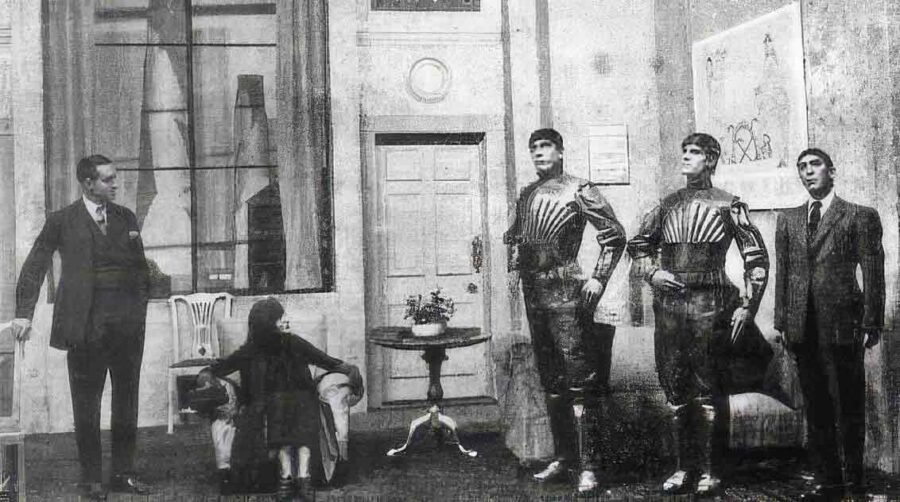
Modern use of the word “robot” stems from a science fiction play, R.U.R. (Rossum’s Universal Robots), by Czech author Karel Čapek. The play was produced in 1920 and translated into English in 1922. Čapek originally wanted to call his protagonists “labori,” but his brother suggested that “robota,” the Czech word for forced labor, sounded better. The play is largely forgotten, but the word “robot” stuck.
In Čapek’s account, the robots are literally artificial humans, and they eventually rise up and destroy humanity. Čapek’s uncanny sense of the future launched a century of paranoia that reached a crescendo in Arnold Schwarzenegger’s 1984 film Terminator and its frightening sequels. It took a little more than a century for actual robots to make their presence felt.
In contrast to Schwarzenegger’s murderous Terminator, R2-D2, in George Lucas’s film Star Wars, came across as a friendly sidekick and a great buddy to have around if you are suddenly attacked by a squad of Imperial stormtroopers. If as a kid you learned to love a teddy bear, you could probably learn to love R2-D2.
Robots like Uber Eats’s snack-delivering Deandre and even the disembodied arms of the multi-cuisine Nala Chef are not likely to rise up and attack any human beings. The real danger is not the robots; it is ourselves. A robot is, after all, just a machine. It’s how we humans decide to deploy the robot that can cause real damage.
The driverless Waymo is a prime example. It could eventually provide enormous benefits. If you can call a driverless cab at a reasonable price, there is less reason for a family to own two or three cars, and that could do wonders both in eliminating traffic jams and in mitigating the risks from climate change by reducing car emissions.
So Waymo looks pretty good — except it may also put an end to freelance ride services like Uber and Lyft, which currently provide a lifeline to a segment of the population trying to figure out how to survive the gig economy. Uber has just announced that it is eliminating 10 percent of its staff and investing heavily in driverless taxis.
Likewise, when a restaurant no longer needs to pay short-order cooks, dishwashers, or servers, it eliminates a whole range of low-level entry jobs that have provided a kind of shock absorber for economic change.
Every advance has an apparent downside. In this case, the shift to robots and AI exacerbates underlying inequities in the job market. In the past, if workers suddenly found themselves out of a job, they could at least go to a Walmart or Target and get temporary work checking out groceries. As automation becomes increasingly ubiquitous, these jobs dry up. That temporary shock absorber is gone.
The same thing is happening in a wide range of other industries, including middle-class white-collar employment. There used to be openings for young or aging lawyers to do legal research — not anymore. AI does it better, or at least some hiring managers think it can. The same goes for many banking functions, insurance, customer service, etc. Customer help lines used to be farmed out to call centers in the Philippines and India; now, many companies are using AI to handle it.
It’s clear that finding even temporary work is going to be a lot harder from here on out — at a time when conservatives in Washington increasingly demand proof that you have a job if you want to access even minimal safety-net government services.
And displaced workers will still need government services — especially unemployment assistance — but the taxes that previously financed those services are likely to disappear along with the human workforce that generated the taxes. The Silicon Valley billionaires who create the robots and the AI will reap enormous profits, but so far they’ve proven extraordinarily adept at avoiding paying their share of the tax bill that enables the government to function. There is nothing new in that.
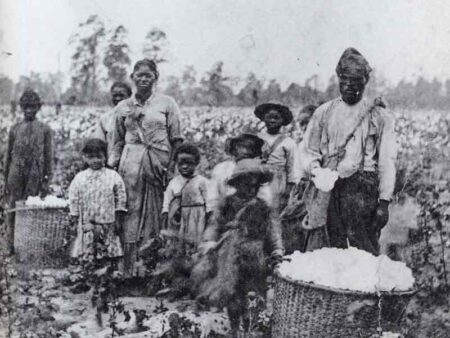
Eliminating the high cost of menial labor has been a dream of business executives since the rise of the market economy. In America, the Southern states did not intentionally set out to be evil when they insisted on maintaining slavery: They were looking for an inexpensive approach to the labor-intensive growing of cotton. As the Mafia used to say: nothing personal; it’s just business.
When slavery ended, the South turned to sharecropping, and when the economy shifted to factory work, the country imported impoverished immigrants from Eastern Europe to work in sweatshops — until even cheaper workers were discovered in China and other countries emerging from the ashes of colonialism. Despite Donald Trump’s vicious campaign against undocumented immigrants, we’re still using off-the-books, undocumented, low-cost immigrant labor.
When I was just out of college, I briefly worked as a farm laborer, a “bracero,” in the lettuce fields of Salinas and Watsonville, California. I wanted to know what it was like to be a migrant worker. In the end, I felt guilty because we were paid as a team, yet I was much slower than any of the immigrant Mexican workers.
Now that way of life is fast disappearing. Robots may not do the work as well as the migrant laborers, but they’re cheaper in the long run, and easier to manage. They don’t complain, and you don’t have to feel guilty about making them work in the brutally hot sun.
The real question is: How do we dispose of the people, the labor, that we no longer need?
Trump and ICE are one answer. It’s not pretty, and it’s not what we want as a country, but, hey, that’s business. I used to regularly ask company CEOs about the social consequences of firing employees. The usual answer was, “Not my problem!” If it’s not their problem, however, whose problem is it?
Labor Day traces its origins to the Haymarket protests in 1886. Workers in Chicago’s McCormick Harvesting Machine Company factory went on strike on May 1, demanding an eight-hour workday. (The typical factory worker at the time worked 10 hours a day, 6 days a week.) Police opened fire on a subsequent protest on May 3. The following day, when police again moved to break up a crowd that had already begun to disperse, an unidentified assailant threw a stick of dynamite at them. Seven police officers were killed along with two bystanders.
Authorities made hundreds of arrests, and eight men were tried and convicted of conspiracy. The only evidence against them was a trove of radical writings and a history of organizing activities; there was no concrete evidence linking them to the dynamite. The trial was widely considered a travesty of justice. Four of the arrested organizers were hanged. A fifth committed suicide. The three surviving protesters were amnestied in the 1890s.
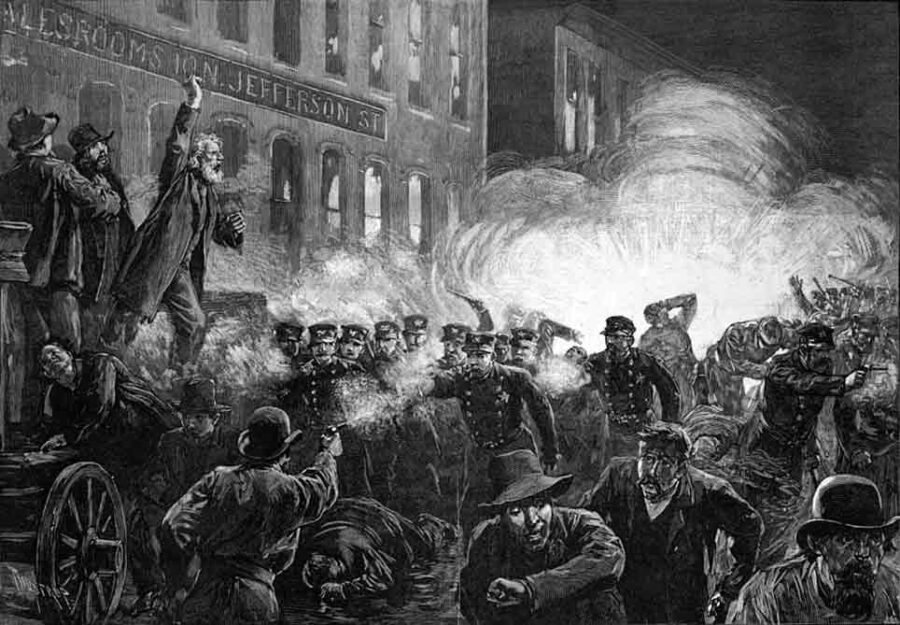
The affair led to May 1 becoming International Labor Day throughout Europe and most of the world. In the US, to calm a deeply divided nation and to distance the American labor movement from socialist and communist movements in Europe, American organizers decided to move the celebration of Labor Day from May 1 to the first Monday in September.
A few years ago, at an economic conference in Paris, I heard what struck me as a sensible response to the threat of a robot takeover, when a participant observed, “If you want to take a society through traumatic change, first make them feel confident about their place in the future.” Returning to the US, I realized that we were doing exactly the opposite.
Besides recalling the divisive shame of the Haymarket riots, Labor Day this year marks the start of the run-up to the midterm elections.
Every election is a potential turning point, but this one may be more defining than any in the nation’s history. Which led me to this thought: If a gaggle of Silicon Valley billionaires succeed in ousting American democracy in favor of the Dark Force and their version of Darth Vader’s evil Galactic Empire, it might be helpful to have R2-D2 at our side, cheerily advising us on the best way to survive the unholy mess that’s likely to follow.