Saturday Hashtag: #DividedGeneration
Welcome to Saturday Hashtag, a weekly place for broader context.
|
Listen To This Story
 |
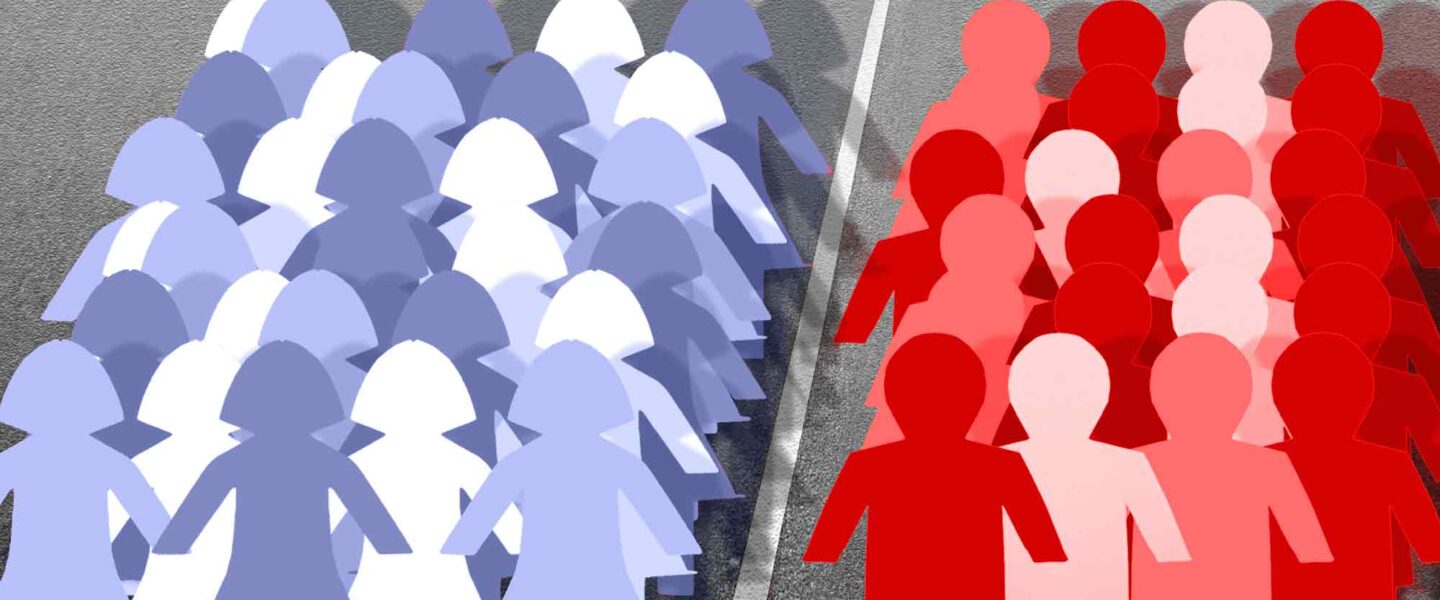
The political divide between young men and women has widened dramatically since 2001. But beneath the contrived digital noise lies a striking asymmetry: Young women have moved sharply left, while young men’s political identity has remained remarkably stable.
That divergence has unfolded alongside an expanding, singular algorithmic prism through which we now perceive the world — filtering what reaches us, refracting it through an increasingly personalized lens, and shaping our vision of reality.
Is that coincidence — or does this digital refraction explain why a massive right-wing transformation appears to have taken place when the underlying data says otherwise?
The Numbers
Here is a breakdown of liberal identification among young adults ages 18–29, from 2001–2024:
Young Men
- 2001–2007: 25 percent
- 2008–2016: 27 percent
- 2017–2024: 25 percent
Young Women
- 2001–2007: 28 percent
- 2008–2016: 32 percent
- 2017–2024: 40 percent
The crucial fact is that young men’s political identity has barely moved in more than 20 years. Yet the digital environment makes it look like a right-wing tsunami has consumed them.
The Asymmetry
Young women’s shift is not the mirror image of some equivalent male radicalization, because young men show no comparable political shift.
Young women are responding to issues that directly affect them:
- Abortion access
- Reproductive rights
- Voting rights
- Gender equality
- Personal safety
These are not reactions to hypothetical online arguments. Women are responding to real changes to legislation impacting bodily autonomy, legal rights, and physical security.
That is the asymmetry: Young women are changing their political position in response to real-world events, while young men are not changing at all — but the digisphere makes it appear as though they have.
The result is not simply a distorted picture of politics. It is a fiat reality: political theater that, through repetition, begins to feel real.
Sound like a familiar tune?
Let me hum a few bars of voter fraud for you.
The Machinery
Social media does not simply reflect society as it once did; now, it distorts it. The broader new system of extraction, where value is taken from users and society, is increasingly shaped by powerful interests seeking profit, control, and political power.
Media owners now openly advance political priorities, including highly charged issues that are not central to Americans’ daily concerns, such as pro-Israel advocacy.
The incentives are clear: Highly emotional and divisive subjects generate disproportionate attention, engagement, and conflict, influencing what gets funded, produced, distributed, and amplified.
The right wing has built an enormous media ecosystem across traditional outlets, digital platforms, partisan media, podcasters, and influencers. Its disproportionate reach can make a political minority look like a mass movement.
Much of this algorithm-driven ecosystem is financed by ideological donors, conservative organizations, and political networks.
The Evidence
A nearly two-year USC Neely Center study found that conservative content was amplified more on X and received greater engagement and distribution on Facebook.
Conservatives were also 25–50 percent more likely than liberals to meet the study’s measure of political extremity.
Two teenagers can sit in the same classroom while their algorithm-driven feeds construct completely different worlds.
One sees:
- Reproductive rights
- Climate activism
- Feminism
- Discrimination
- Progressive politics
The other sees:
- Anti-feminist content
- Immigration fears
- Election conspiracies
- Culture-war outrage
- Antiestablishment narratives
The system is designed to maximize engagement and profit, feeding a cycle of the Furies in which ever more extreme content is amplified and rewarded until political-minority views appear mainstream and begin to overwhelm fact-based reality.
Can you say QAnon?
The Social Consequence
In 1987, nearly 90 percent of high school seniors had been on at least one date. By 2024, that had fallen to just 46 percent, with only 1 in 5 dating weekly.
At the same time, about 60 percent of Gen Z says it is important to date someone who shares their political views, compared with only about one-third of people over 60.
As young people date less, they have fewer chances to meet people who see the world differently. Siloed online ecosystems fill that gap, reinforcing political identities and making real-life disagreement feel more alien and threatening.
The Map Is Not the Territory
The contradiction is the point: Young men’s political beliefs are literally the same as they were in 2001, yet the online ecosystem portrays a political transformation among them that defies the survey data. Young women, by contrast, are moving left because material changes are affecting their rights, bodies, and security.
That widening break between the sexes transcends politics, unfolding against a backdrop of declining birth rates and family formation. The feed is a map, not reality. It can magnify, obscure, and distort — until the map feels more real than the territory.
To paraphrase Polish-American philosopher and mathematician Alfred Korzybski: The feed is not the territory.
Hashtag Picks
Gen Z’s Political Gender Divide Is Now Showing Up in Schools
From The 74 and The 19th: “Young men and women split sharply in 2024. Teachers and students say that rift is reshaping classrooms, friendships and dating.”
Redesigning Algorithms To Intervene on Social Norm Misperceptions During a National Election
The authors write, “For the first time in history, civic discourse commonly occurs in digital environments in which algorithms influence exposure to social information. It is increasingly important to understand whether and how these algorithms affect political discourse.”
How Do Recommender Systems Learn Political Opinions? A Semi-Synthetic Step-By-Step Experiment
The authors write, “Recommendations play a crucial role in shaping informational diets on social media, raising concerns regarding potential consequences such as political segregation. We take an algorithm explainability approach, as opposed to a description of recommendations, to show how recommenders inadvertently create geometrical representations of the ideological position of users with minimal and ubiquitous platform data, and how this impacts content diets.”
Two-Thirds of Youth Have Shifted their Political Views in Recent Years
From The Center for Information & Research on Civic Learning and Engagement: “In recent years, there has been a lot of public conversation about young people’s rightward shift on the political spectrum. Youth were more likely to vote for President Trump in 2024 than in previous election cycles, and exit polls show that young voters in 2024 were more likely to identify as conservative than in 2020. However, that only captures shifts among youth who turned out to cast a ballot, who are not necessarily representative of all young people.”
America’s News Influencers
From Pew Research Center: “In the heat of the 2024 election, news influencers seemed to be everywhere. Both Republicans and Democrats credentialed content creators to cover their conventions — and encouraged influencers to share their political messages. Influencers also interviewed the candidates and held fundraisers for them. But up until now, it has been difficult to get a sense of the size and characteristics of this new wave of news providers.”
Broken Taboo: Politics Are Coming Up on First Dates (2024)
The author writes, “Ideological differences among young people are coming up on first dates, and often complicating them. Why it matters: Political views are becoming an increasingly important factor, or even dealbreaker, in dating.”
The Growing Gender Gap Among Young People (2024)
From Brookings: “In politics, the ‘gender gap’ is the difference in the percentage of women and the percentage of men voting for a given candidate. The political gender gap has appeared in one way or the other in every election since 1980 with women tending to vote for the Democratic Party and men tending to vote for the Republican Party. But the apparent gender gap among young voters also appears in measures other than politics and points to some deeper and potentially even more concerning issues among young people.”