Trump Twists FIFA’s Arm and Gets His Way
No, it shouldn’t have been a red card and suspension for Flo Balogun. And no, Donald Trump had no business getting FIFA to fix it.
|
Listen To This Story
 |
“Well,” I said to my partner, at the beginning of the FIFA World Cup group stage last month, “it’s only a question of time before Trump touches this and it dies.” Somehow, it was always in the cards.
Donald Trump, who dozed off at the NBA finals, cannot possibly be a soccer fan: It’s a game that requires an attention span greater than a gnat’s and an appreciation for the subtle. Trump seems capable of appreciating exactly two things in sport: scoring and violence. Soccer has notably little of either: the first is rare and the second is severely punished.
Which brings us to the subject of Trump’s toxic touch.
First let me say that, somewhat in spite of itself, it’s been a great World Cup thus far: The expanded format has allowed unheralded and unheard-of sides like tiny Cape Verde to show their unexpected mettle and pull off a few miracles. There’s been high, and then higher, drama. And, again for the most part, it has brought much of the world together in shared enthusiasm and mutual respect — very encouraging in an age of closing borders, exclusion, and hostile nationalism.
And the American squad is having a very good run, displaying a combination of talent, cohesion, discipline, and grit pretty much missing just about as far back as one cares to look.
In last Wednesday’s Round-of-32 win over Bosnia-Herzegovina, American prospects took something of a hit when striker Folarin “Flo” Balogun, their leading scorer and an emerging linchpin of the American attack, was issued a red-card sendoff for “serious foul play” with about a half hour to play. Playing at a man disadvantage, the US side — leading 1–0 at the time, on Balogun’s earlier goal — manfully saw the match out, and in fact added a goal to win 2–0.
But by FIFA rules, a red card received in any World Cup match carries an automatic one-game suspension, to be served in the team’s next scheduled match, and this is where things got interesting.
Related: The Beautiful Game in an Ugly Era: My View as a Soccer Referee and Journalist
The whole situation raises issues well beyond the technicalities of soccer, and so should be of interest even to those with limited soccer knowledge who have not parsed the play and call that led to all the off-field intrigue. With apologies, therefore, to anyone already steeped in the play itself and the Laws of the Game as they were applied to it, here’s a brief explanation of what happened and what all the fuss was about.
Soccer, at least at its highest levels, has, for better or worse, done its best to eliminate the human-error aspect of officiating by introducing video review, known as VAR (for Video Assistant Referee), into the referees’ toolkits, and continually expanding its role, the situations where it applies. Hence, a separate official, or crew of officials, sits in a field-adjacent booth with their eyes screwed to a bank of video monitors, catching play from various angles and, of course, in slow-motion and freeze-frame formats.
When this VAR ref or crew spots something that the on-field officials may have missed or called erroneously, they communicate this to the center referee, who is then obliged to review the play at a field-side monitor — using the feed provided by the VAR crew — and either confirm or alter his or her initial decision. (There’s a separate, technology-enhanced protocol for offside calls, not relevant here.)
On the Balogun play, this is what happened: Balogun and an opposing player were grappling for position to play the ball; each was holding, grabbing the other to a degree accepted as fair play at this high level. Balogun’s studs made contact with his opponent’s calf and then, as they continued to grapple, came down on his opponent’s ankle, twisting it awkwardly and painfully over. Such a position often causes a familiar injury known as a high-ankle sprain, though the injured player did return immediately to play..
Although the injured player went down grabbing his leg, the referee, in real time, did not see or call a foul and play continued. The VAR official then radioed the referee (they wear communication devices) to review the play, and sent slow-motion views to the on-field monitor. The referee, having watched that feed, issued a red card to Balogun for “serious foul play.” (Balogun, who must have been shocked, accepted that decision with little protest. He later mentioned he had wanted to set a good example for all the kids watching around the world.)
We could now dive deep into the suite of “considerations” laid out for referees to judge serious foul play — mode of contact, point of contact, degree of force, play on ball (or not) — but the bottom line here is that, while a very tortured argument could be ginned up to support the referee’s red card decision, basically the entire soccer world knew that the red card decision was wrong, an egregious error with great import.
Here, from yesterday’s England-Mexico match, and by way of contrast, is what a genuine case of serious foul play (red-carded) looks like:
https://twitter.com/FOXSports/status/2073954270575996971
Viewed most charitably, it was thought that the referee, a Brazilian who had in the past come under suspicion related to a match-fixing scandal involving the issuance of red cards, might have been swayed by viewing the slo-mo video provided by VAR (improperly provided, as World Cup protocol supposedly reserves slo-mo replay solely for questions about point of contact, which was never in question here), which has a tendency to make such tackles look more forceful, more deliberate, and more injurious than they do (and are) when viewed at actual speed.
However that may be, and whatever was in the referee’s mind, the issuance of the red card came with a minimum one-game suspension that, according to World Cup rules provisions, was mandatory and not subject to appeal. (If a FIFA disciplinary committee decides to tack on additional matches to the suspension — for actions or behavior judged particularly dangerous or egregious — that decision can be appealed, all within a 24-hour window. But not the mandatory one game.)
So the US was preparing to play Belgium later today without Balogun. And Belgium was also preparing. (That is the reason behind the tight, 24-hour window — so that opponents can know which players are eligible to play, and can prepare accordingly.)
Meanwhile, MAGAworld was going nuts. Laura Ingraham, for example, hyperbolized it this way: “After watching the bogus red card call against Team USA, only a moron would think America would do well under a World Government.”
Told by several members of his entourage that the red card was bogus, Trump did what comes naturally, whether we’re talking about red cards or red votes: He picked up the phone and called his pal Gianni Infantino, head of FIFA. Three times.
Enter Donald Trump.
Told by several members of his entourage that the red card was bogus, Trump did what comes naturally, whether we’re talking about red cards or red votes: He picked up the phone and called his pal Gianni Infantino, head of FIFA. Three times.
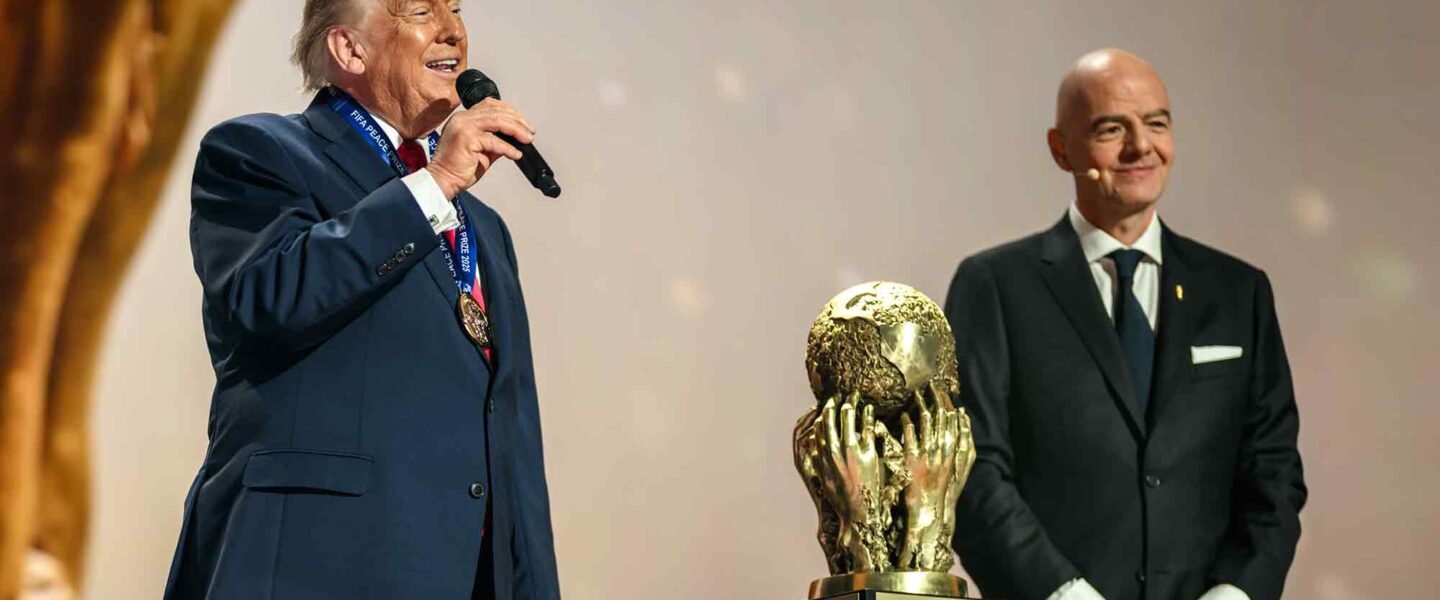
FIFA, of course, global sports juggernaut that it is, had joined so many other powerful institutions in bending the knee to Trump — making all kinds of logistical concessions to the principal host country (including treating the Iranian team very shabbily) and awarding the bomb-happy president the first (and quite possibly last) FIFA Peace Prize to soothe his savage Nobel-less breast.
Infantino proved more pliable than, say, Brad Raffensperger or Jerome Powell, and yesterday FIFA announced it had reversed the decision and removed Balogun’s ban.
Well, not entirely. You see, FIFA had no genuine basis in its laws for overturning the decision, no basis for entertaining an appeal — whether it came from the US Men’s National Team equipment manager or from the occupant of the White House. Any more than Raffensperger had for “finding” 11,780 votes in Georgia in 2020.
Upon review, Balogun either deserved the red card or he did not. If he did, then lifting his mandatory suspension is clearly improper; if he did not, then putting him on probation is equally improper.
That is perhaps why it took four days from Trump’s first call for FIFA to come up with a workaround, specifically some folderol about a “probationary period” under Article 27 of the FIFA constitution (or whatever). FIFA has yet to explain why it reinstated Balogun, but has let it be known that Balogun is serving a one-year probation, during which any further such incident will result in the restoration of the one-game ban.
Which is, of course, ridiculous on its face. Upon review, Balogun either deserved the red card or he did not. If he did, then lifting his mandatory suspension is clearly improper; if he did not, then putting him on probation is equally improper.
But Infantino and his FIFA legal eagles, after four days of rooting around with Trump’s hot breath on their necks, could find nothing better, had nowhere else to go, if they wanted to stay in Trump’s good graces.
None of this compromised circus, of course, escaped the notice of a furious Belgium — which spent four of the five days between matches preparing for the wrong US lineup — nor the rest of the world, which didn’t much like the smell of it all. I suspect that if FIFA, of its own accord and without Trump’s pressure, had reversed the Balogun ban four days ago, citing the impropriety of the VAR’s showing of the slo-mo replays to the referee, reaction would have been calmer, most likely split.
Because the outcome, viewed narrowly and pace Belgium, is right. This play was not intentional (Balogun was looking in the opposite direction), nor excessively forceful — as soccer aficionados say, never a red.
But the process was all wrong, redolent with the kind of corruption, or appearance of corruption, long associated with both FIFA and Donald Trump. Neither the organization nor the man have earned a drop of benefit of the doubt when it comes to corruption, to deals that stink in the national or global nose.
We can see now what was so wrong with Infantino and FIFA sucking up to Trump with their joke of a peace prize. When things start to look quid pro quo-ish, dark clouds immediately start forming over the integrity of the sport and detract mightily from the beauty of the game.
It’s a shame because there is some great soccer being played and great stories being written, for which one hopes this World Cup will be remembered, without the taint of this latest scandal.
This was yet another (failed) test of the rule of law, another skirmish in Trump’s war against it. Good news for the American team — but more bad news for America and the world.