Georgia’s New Property Owner Bill of Rights Seen as Breakthrough for Reformers
Rare bipartisan cooperation to put a check on all-powerful Home Owners’ Associations.
|
Listen To This Story
 |
What do these three news items have in common?
A Florida homeowners association (HOA) president was arrested after stealing over $1.2 million from homeowners.
In Florida, condo owners had raw sewage from an upstairs residence pour into their unit. The condo association refused to take responsibility to fix the problem. In the landmark case McLlenan v. Cypress Chase N. Condo No. 4 Ass’n, Inc., the court ruled in favor of the homeowners and forced the condo association to do remediation.
A Florida woman faced jail, legal debt, and foreclosure after minor HOA violations. Irena Green was jailed for seven days for minor violations such as dry grass, a dented garage door, and a dirty mailbox. She then faced a risk of losing her home through foreclosure.
All three highlight the power of HOA boards to inflict damage to their communities, and the great difficulty in holding them accountable.
An HOA is commonly defined as an organization that makes or enforces rules for a group of residents in a subdivision, community, or residential building. HOAs collect fees from their members to pay for the maintenance of common areas and the upkeep of facilities. An estimated 77 million people, or one-third of the US population, live in an HOA, condo, or housing cooperative, all of which are considered common ownership communities (COC).
However, one recent survey found that 57 percent of HOA residents did not like living in an HOA. Incompetent and unaccountable HOA boards were cited in the poll among the reasons for this dissatisfaction.
Patrick Johansen is the founder of HOA Reform Leaders National Group (HRLNG), a nonprofit advocating for reform of state and national HOA laws. He told WhoWhatWhy:
The way the law is set up in almost every state, there are no penalties in the law for board members or property managers that knowingly violate the laws of the governing documents. There is no government agency that will investigate crimes, even embezzlement and racketeering crimes if it happens in an HOA.
But the status quo might be about to change.
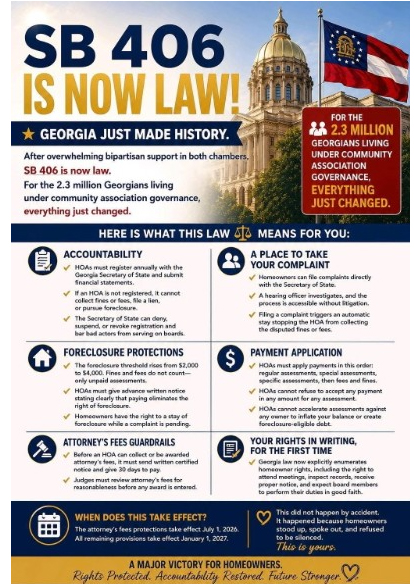
On May 12, Georgia Gov. Brian Kemp (R) signed into law the “Georgia Property Owners’ Bill of Rights Act.” The sweeping legislation seeks to level the playing field between homeowners and HOA boards, as well as make board members more accountable. And there are already signs that passage of this law may create political momentum for similar legislation in other states.
Georgia Breakthrough
Under this new Georgia law, the following changes were made:
- All property owners’ associations must register with the Secretary of State’s office.
- All HOA homeowners will have the right to inspect and obtain copies of their community association’s records.
- The HOA can initiate foreclosure proceedings only when payment delinquency hits $4,000, double the current $2,000 threshold.
But perhaps the most sweeping change made by the law is the new process aggrieved homeowners will have in settling disputes with HOA boards. Theoretically, a homeowner could always take their dispute through the judicial system.
But that process is very time-consuming and expensive. “The way the laws are set up, if the homeowner wants to force the board to follow the laws, they have to risk their life savings, retirement savings, and potentially even their home to pay their attorney to force the HOA to follow the law,” said Johansen.
Others concurred, noting that the current legal system was stacked against the homeowner winning their disputes with HOA boards.
A key backer of the new law, state Sen. Donzella James (D) noted how tilted the playing field has been against homeowners. “If someone is not paying their dues or assessments … and they get behind, in the past, after the debt hit $2,000, [management] could immediately foreclose on you without any oversight,” James told WhoWhatWhy.
The new law creates a more streamlined and far less expensive alternative to settle disputes. Homeowners can file written complaints regarding HOA actions with the secretary of state, which will investigate and assign a hearing officer. Filing a complaint will also automatically suspend an association’s collection or attempted collection from the complainant of any fines or fees that are the subject of or related to the complaint.
Johansen believes the Georgia secretary of state’s office would act in the same relatively sleek and effective manner to resolve disputes as small claims courts and consumer protection agencies. The $100 registration fee that HOAs are required to pay would be used to hire additional staff at the secretary of state’s office to help investigate complaints.
This provision in the law is seen as key to effective resolution of disputes. “It doesn’t make sense to write anything if no one is enforcing it,” said Johansen. Indeed, while Johansen’s organization, HRLNG, has twenty model laws for HOA reform activists — ranging from stricter foreclosure rules to full transparency to fair voting laws — without an effective enforcement mechanism it is all for naught.
The legislation passed by lopsided margins in both the Georgia House and Senate, well beyond the majorities Republicans hold in each chamber. “It’s not just a partisan issue. They [legislators] realized it’s a state issue that affects everyone who is a homeowner or owner of property in their district,” said James.
The First Domino?
There is some anecdotal evidence that other states are looking at the new Georgia law as a model. James told WhoWhatWhy, “We’ve had interest in Pennsylvania. Many people in Florida are really having these problems. A lot of senior citizens are having it there. We’ve had Texas… We are getting a lot of interest from a lot of states.”
And there have been some successes and near misses for HOA reform legislation in a few other states this year. Both houses of the Minnesota Legislature passed, and Gov. Tim Walz (D) signed into law, an “HOA Residents’ Bill of Rights.” The new law will cap the fines HOAs can charge homeowners and contains a requirement for board members and property managers to recuse themselves from decisions in which there may be a financial conflict of interest.
In Florida, an even more far-reaching measure, which has granted HOA residents the power to petition to terminate the HOAs they lived in, passed in the House but died in the Senate.
“I think this Senate Bill 406 [Georgia’s Property Owners’ Bill of Rights] passing and becoming a law now is the best thing if you want to save your American dream of homeownership,” said James.