With Louisiana Rush Job, SCOTUS Proves Gutting Voting Rights Act Was Political
By taking the unusual step of allowing one of their decisions to go into effect immediately, the Supreme Court’s conservative majority is making it easier for Louisiana to disenfranchise its Black voters right away.
|
Listen To This Story
 |
By ruling on Monday that its decision to gut what was left of the Voting Rights Act should go into effect immediately, the Supreme Court’s conservative majority left no doubt that this was all a partisan political move designed to help the GOP.
Instead of waiting the customary 32 days, this means that the court allows Louisiana to rig its congressional map and disenfranchise its Black voters more quickly.
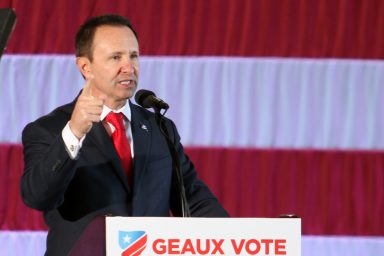
Last week, shortly after the original decision was handed down, Gov. Jeff Landry (R) suspended the state’s House primaries, which were set to begin last Saturday (and some voters had already mailed in their ballots), citing a “state of emergency.”
If you are wondering what the “emergency” is in this case, it would be for Louisiana voters to send two Black Democrats to Congress in November.
Fortunately for the GOP, that won’t happen if Samuel Alito, the author of the original decision and of a concurring opinion attached to Monday’s order, and the other conservative Supreme Court justices have anything to say about it.
Unfortunately for democracy, they do.
The argument that Alito made is that, if the decision were not be allowed to go into effect immediately, then the midterms would “be held under a map that has been held to be unconstitutional.”
However, this happens all the time. In fact, if the courts had not allowed illegal Republican-drawn maps to be used in recent elections, Louisiana’s own Mike Johnson (R) would not be House speaker and Democrats would be in the majority.
That really highlights how blatantly partisan the Supreme Court’s order is.
Sure, in theory, the court could block a new map, but then there would have been no point in speeding up the process now, especially because the primary had already begun.
Justice Ketanji Brown Jackson points this out in her dissent.
“To avoid the appearance of partiality here, we could, as per usual, opt to stay on the sidelines and take no position by applying our default procedures,” she wrote. “But, today, the Court chooses the opposite. Not content to have decided the law, it now takes steps to influence its implementation. The Court’s decision to buck our usual practice … and issue the judgment forthwith is tantamount to an approval of Louisiana’s rush to pause the ongoing election in order to pass a new map.”
She might want to get used to it.
Now that the Supreme Court essentially gave them permission to engage in race-based gerrymandering (as long as they don’t say so out loud), Republicans in Southern states are trying to quickly redraw their maps… and put (mostly) Black lawmakers out of their jobs.
Some of these efforts will likely end up before the high court and give Alito et al. even more opportunities to help their party.